How Opositive Helped a Large Co-living Brand Improve Crawl Efficiency, Fix Technical SEO Issues & Unlock Local Search Demand
CategoryTechnical SEO / Enterprise SEO / Local SEO / Content Optimization
IndustryCo-living / Managed Accommodation / Real Estate
MarketIndia
About the Client
The client is one of India’s leading managed accommodation and co-living brands, operating across multiple cities with a large website footprint.
As the brand scaled rapidly, the website accumulated a complex index profile with thousands of pages across cities, properties, locations, and informational content. While this helped the brand expand digitally, it also created serious technical SEO challenges that affected crawl efficiency, search visibility, and page-level performance.
The Challenge
The website had grown quickly over time, but its SEO foundation had not scaled at the same pace.
Several technical issues were preventing search engines from efficiently crawling, understanding, and prioritizing the most valuable pages.
Key Challenges We Identified
1Index bloat across the website
The site had accumulated several low-quality, thin, duplicate, and irrelevant URLs in Google’s index. This diluted crawl budget and made it harder for search engines to focus on high-value pages.
2Duplicate and competing pages
Multiple URLs had similar or nearly identical content. This created confusion for search engines and diluted ranking signals across different page versions.
3Outdated content on important pages
Some pages had become stale and no longer matched current user expectations or search intent, reducing engagement and relevance.
4301 redirect URLs present in XML sitemaps
The XML sitemap contained URLs that redirected instead of pointing directly to final destination pages. This created unnecessary crawl friction and delayed indexing.
55xx server-side errors
Several URLs were returning server errors, making them inaccessible to both users and search engine crawlers.
6Keyword cannibalization for “near me” searches
Multiple pages were competing for similar local-intent keywords, especially “near me” queries. This fragmented search performance instead of building one strong ranking asset.
The Opositive Approach
Opositive built a technical SEO and search consolidation strategy focused on improving crawl efficiency, eliminating duplication, strengthening content quality, and unlocking local search demand.
The strategy focused on six major objectives:
1Reduce index bloat and improve crawl budget efficiency.
2Remove duplicate and competing pages.
3Refresh outdated content for stronger relevance.
4Clean up sitemap issues and redirect URLs.
5Resolve critical server-side errors.
6Consolidate keyword cannibalization and build stronger local-intent pages.
What We Did
1Reduced Index Bloat
Opositive conducted a comprehensive audit of indexed URLs to identify pages that were adding little or no SEO value.
We reviewed pages that were:
Thin or low-value
Duplicate or redundant
Overlapping with stronger pages
Not useful for search users
Not required to be discoverable through Google
Low-value URLs were either removed, noindexed, or consolidated into stronger destination pages.
This helped search engines focus crawl activity on the most relevant, high-quality URLs.
2Fixed Duplicate Content Issues
Many URLs were technically different but carried very similar content.
To resolve this, Opositive re-optimized affected pages with unique and purpose-led content.
The work included:
Creating distinct content for each important URL
Defining a clear search purpose for every page
Improving keyword relevance
Reducing overlap across similar pages
Strengthening individual page authority
This helped remove duplication and allowed key pages to perform independently.
3Refreshed Outdated Content
Opositive identified stale or incomplete pages and updated them with fresher, more useful content.
The content refresh focused on:
Updated information
Better structure
Stronger relevance to search intent
Clearer page messaging
Improved on-page engagement
This helped improve overall content quality and contributed to stronger domain authority.
4Cleaned XML Sitemap Redirect Issues
The website’s XML sitemap included URLs that returned 301 redirects instead of final destination URLs.
Opositive audited the sitemap, removed redirecting URLs, and replaced them with the final canonical destination pages.
This helped:
Improve crawl efficiency
Reduce unnecessary crawler friction
Ensure correct URLs were indexed
Reduce indexing delays
5Resolved 5xx Server Errors
Opositive reviewed URLs returning 5xx server errors and worked to identify the root causes.
The team checked affected URLs, reproduced errors, reviewed server-side behavior, and aligned fixes at the infrastructure or configuration level.
This improved website accessibility and reduced the risk of ranking loss caused by technical instability.
6Fixed Keyword Cannibalization for “Near Me” Queries
Multiple pages were competing for similar local-intent searches, especially around “near me” queries.
Opositive consolidated overlapping pages and created a clearer keyword mapping structure.
The work included:
Identifying competing pages
Merging or consolidating similar content
Assigning unique primary keywords
Updating internal links
Creating dedicated local-intent pages
Strengthening “near me” search relevance
This helped search engines better understand which pages should rank for local discovery queries.
The Results
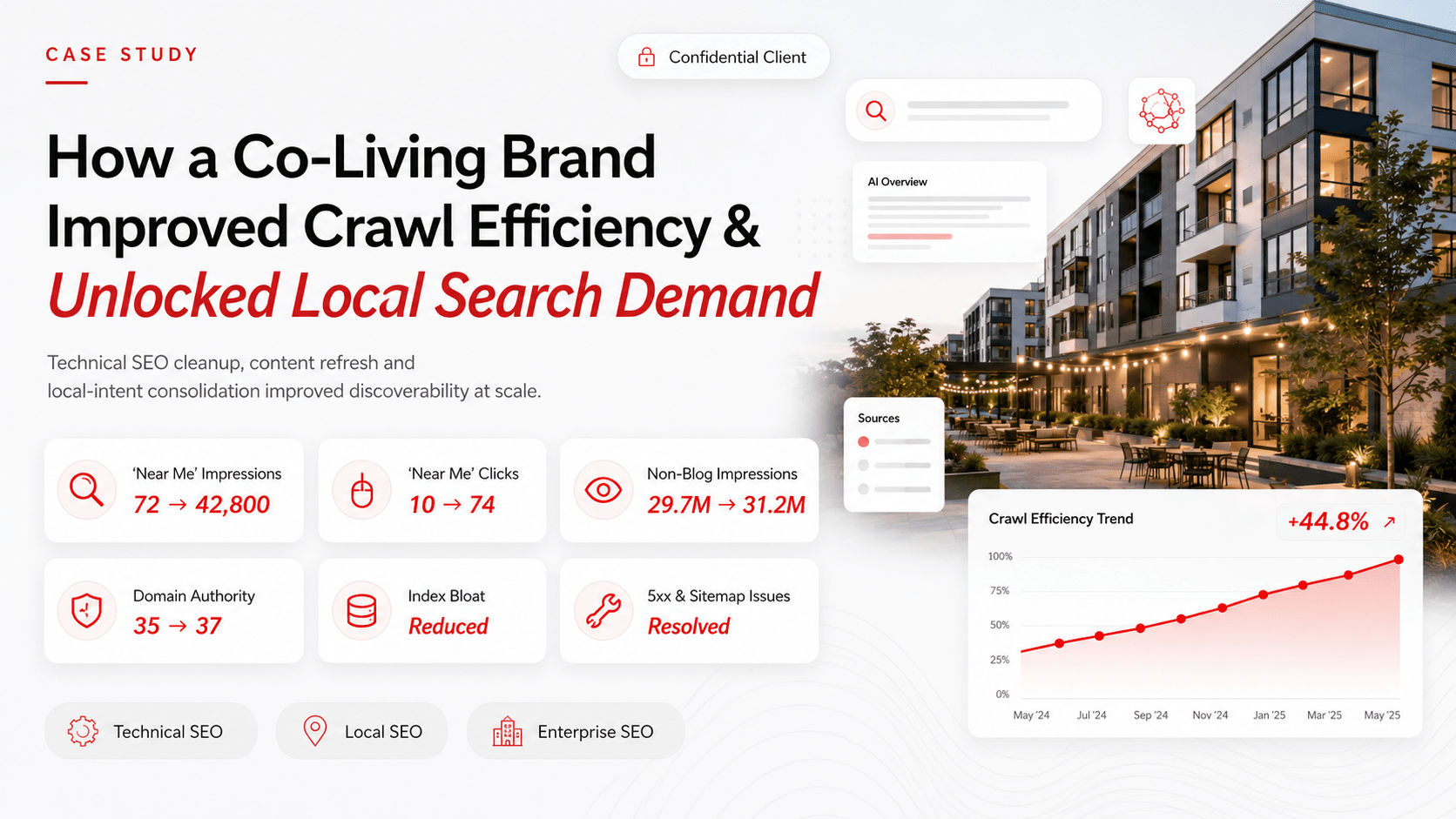
The campaign helped the website improve crawl efficiency, reduce technical friction, grow non-blog visibility, and unlock strong local search demand.
Key Performance Highlights
Metric
Before
After
Growth / Impact
Non-blog Clicks
659,000
681,000
+3.34%
Non-blog Impressions
29.7M
31.2M
+5.05%
Domain Authority
35
37
+2-point increase
“Near Me” Clicks
10
74
+640%
“Near Me” Impressions
72
42,800
Massive uplift
Index Bloat
High
Reduced
Crawl efficiency improved
Duplicate Content
Present
Resolved
Stronger page-level clarity
301 URLs in Sitemap
Present
Better crawl path
5xx Errors
Present
Improved accessibility
AI Search Impact
The Big Win
“Near Me” Impressions Grew From 72 to 42,800
The strongest win came from fixing keyword cannibalization and creating clearer local-intent targeting.
By consolidating overlapping pages and building dedicated pages for “near me” queries, the website saw impressions jump from 72 to 42,800, while clicks increased from 10 to 74.
This proved that technical SEO and keyword consolidation can directly unlock demand that was previously being lost due to confusing page signals.
Our Learning
For large-scale location-based websites, SEO growth depends heavily on technical clarity.
When thousands of pages exist across locations, properties, and city-level searches, issues like index bloat, duplicate content, redirecting sitemap URLs, server errors, and keyword cannibalization can silently limit performance.
This case proves that by cleaning the index, refreshing outdated content, resolving technical errors, and mapping keywords properly, a large website can improve crawl efficiency and unlock stronger organic visibility.
Want your large-scale website to rank with more clarity and efficiency?
Opositive helps enterprise and location-based brands fix technical SEO gaps, reduce index bloat, improve crawl efficiency, and grow organic visibility across high-intent search journeys.
How Opositive Helped a UAE-Based Racquet Sports E-commerce Brand Grow
Organic Visibility, Tournament Demand & AI Search Presence
+3.34% —
Non-blog Clicks
Organic discovery growth
+3.34%
Non-blog Clicks 659,000 → 681,000
+5.05%
Non-blog Impressions 29.7M → 31.2M
+2-point increase
Domain Authority 35 → 37
+640%
“Near Me” Clicks 10 → 74
Massive uplift
“Near Me” Impressions 72 → 42,800
Crawl efficiency improved
Index Bloat High → Reduced
🛒 E-commerce SEO🤖 AI SEO🏆 Topical Authority🎾 Sports Retail
AI Powered, Human Led, Autopilot Growth
Opositive.io drives AI-powered, human-led growth on autopilot, delivering 7-10X recurring impact through sustainable, ad-free strategies, ensuring forever growth with advanced, strategic SEO for long-term success.
Opositive drives AI-powered, human-led growth on autopilot, delivering 7-10X recurring impact through sustainable, ad-free strategies, ensuring forever growth with advanced, strategic SEO for long-term success.