What Are Citations in SEO?
This guide explains what SEO citations are, why they still influence local rankings and AI search visibility, the types you need, where to build them, and how to fix the citation errors that quietly hurt your business. By the end, you will have a practical workflow you can run this week.
Key takeaways
- A citation is any online mention of your business name, address and phone number – no link required
- Citations now carry roughly 6-7% of local pack weight but around 13% of AI search visibility weight, per Whitespark’s 2026 data
- NAP consistency across every platform is the single factor that makes or breaks a citation profile
- 30-50 accurate, complete listings beat hundreds of rushed directory submissions
- Citations work best combined with Google Business Profile, reviews, schema and entity SEO – not as a standalone tactic
When someone searches “dentist near me” or “best coffee shop in Delhi”, Google has milliseconds to decide which businesses deserve the top three map spots. It makes that call partly on information it finds about your business across the web – and whether that information agrees with itself.
That is where citations come in. A citation is any online mention of your business’s core details, and it works as a trust signal for both search engines and customers. Google cross-checks your name, address and phone number across directories, review sites and articles. When everything matches, confidence goes up. When it conflicts, rankings quietly slip.
Citations have also picked up a second job. With AI assistants now answering “best plumber in my area” style questions, consistent business information across the web decides whether ChatGPT or Gemini mentions you at all.
This guide covers what citations are, why they matter in 2026, the types you need, where to build them, and the mistakes to avoid.
SEO Citations: Meaning, Purpose & How They Work
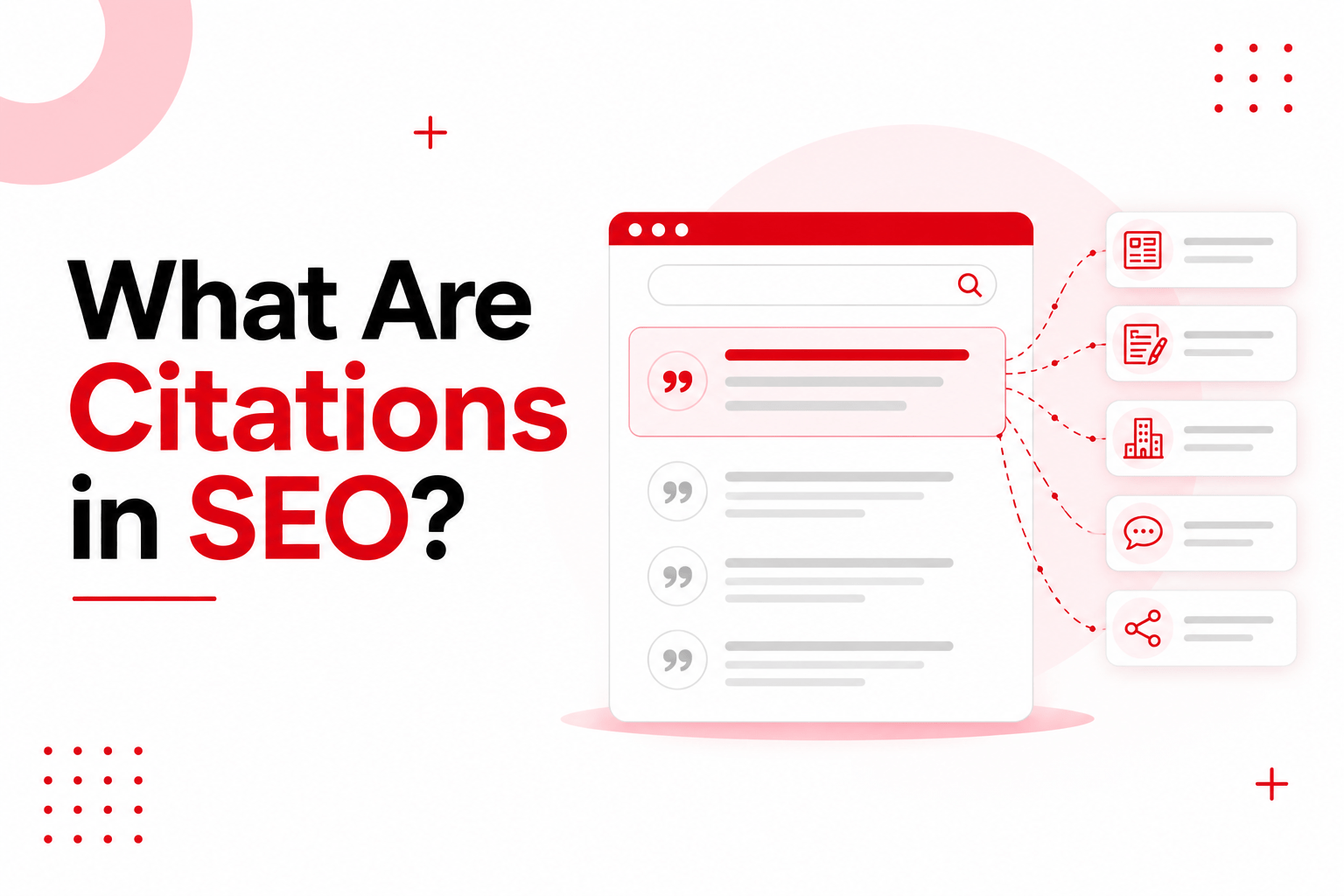
A citation in SEO is any online reference to your business that includes some combination of your Name, Address and Phone number – the trio SEOs call NAP. A citation does not need a link to count. The mention itself is the signal.
That listing on Justdial, Google Business Profile or a dental directory is one citation. Fifty accurate listings across fifty platforms is a citation profile.
A typical citation includes the NAP trio plus website, business hours, categories, photos and a short description.
How citations differ from backlinks, in one line: a backlink passes authority through a clickable link; a citation builds trust through consistent information, link or no link. We compare them fully later in this guide.
Why Citations Still Play an Important Role in Local SEO
Citation weight in the local pack has declined – Whitespark’s 2026 Local Search Ranking Factors survey of 47 local SEO experts puts citation signals at roughly 6-7% of local pack influence</a>, behind Google Business Profile signals (32%) and reviews (around 20%). But writing citations off would be a mistake, for five reasons.
Increase Business Trust
Google’s local algorithm rewards prominence – how well-known and verified a business appears. Citations are corroborating evidence. Ten independent sources agreeing on your details is far stronger proof of legitimacy than your website alone claiming them.
Improve Local Search Rankings
Citations are a foundational factor: they won’t outrank a competitor with 200 reviews, but inconsistent citations will drag down everything else you build. Think of them as the floor, not the ceiling.
Support Google Business Profile Signals
GBP is the single biggest local ranking driver. Google validates your GBP data against citations across the web. Matching information strengthens your profile; conflicts undermine it.
Strengthen NAP Consistency
Every accurate citation reinforces one canonical version of your business identity. That consistency is what lets Google – and now AI engines – state your details with confidence.
Build Brand Credibility Across the Web
Customers check you on Justdial, Yelp-style platforms and review sites before calling. A wrong phone number on one popular directory costs real enquiries, not just rankings.
Types of SEO Citations You Should Know
Structured Citations
Formal directory listings with dedicated fields for each business detail:
- Google Business Profile
- Bing Places
- Apple Maps
- Justdial and IndiaMART (for Indian businesses)
- Yelp
- Industry directories – Practo for clinics, Zomato for restaurants, Houzz for interior firms
Structured citations are machine-readable by design, which makes them the easiest sources for search engines and AI crawlers to extract and verify.
Unstructured Citations
Business mentions inside regular content:
- A local news article covering your store opening
- A blog listing “10 best cafes in Satellite”
- A press release announcing your expansion
- A local event sponsorship page
- A Reddit or forum thread recommending your service
Unstructured citations carry editorial weight – a journalist or community member chose to mention you. AI engines lean on exactly these sources when deciding which businesses to recommend, which is why both types belong in your strategy.
What Information Should Every Business Citation Include?
Complete every field the platform offers:
- Business name – exact legal or trading name, no keyword stuffing
- Address – identical formatting everywhere (pick “Road” or “Rd” once, stick to it)
- Phone number – one primary local number
- Website URL – your homepage or location page, with https
- Business hours – accurate, including holiday hours
- Email – a monitored business address
- Categories – the most specific match for your core service
- Images – storefront, team, work samples
- Social profiles – linked and active
- Description – what you do, who you serve, where
Why consistency matters: search engines match citations by comparing these fields. “Sharma Dental Clinic” on one site and “Sharma Dental Care Centre” on another may be treated as two different businesses – splitting your trust signals in half.
Where Should You Build Local SEO Citations?
Build in this priority order:
Major Search Platforms
Google Business Profile, Bing Places, Apple Maps. Non-negotiable – these feed the map results people actually use.
Business Directories
Justdial, Sulekha, IndiaMART, Yellow Pages equivalents in your market. High-traffic general directories that search engines crawl constantly.
Industry-Specific Directories
Practo (healthcare), Zomato/Swiggy (food), MagicBricks (real estate), Clutch (agencies). Category directories signal relevance, not just existence.
Local Chamber & Community Websites
Chamber of commerce, trade associations, local business councils. Harder to get, higher trust.
Maps & Navigation Platforms
MapmyIndia, Waze, HERE Maps. Often overlooked, directly used by customers in transit.
Review Websites
Google reviews, Trustpilot, MouthShut, platform-native reviews. Review platforms are citations plus social proof in one.
Social Business Profiles
LinkedIn company page, Facebook business page, Instagram business profile. AI engines check these for entity confirmation.
Citations Building: A Step-by-Step Process
Step 1 – Audit existing listings. Search your business name plus phone number, and name plus old addresses. Log every listing you find in a sheet: platform, URL, NAP shown, status.
Step 2 – Correct incorrect information. Fix wrong details on live listings before building anything new. Claim unclaimed profiles – you can’t fix what you don’t control.
Step 3 – Create missing listings. Work through the priority categories above. Ten accurate, complete listings beat fifty rushed ones.
Step 4 – Optimize business profiles. Go beyond NAP – add photos, descriptions, categories, hours and services on every platform that allows them. Complete profiles rank and convert better.
Step 5 – Monitor and update regularly. Set a quarterly review. Update all listings within a week of any change to hours, address or phone. Watch for duplicate listings that platforms auto-generate.
Citation Building vs Backlinks: Understanding the Difference
| Factor | Citations | Backlinks |
|---|---|---|
| Purpose | Verify business identity and location | Pass authority between websites |
| SEO value | Local trust and NAP consistency | Domain authority and rankings |
| Link required | No – mention alone counts | Yes – the link is the signal |
| Ranking impact | Local pack and AI visibility | Organic rankings sitewide |
| Traffic | Direct referrals from directories | Referral plus ranking-driven traffic |
| Examples | GBP listing, Justdial profile | News article linking your guide |
| Best use case | Local and multi-location businesses | Every business competing organically |
Can they work together? Constantly. A local news article that mentions your business and links to it is both at once – the strongest single asset in local SEO. This is also where off-page SEO and citation work overlap.
Best Practices for Managing SEO Citations
- Keep NAP identical everywhere, down to formatting
- Update every listing within days of any business change
- Remove or merge duplicates as soon as you spot them
- Complete every field on every profile
- Add fresh photos twice a year minimum
- Encourage reviews on citation platforms, not just Google
- Verify every listing you control
- Monitor competitor citation profiles for gap opportunities
- Run a full citation audit every quarter
How Citations Fit into a Modern Local SEO Strategy
Citations don’t work in isolation. They sit inside an ecosystem:
- Google Business Profile – the hub every citation validates
- Reviews – the highest-growth ranking signal, hosted on citation platforms
- Local landing pages – on-page NAP and location content that matches your listings
- Schema markup – LocalBusiness schema restates your NAP in code, connecting site to citations
- Backlinks – authority that citations corroborate
- Content marketing – earns the unstructured mentions AI engines trust
- Entity SEO – the discipline that ties all of it into one recognized brand identity
- AI search visibility – where consistent citations decide whether ChatGPT and Gemini recommend you
Citations remain the foundational trust layer. They deliver their real value when combined with a complete local SEO strategy – and increasingly, with AI citation building that extends the same principle to AI-generated answers.
Why Choose Opositive.io for Citation & Local SEO Services
We treat citations as an entity problem, not a data-entry task. Our local SEO work covers citation audit and cleanup, citation building across search platforms and directories, Google Business Profile optimization, hyperlocal SEO strategy, multi-location consistency, entity optimization and AI search optimization – so your business shows up correctly on Google Maps and in AI answers alike. Start with a free SEO audit to see where your citation profile stands today.
FAQs
What are citations in SEO?
Online mentions of your business’s name, address and phone number on directories, review sites, articles and other platforms. They verify your business identity for search engines and AI assistants.
Why are citations important for local SEO?
They build the trust and consistency Google uses to validate your business, support your Google Business Profile, and increasingly influence whether AI engines recommend you.
What is NAP consistency?
Keeping your Name, Address and Phone number identical across every online mention, down to spelling and formatting.
How many citations does a local business need?
Quality over volume. Accurate listings on the major platforms plus your top industry and local directories – typically 30-50 done well – outperform hundreds of rushed submissions.
Which citation websites are most important?
Google Business Profile first, then Bing Places, Apple Maps, your market’s dominant general directory, and your industry’s category directory.
How often should citations be updated?
Within a week of any business change, with a full audit every quarter.
Can duplicate citations hurt SEO?
Yes. Duplicates split reviews and signals across multiple profiles and confuse search engines about which listing is authoritative.
How do citations help Google Business Profile rankings?
Google cross-references your GBP data against citations across the web. Agreement strengthens your profile’s trust; conflicts weaken it.
Should every business build citations?
Every business serving customers in a defined area, yes. For online-only brands, entity consistency across profiles serves the same function.
Can citations improve AI search visibility?
Significantly. Whitespark’s 2026 data weights citations at around 13% of AI search visibility – consistent business information is how AI engines verify who you are before recommending you.

Mansi Jain
Senior AI SEO Specialist @ Opositive.io
GEO, AEO & LLM Optimization Specialist · 6.5+ yrs Technical SEO
About Mansi
Mansi Jain is a Senior SEO Specialist with 6.5+ years of experience in technical SEO, content strategy, ecommerce SEO, and AI-powered search optimization. At Opositive.io, she helps businesses improve their visibility across traditional search engines and emerging AI platforms through data-driven SEO strategies.
Her expertise includes technical audits, keyword research, schema implementation, content clustering, and AI SEO (GEO/AEO). Passionate about staying ahead of search trends, Mansi shares practical insights and actionable strategies that help marketers, founders, and businesses achieve sustainable organic growth.
“Practical, data-driven SEO that helps businesses grow sustainably across both traditional search and AI platforms.
Specialization
Technical SEO, Ecommerce SEO & AI SEO (GEO/AEO)
Education
B.Tech, Information Technology
College of Technology and Engineering, Udaipur · 2015 – 2019
Experience
Senior SEO Specialist, Opositive.io
3+ years at Opositive · 6.5+ years in SEO & AI-powered search
Skills
Technical audits, keyword research, schema, content clustering