What Is Programmatic SEO? A Complete Guide to Scaling Traffic
Zapier has a page for almost every pair of apps it connects. Wise has one for nearly every currency route. Neither company wrote those pages by hand, and both of them pull in search traffic that no editorial calendar could realistically produce.
That is programmatic SEO. The idea is simple enough to explain in a sentence and difficult enough to execute that most attempts end in a few thousand pages Google refuses to index.
This guide covers what it is, how it actually moves traffic, whether your business is a fit, and precisely where Google draws the line between a useful page set and scaled content abuse.
Key takeaways
- Programmatic SEO builds pages from templates plus structured data, targeting repeatable long-tail search patterns at a scale manual writing cannot reach
- Traffic growth comes from breadth, not from any single page ranking well — the model only works when hundreds of pages each earn modest, consistent visits
- Google’s spam policies do not prohibit automation; they prohibit publishing many pages that add nothing. The distinction is value per page, not method of production
- Most D2C brands should skip location pages entirely and build pSEO from first-party data instead: reviews, sizing, ingredients, compatibility, use cases
- Indexation rate is the metric that decides success. If Google indexes 15% of your page set, you do not have a traffic problem, you have a quality problem
What is programmatic SEO?
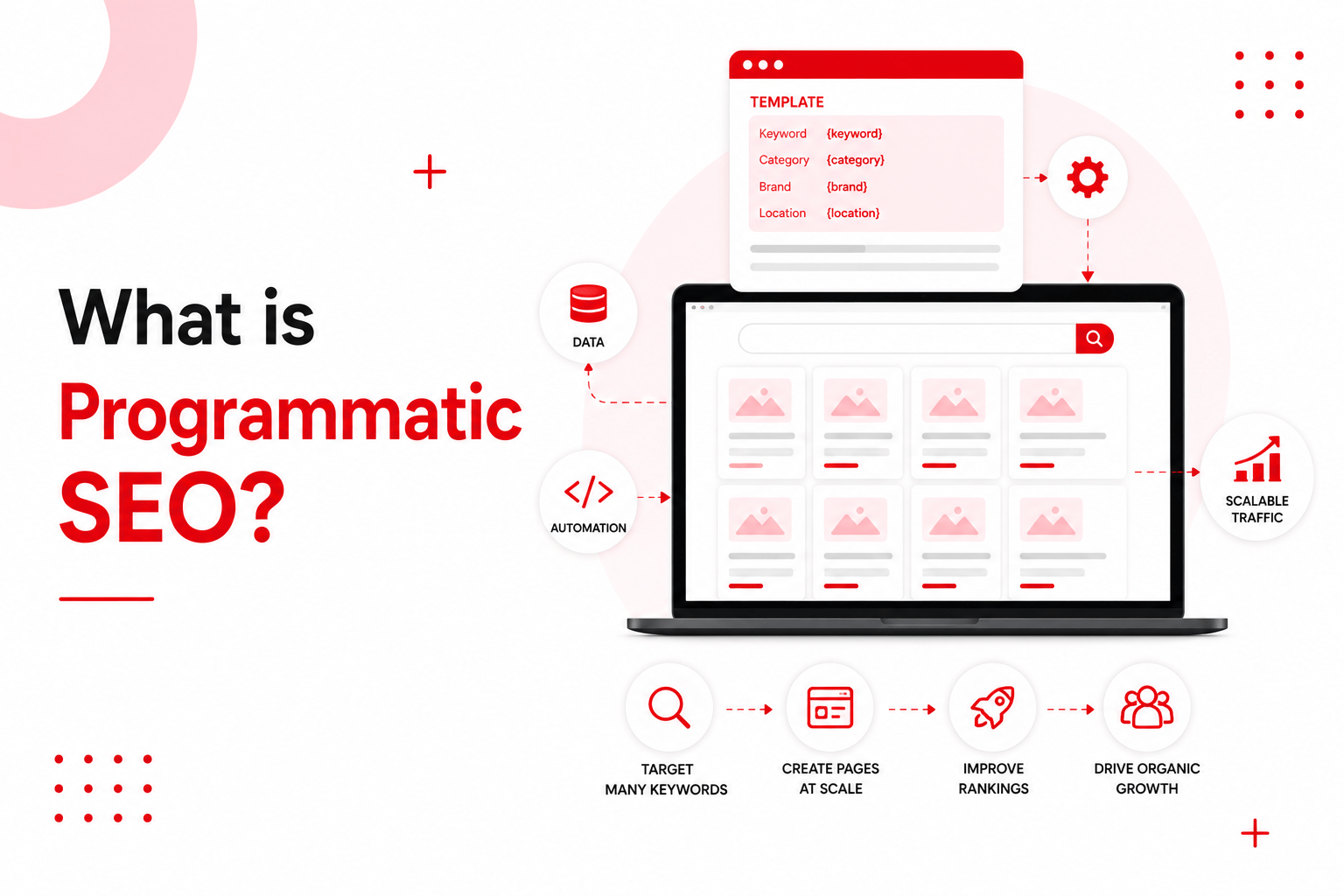
Programmatic SEO is the practice of generating large sets of search-targeted pages from a page template combined with a structured dataset, rather than writing each page individually.
The template holds everything that stays constant: layout, headings structure, internal link modules, schema, calls to action. The dataset holds everything that changes: the city, the product, the material, the integration, the price band. A build process merges the two and publishes a URL per row.
If you run an ecommerce store, you already do this. Every product page on your site comes from a template filled with database values. Programmatic SEO applies the same mechanic to page types you have not built yet, aimed at searches you are not currently capturing.
Programmatic SEO vs traditional SEO
These are not competing approaches. They solve different problems and most mature programmes run both.
Programmatic SEO vs traditional SEO
These are not competing approaches. They solve different problems and most mature programmes run both.
| Traditional SEO | Programmatic SEO | |
|---|---|---|
| Unit of work | One page, written and edited | One template plus one dataset |
| Best for | High-value, high-competition, narrative or expertise-led topics | Large sets of repeatable, predictable long-tail queries |
| Search volume per page | Medium to high | Low, often under 100 monthly searches |
| Time to first page | Days | Weeks for the system, then minutes per page |
| Main risk | Slow output, high cost per page | Thin pages at scale, indexation failure, spam penalties |
| Quality control | Editorial review | Data quality, template logic, QA sampling |
| Where value lives | In the writing | In the data |
That last row is the one to internalise. In traditional SEO you win by writing better than the competition. In programmatic SEO you win by having data the competition does not have. If your dataset is the same public information everyone else can scrape, your pages will look like everyone else’s pages, and Google has no reason to prefer yours.
Templates versus AI generation
These get conflated constantly, and they carry different risks.
Template-based generation assembles pages from fixed copy and dynamic fields. A phrase like “Shipping to {city} typically takes {delivery_days} business days” produces sentences that are structurally identical across every page and factually specific to each one. Predictable, safe, and boring in a way that works.
AI generation drafts new prose per page from a prompt. It produces more varied copy but introduces accuracy risk, and at volume it is exactly what Google’s scaled content abuse policy names first.
The sensible pattern is a hybrid. Use templates for the structural and factual scaffolding. Use AI selectively for the parts where variation genuinely helps — a two-line intro, an FAQ answer — grounded in the row’s actual data and reviewed in batches before publishing. Never let a model invent a fact that belongs in the dataset.
How programmatic SEO actually increases traffic
Most guides assert that pSEO grows traffic and move on. The mechanism is worth spelling out, because understanding it tells you whether your project will work before you build it.
The arithmetic
A single programmatic page is almost never impressive. It targets a query with maybe 40 to 200 monthly searches. Even ranking third, it might bring 15 to 40 visits a month. On its own, not worth building.
The model works on multiplication. Take a page set of 800 URLs. Assume, conservatively, that Google indexes 60% of them and that half of those indexed pages earn any meaningful visibility. That leaves roughly 240 pages contributing traffic. At an average of 25 monthly visits each, you are at 6,000 monthly organic sessions from a system that took one template and one dataset to build.
Those numbers are illustrative, not benchmarks — your own indexation rate and ranking distribution will differ by industry, domain authority and competition. But the shape holds. The traffic comes from breadth, and the variables that matter most are indexation rate and how many indexed pages actually rank. Not how well your best page performs.
This is why the correct question at project kickoff is never “how many pages can we make.” It is “how many pages deserve to exist,” followed by “what will make Google index them.”
The three compounding effects
Beyond raw page count, a well-built page set produces three secondary gains.
Topical coverage. Hundreds of pages covering every variation within a subject area signal genuine depth on that topic. This tends to lift the performance of your core commercial pages too, not just the programmatic ones.
Internal link surface. Every programmatic page is a place to link from. A properly designed set funnels authority toward your category and product pages through hundreds of contextual internal links, which is often worth more than the direct traffic.
Long-tail intent quality. Someone searching “waterproof hiking boots for wide feet size 11” is much closer to buying than someone searching “hiking boots.” Programmatic pages catch queries at the specific end of the funnel, where conversion rates are usually higher even though volumes are lower.
What it does not do
Programmatic SEO will not rank you for head terms. It will not fix a site with weak authority, thin backlinks or technical problems — publishing 5,000 pages on a struggling domain makes the situation worse, not better. And it will not produce results in month one. Expect three to six months before indexation stabilises and rankings settle.
If your fundamentals are shaky, fix those first. A technical SEO audit before a pSEO build is not optional; it is the thing that decides whether Google can crawl what you are about to publish.
Does your business qualify? A four-condition test
Programmatic SEO is oversold. Plenty of businesses that read about it should not attempt it. Run through these four before committing budget.
1. Do you have a repeatable search pattern with real demand? You need a query template where the variable changes and the intent stays constant: {product} for {use case}, {service} in {city}, {brand} vs {brand}, how to {task} in {software}. Then verify demand actually exists across the variations. Plenty of patterns look scalable and turn out to have volume on twelve combinations and zero on the other four hundred.
2. Do you have data that is genuinely yours? This is the condition most projects fail. If every field in your dataset comes from a public source, your pages will be duplicates of your competitors’ pages in everything but design. Ask what you know that nobody else does. Order data, review text, return rates, sizing feedback, support tickets, test results, inventory, delivery times, usage patterns.
3. Is your dataset deep enough per row? Ten fields per page is a page. Three fields per page is a database record with a header on it. If you cannot populate a page with enough specific information to make it worth landing on, either enrich the data or reduce the number of pages.
4. Can your site handle the crawl load? Adding 3,000 URLs to a site with 200 pages changes your crawl economics completely. If your server is slow, your internal linking is shallow, or you already have indexation problems, Google will spend its crawl allowance on your new pages and start neglecting your old ones.
Fail condition two or three and the honest recommendation is to write fewer, better pages instead. That is not a consolation prize. For a lot of businesses it is simply the correct strategy.
Programmatic SEO for ecommerce brands
Ecommerce is the natural home for pSEO because the data already exists in a structured form. The trap is that ecommerce sites are also the most likely to generate thousands of near-identical URLs by accident.
Page types that actually work
| Page type | URL pattern | Where the unique value comes from |
|---|---|---|
| Attribute-filtered category | /running-shoes/waterproof | Curated product set, category-specific buying guidance |
| Use case | /backpacks/for-cabin-luggage | Airline size limits, which SKUs comply, why |
| Comparison | /compare/{product-a}-vs-{product-b} | Spec differences, review sentiment, who each suits |
| Brand within category | /laptops/dell | Range overview, model differences, availability |
| Compatibility | /filters/for-{appliance-model} | Verified fit data, part numbers |
| Price band | /headphones/under-5000 | Live pricing, what you compromise at that band |
| Size and fit | /jeans/mens-32-inch-waist | Aggregated fit feedback from your own reviews |
Comparison and compatibility pages are underrated. They demand real data, which means competitors cannot copy them easily, and they catch shoppers at the exact moment they are choosing between options.
The faceted navigation trap
Here is where ecommerce pSEO most often goes wrong.
Your filters can already produce URLs. Colour, size, price, brand, material — multiply four filters with five options each and you have created hundreds of crawlable combinations without deciding to. Google’s ecommerce URL guidance is worth reading in full, but three points matter most for pSEO.
Google does not use fragment identifiers when indexing. /product/t-shirt#black and /product/t-shirt#white are the same page to Google. If your variants rely on fragments, they do not exist in search.
Multiple URLs returning the same content waste crawl budget, because Google cannot tell they are duplicates until after fetching both. /product/black-t-shirt and /product?sku=1234 look different and cost two crawls.
Parameters that change constantly can make your site look infinite. Session IDs, timestamps and relative values like location=nearby create URL sets with no end, and Googlebot will burn through your crawl allocation exploring them.
The discipline is to decide deliberately which filter combinations deserve indexable URLs, and to canonicalise, noindex or block the rest. A three-facet combination page is usually worth indexing if it has search demand and enough products. A five-facet combination with two products in it is not.
Google also advises against linking to or indexing category pages with no useful content. An empty category should carry a noindex tag, or return a 404 if it has been removed. Programmatic sets that publish empty result pages are a reliable way to earn a quality problem.
If you are running this on Shopify, the platform handles some of this for you and creates its own duplication patterns in return — worth reviewing alongside your Shopify SEO setup rather than assuming defaults are safe. The broader page-type architecture is covered in our ecommerce SEO strategy guide.
Programmatic SEO for D2C brands
D2C is the hard case, and most advice on this topic ignores why.
A marketplace has a million listings. A D2C brand has 40 SKUs. The standard pSEO playbook assumes catalogue scale that a D2C brand simply does not have, which is why so many D2C programmatic projects default to location pages — and why so many of those get flagged as doorway pages.
Why location pages are usually the wrong answer for D2C
If you ship nationwide from one warehouse, a page for every city is a page where the only variable is a place name. The products are the same, the shipping is the same, the content is the same. Google’s doorway abuse policy specifically names “multiple domain names or pages targeted at specific regions or cities that funnel users to one page.” That is a description of exactly this tactic.
Location pSEO works when location genuinely changes the offer — different stock, different delivery times, different pricing, physical locations, service areas, regional regulations. For a nationwide D2C brand, it usually changes nothing.
Where D2C brands should actually look
The good news is that D2C brands often sit on better proprietary data than marketplaces do, because they own the customer relationship end to end.
Reviews at scale. If you have 4,000 reviews across 40 products, you have a dataset. Aggregate by attribute and build pages around what customers actually report: which products run small, which hold up after a year, which suit which use case.
Sizing and fit. Fit data pulled from your own returns and review text is genuinely unique. Nobody else can build /{product}/fit-guide-for-{body-type} with real numbers behind it.
Ingredients, materials and specifications. Beauty, supplements, food and apparel brands can build pages around a component: what it does, which products contain it, at what concentration, and why.
Problem and use case pages. {product category} for {specific problem} scales across every problem your customers describe in support tickets. The dataset is your own helpdesk.
Comparison against competitors. Honest, specific, sourced comparisons. Risky if done badly, powerful if done fairly.
The pattern across all five: the multiplier is not your SKU count, it is the attributes, problems and contexts attached to your SKUs. Forty products with fifteen genuine use cases each gives you 600 candidate pages, and each one can hold information that only you possess.
That is a fundamentally different project from bolting city names onto a template, and it is the version we would recommend to any D2C SEO client. For the groundwork underneath it, our guide on what D2C ecommerce SEO involves covers the fundamentals this sits on top of.
The unit of unique value
Here is the test we apply to every programmatic page set before a single URL goes live.
Every page must contain at least one piece of information that could not appear on a competitor’s version of the same page.
Not a rewritten sentence. Not a different adjective. A fact. A number from your data. A finding from your reviews. A test result. A price only you charge. A compatibility confirmation only you have verified.
Apply this and most of the difficult decisions resolve themselves. A city page with no city-specific fact fails, so you either add real local data or you do not build the page. A comparison page that restates two spec sheets fails, so you add your own return-rate or review-sentiment data or you drop it. A use case page that could describe any competitor’s product fails.
This test also happens to be the clearest practical translation of Google’s helpful content guidance. Google asks whether your content provides substantial value compared to other pages in results. “One fact nobody else has” is that question, made answerable during a build review.
Where programmatic SEO crosses into spam
Three of Google’s spam policies apply directly to programmatic page sets. Most guides mention the first and skip the other two, which is unfortunate because the second one is where local pSEO usually dies.
Scaled content abuse
Google defines this as generating many pages “for the primary purpose of manipulating search rankings and not helping users,” typically producing “large amounts of unoriginal content that provides little to no value to users, no matter how it’s created.”
Read that last clause again. The policy is deliberately method-neutral. Templates are not the problem. AI is not the problem. Volume plus emptiness is the problem. Google’s listed examples include using generative AI to produce many pages without adding value, stitching content from different pages without adding value, and creating pages where the content makes little sense to a reader but contains search keywords.
Doorway abuse
This one gets far less attention than it deserves. Google describes doorway abuse as pages “created to rank for specific, similar search queries” that lead users to intermediate pages less useful than the final destination. Its examples include multiple pages targeted at specific regions or cities that funnel visitors to one page, and creating substantially similar pages that sit closer to search results than to a clear, browseable hierarchy.
Nearly every “we built 500 city pages” project fits that description. If the page exists only to capture a query and push the visitor onward to the page that actually serves them, it is a doorway regardless of how the content was produced. The fix is not better copy on the doorway. The fix is making the page the destination — giving it stock, pricing, delivery, availability or guidance that makes landing there genuinely useful.
Thin affiliation
Relevant to any programmatic set built on merchant or supplier data. Google flags pages where product descriptions and reviews are copied from the original merchant without original content or added value, and specifically describes “cookie-cutter sites or templates with the same or similar content replicated within the same site.”
The escape route Google names is instructive: good affiliate pages add original reviews, rigorous testing and ratings, price information, product comparison, or navigation value. All five are things a programmatic system can supply, provided the data behind it is yours.
The line, stated plainly
Automation is not the risk. Emptiness is. A thousand pages each carrying real, specific, useful information is a legitimate content asset. A thousand pages carrying a swapped noun is a liability, and it does not matter whether a human, a template or a language model produced them.
How to build a programmatic page set
1. Find the pattern and validate demand. Identify the query template and pull volume for every variation. Kill combinations with no demand before they become URLs.
2. Build and clean the dataset. This is 60% of the project. Every field that will appear on a page needs to be complete, accurate and consistently formatted. Missing values produce broken sentences at scale.
3. Design the template around the data. Not the other way round. Start from what your dataset can actually support, then design a page that presents it well. Templates designed first always end up with fields nobody can fill.
4. Write variation into the template. Multiple intro variants selected by data condition, conditional sections that appear only when relevant, different module orders by page type. This is what stops 500 pages reading as one page.
5. Plan indexation before you publish. Decide which pages are indexable, what canonicals point where, how the sitemap is segmented, and how each page will be reachable through internal links. Orphaned programmatic pages do not get crawled.
6. Launch in stages. Publish 50 pages. Wait three to four weeks. Check indexation, impressions and engagement. Only then scale. This single discipline prevents most pSEO disasters, and almost nobody follows it.
7. Sample manually. Open twenty random pages and read them as a visitor. If any read as filler, the template is not ready. Twenty pages takes an hour and saves months.
8. Prune on a schedule. Every quarter, find pages with no impressions and no clicks over 90 days. Improve them, consolidate them, or remove them. A page set that only grows will eventually drag on site quality.
Steps five and eight are the two most commonly skipped, and they are the two that separate page sets that compound from page sets that decay.
Indexation is the metric that matters
Most teams measure pSEO by pages published. That number tells you nothing.
Track indexation ratio: indexed pages divided by submitted pages, from the Search Console Pages report. A healthy programmatic set sits at 70% or above. Between 40% and 70% suggests quality or crawl issues worth investigating. Below 40% means Google has looked at your pages and declined, and publishing more will not change its mind.
Two Search Console statuses deserve particular attention. “Crawled — currently not indexed” means Google fetched the page and judged it not worth keeping. That is a direct quality verdict. “Discovered — currently not indexed” means Google knows the URL exists but has not prioritised crawling it, which usually points to crawl budget or weak internal linking rather than quality.
Alongside indexation, watch the share of indexed pages receiving at least one impression per month, clicks per indexed page, and conversion rate compared with your manually written pages. If programmatic pages convert far worse, they may be attracting the wrong intent — a strategy problem no amount of template tuning will fix.
Programmatic SEO in the age of AI search
The rise of AI Overviews, ChatGPT and Gemini as discovery surfaces changes the calculation in both directions.
Against pSEO: AI answers absorb a lot of simple informational long-tail queries. If your page set targets questions with straightforward factual answers, those queries were always the most vulnerable to zero-click, and generative summaries accelerate that.
For pSEO: structured, factual, well-organised pages are exactly the kind of source AI systems draw on. A page with a clean comparison table, specific figures and a direct answer near the top is more extractable than a 2,000-word narrative essay. Pages built on proprietary data are also more likely to be cited, because the model cannot reconstruct that information from anywhere else.
The strategic adjustment is to skew your page sets toward queries where the answer depends on your data rather than on general knowledge. “What is a chelated mineral” is a question an AI answers without you. “Which of your products contain chelated magnesium and at what dose” is a question only your pages can answer. The first was always a weak pSEO target. The second is stronger now than it was two years ago.
This is the same logic underpinning generative engine optimisation and answer engine optimisation, and it is why we increasingly plan programmatic sets alongside AI SEO rather than as a separate workstream. If you want to know whether your pages are actually being cited, that requires AI visibility tracking rather than rank tracking alone.
Conclusion
Programmatic SEO is a data project that produces web pages, not a content project that uses automation. Teams that understand this build page sets that compound for years. Teams that treat it as a way to publish faster build liabilities they eventually have to delete.
The decision comes down to one honest question: do you have information your competitors do not? If yes, programmatic SEO is a way to put that information in front of every person searching for it. If no, the answer is not a better template. It is going and getting the data first.
Start small, measure indexation before you measure traffic, and hold every page to the standard that it must tell the visitor something only you could tell them.
FAQs
Is programmatic SEO against Google’s guidelines? No. Google’s spam policies target pages that provide little value at scale, explicitly regardless of how they were created. Well-built programmatic pages with genuine per-page value are entirely legitimate, and many of the web’s largest sites depend on them.
How many pages should I start with? Fifty. Publish that batch, wait three to four weeks, review indexation and engagement, and scale only if the signals are good. Starting with thousands removes your ability to learn cheaply.
How long before programmatic SEO produces traffic? Typically three to six months. Crawling and indexation take weeks, rankings take longer to settle, and long-tail pages tend to climb gradually rather than arriving at a final position.
Can I use AI to write programmatic pages? Yes, with guardrails. Ground every generation in the row’s real data, use it for sections where variation helps rather than for facts, and review in batches. What Google penalises is generating many pages without adding value — not the involvement of a model.
Does programmatic SEO work for small ecommerce catalogues? Yes, if you build on attributes rather than SKUs. Forty products with fifteen use cases each is 600 candidate pages. The multiplier is the contexts attached to your products, not the product count itself.
What is the difference between programmatic SEO and doorway pages? A programmatic page is a destination that satisfies the query it targets. A doorway page exists to capture the query and pass the visitor along to somewhere more useful. Google names region and city pages funnelling users to a single page as an example of doorway abuse, which is why undifferentiated location pages are the riskiest common pSEO pattern.
Will programmatic pages hurt my existing rankings? They can, if they consume crawl budget without earning indexation, or if a large volume of low-quality pages affects sitewide quality signals. This is why staged launches and quarterly pruning matter.
How do I know if my pages are too thin? Apply the unique value test: does each page contain at least one fact that could not appear on a competitor’s version? If not, the page is thin regardless of word count.
Should I use subfolders or a subdomain for programmatic pages? Subfolders, in almost all cases. Programmatic sets benefit from your domain’s existing authority, and a subdomain forfeits much of that while adding operational overhead.

Mansi Jain
Senior AI SEO Specialist @ Opositive.io
GEO, AEO & LLM Optimization Specialist · 6.5+ yrs Technical SEO
About Mansi
Mansi Jain is a Senior SEO Specialist with 6.5+ years of experience in technical SEO, content strategy, ecommerce SEO, and AI-powered search optimization. At Opositive.io, she helps businesses improve their visibility across traditional search engines and emerging AI platforms through data-driven SEO strategies.
Her expertise includes technical audits, keyword research, schema implementation, content clustering, and AI SEO (GEO/AEO). Passionate about staying ahead of search trends, Mansi shares practical insights and actionable strategies that help marketers, founders, and businesses achieve sustainable organic growth.
“Practical, data-driven SEO that helps businesses grow sustainably across both traditional search and AI platforms.
Specialization
Technical SEO, Ecommerce SEO & AI SEO (GEO/AEO)
Education
B.Tech, Information Technology
College of Technology and Engineering, Udaipur · 2015 – 2019
Experience
Senior SEO Specialist, Opositive.io
3+ years at Opositive · 6.5+ years in SEO & AI-powered search
Skills
Technical audits, keyword research, schema, content clustering