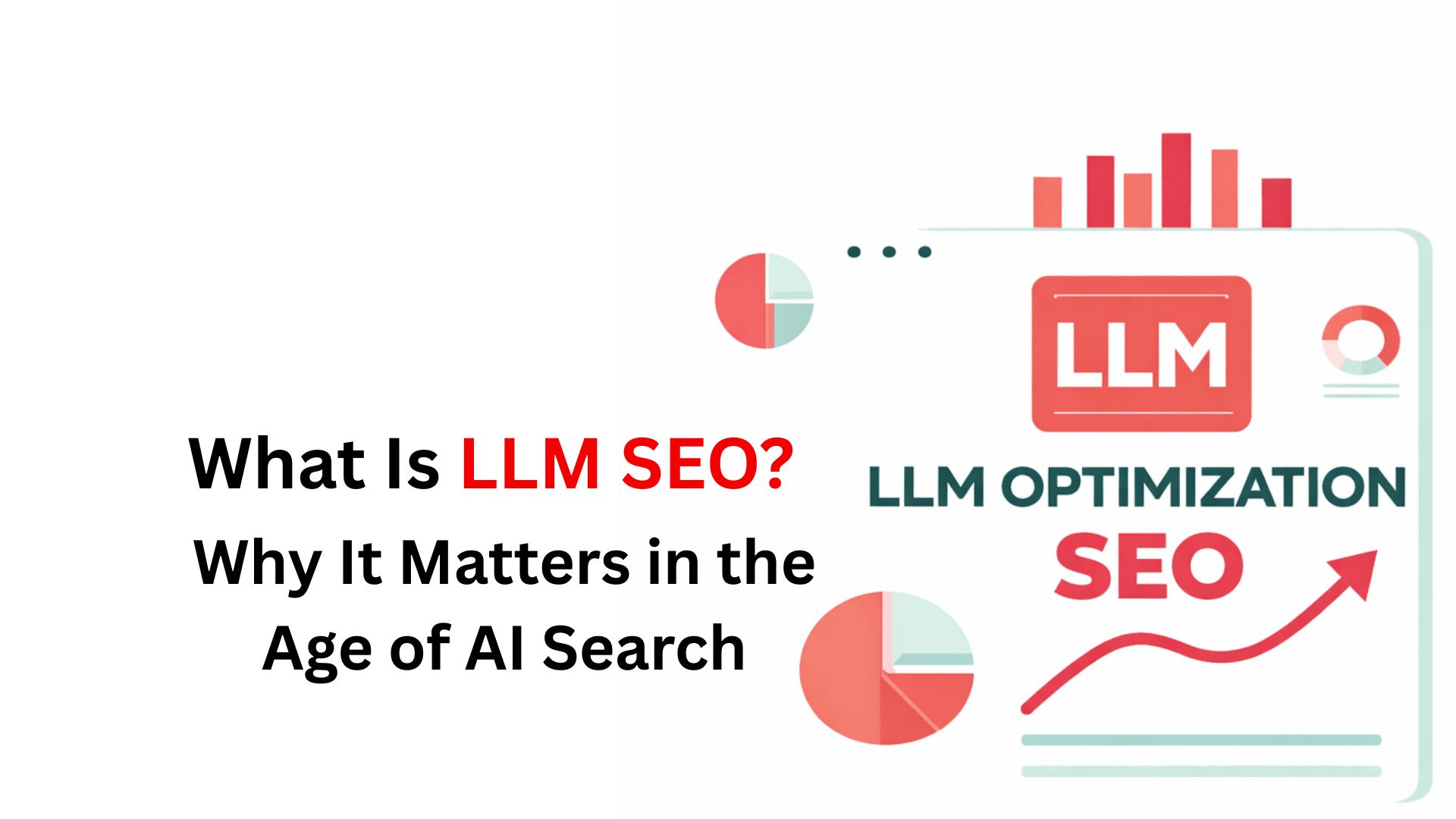
What is LLM SEO? Why It Matters in the Age of AI Search
Until now, ranking on Google has been all about optimizing for SEO. However, modern search habits have changed. People now come up to AI tools like ChatGPT and Gemini for answers before clicking any link. The development of this new model resulted in the creation of LLM SEO.
This model can be described as “AI Model SEO,” or SEO for AI-generated answers. Its main focus is to ensure that AI-generated answers clearly and reliably identify brand, products or content, and expertise. This model is focused on creating simple and powerful models, and of being related to the real world. People use AI to help them decide what to buy these days. The next step to getting more online visibility is to optimize for LLM SEO.
Understanding the Basics of LLM SEO
It is the modern version of search optimization. It is related to making your content discoverable, understandable, and usable by LLMs like ChatGPT, Claude, and Gemini. LLM SEO does not optimize individually for traditional ranking signals, like page rank, backlinks, and keywords. Instead, it focuses on structuring content such that AI systems are capable of citing, referencing, or surfacing it directly in conversational search responses.
This change is important because users are now relying on AI to get instant answers and not clicking through a list of links. This implies that visibility now depends on how well your content performs in an AI search context.
LLM SEO is capable of covering this gap as it helps brands serve as the ‘answer,’ boost AI visibility & relevance, and walk on AI discovery paths effectively.
LLM SEO refers to search optimization designed for Large Language Models, systems like ChatGPT, Gemini, and Claude that now influence how users discover brands. It’s important because the way people search is changing quickly. People are asking questions in a relaxed way and want a single answer they can trust. AI responses won’t show up as often if your content isn’t LLM-friendly.
The growth of AI in search has impacted every aspect of the way consumers find brands. With AI, consumers can now quickly access recommendations and summaries for any topic. AI has developed a more efficient way to find and connect brands with their designated audience, as well as to effectively deliver specific, clean content using multiple languages.
Why is LLM Important for 2025?
As we move into a new year, LLM SEO has become the core requirement for digital visibility. As users increasingly utilize AI-assisted search engines powered by LLMs such as Gemini, ChatGPT, Claude, etc., to find information. They are now asking conversational questions and not scanning link lists.
How LLMs Transform Search Behaviour & Content Discovery
As we start a new year, LLM SEO has become the most important thing for being seen online.
For marketers, this means that the content has to be optimized for how AI reads and interprets text. AI now uses clean content architecture, semantic signals, and knowledge graphs to find and connect brands to their target audience. It is an important aspect of LLM SEO optimization to influence discovery and engagement.
Impacts to Brands, Publishers and Digital Presence
The rise of LLM SEO provides many chances for brands and publishers to develop brand credibility, build new ways to drive users to their websites and to have a greater level of visibility of their brand through the use of AI-generated content. On the other hand, all those relying on traditional methods of SEO to grow will find themselves in a state of digital anonymity. Today, AI-generated summaries fulfil user intent at an increasing rate without the need for a click-through from their site. As a result, being the source of the information displayed in an AI-generated response is like being ranked number one on a search engine results page.
LLMSEO enables brands and publishers to be more visible digitally within their niches by recognizing quality content, providing semantic clarity about what has been written, and benefiting from AI formating benefits. Brands that take advantage of this New Internet Optimization will prosper only if they adapt quickly to the fast pace at which AI advancements are changing the Internet.
How LLMs Understand & Interpret Content
Large Language Models evaluate meaning. Through analyzing a variety of contexts and breaking down sentences, LLMs evaluate whether content satisfies a user’s intent.
This is why LLM SEO matters today. It helps in optimizing content for models that reward clarity, topic depth, entity accuracy, and informational value. If your page reads like a real explanation, an LLM is more likely to surface it inside AI Overviews and generative search answers.
For brands that aim to improve LLM SEO visibility, it means writing for interpretation because LLMs want topical confidence.
How LLMs Parse, Embed & Decode Web Information
When an LLM scans a page, it converts text into “embeddings.” These embeddings allow the model to compare your content with millions of other documents and evaluate similarity, depth, and expertise.
Because of this, SEO for LLM is about offering a narrative that fits into a larger semantic universe.
Semantic Mapping, Entities & Context Relationships
LLMs have the ability to build internal systems to map “entities,” such as brands, products, locations, processes and other niche/individual topics and then identify how they are connected to each other.
When content introduces entities clearly to LLMs, describes how they’re related to each other and links them back to outcomes, they are treated by the LLM as a relevant authority.
Core Pillars of LLM SEO Optimization
When it comes to AI searches, LLM SEO Optimization is focused on being understood, cited as an authoritative source, and being credible in the eyes of large language models (LLM’S) such as Google Gemini, ChatGPT, and others. Simply put, it requires changing how you think about search because rather than just looking for keywords, you should also be looking for logical structure, coverage of your topic, and signals for AI systems to identify your piece of content as a direct answer.
Structuring Your LLM Content
To AI, you want to present your audience with clear sections and easy-to-read headings that allow AI to find answers quickly and accurately. By generating clear headings and logical sections of text, LLMs can quickly create a logical, complete image of your article, locate the answers and ideas that they want quickly, and summarize those ideas for you in a very natural way.
Semantic Coverage, Topic Depth, and Entity Optimization
Modern LLM SEO thrives on semantic relevance and depth. Cover related concepts, explore topics fully, and use contextually rich language that shows expertise on the subject. Entities, including named people, products, tools, and concepts, act as anchors for LLMs to relate your content to broader knowledge graphs and increase your chances of being cited.
Authoritativeness for LLM-Based Results
Authority is about trust signals. Back up your claims with reputable sources, include author credentials, and demonstrate expertise through detailed explanations. AI SEO Services and AI SEO Tools today evaluate content credibility alongside topical relevance. Therefore, solid authority builds long-term LLM presence in AI-powered answers.
Authority is about trust signals. Back up your claims with reputable sources, include author credentials, and demonstrate expertise through detailed explanations. AI SEO Services and AI SEO Tools today evaluate content credibility alongside topical relevance. Therefore, solid authority builds long-term LLM presence in AI-powered answers.
LLM SEO Visibility & How LLMs Surface Information
Visibility today relies on how well you can find your content among answers provided by LLMs. Where traditional SEO worked to rank at the top of SERPS by using keywords, backlinks, and technical optimization techniques, LLM SEO emphasizes making it possible for your content to also be included in the LLM’s response to a query.
How LLMs Reference Websites Inside AI Answers
LLM uses many pieces of content from several sources to create an answer. The response may include direct citations from your content, or a summary, or simply be treated as training level information. As a result, anything published that has been interpreted and integrated into the LLM’s, will be visible, regardless of whether your web page actually ranks #1 or not.
Difference Between SERP Visibility & LLM Visibility
The key difference is intent and output format:
- SERP visibility is about positioning in a list of links that users click through.
- LLM visibility is about inclusion within a direct answer delivered by an AI. Modern SEO strategies should aim for both AI-powered discovery and traditional organic traffic.
Technical Foundations Behind SEO for LLM
When we discuss SEO for LLM, the technical aspects shift from traditional search optimization to better clarity for AI evaluation. A useful signal you can send is structured data & schema markup. This refers to metadata to tell exactly what a piece of content is, like an article, an FAQ section, product details, or a step-by-step guide.
Structured Data, Schema, and Metadata Signals
One of the biggest technical blocks behind LLM SEO optimization is helping machines understand what your content means. Structured data and schema give AI models explicit context. If you mark a page as an Article, a FAQ, a Product, or a How-To, you are feeding the LLM unambiguous information that can be reused in summaries, answers, and conversational outputs.
Titles, headers, and metadata also play a bigger role than before. A precise <title>, keyword-aligned meta description, proper canonical tags, and well-defined OG tags allow AI interfaces to frame content effectively.
Internal Linking & Knowledge Architecture
Internal linking is about knowledge mapping. LLMs learn by association. If your site connects major themes to supporting sub-topics, you are effectively building a topical graph that an AI system can navigate and trust.
For example, pillar pages connected to guides, FAQs, glossaries, and product explainers give LLMs a structured path to follow. The more interconnected the content, the easier it is for AI systems to identify authority, chronology, and conceptual depth.
Content Types LLMs Understand Best
Clear Explanations, Definitions & Concept-Based Content
LLMs digest meaning. That is why content that breaks down ideas with precise definitions, simple explanations, and concept-first language performs best. Short declarative sentences, well-structured paragraphs, and direct answers help models like ChatGPT, Gemini, or other free SEO tools extract exactly what they need to serve users.
When you define what LLM SEO means, explain how it differs from traditional SEO, or walk through concepts like What is On-Page SEO, you are giving the model a compact, citatable nugget to reference.
Real-World Examples & High-Context Use Cases
LLMs thrive on real-world examples and high-context scenarios.
By grounding abstract ideas in everyday use cases, you give LLMs meaningful patterns to learn from. These practical passages become ideal candidates for AI citations to boost LLM SEO optimization.
LLM Optimization Beyond Google
Visibility in ChatGPT, Perplexity, Gemini & Other AI Engines
Traditional SEO Guide principles taught us how to win the first page of Google. But LLM SEO flips that script.
This shift matters because users ask conversational queries. That is why LLM SEO visibility is central to modern content strategy.
To gain visibility in this environment, brands need to think in entities and context so AI engines can find, understand and cite their answers.
The Future of LLM SEO
Conversational Search & New Discovery Paths
LLMs interpret questions and return direct insights, often without a traditional results page. This means discovery is about being chosen. Your content must look like the best answer to the question at hand, every time.
New Metrics
Traditional ranking reports give way to citations, entity mentions, semantic relevance, and AI reference rates to indicate whether AI systems are actually drawing from your content. Along with established clicks and impressions, these items become key performance indicators.
Opositive’s Methods of Preparing Organizations for the Increase of AI-oriented Discoverability
At Opositive, we utilize the AI SEO tools within an AI-based search strategy. The application of our proprietary Search Engine Optimization for AI will leverage the use of intelligent technological advances and human strategists. We’ve employed advanced optimization techniques to prepare content for maximum discoverability on all of the major marketplaces to ensure it not only to be discovered but also featured.
Conclusion
In combination with the basics of traditional SEO, an LLM-centric strategy allows organizations to unlock visibility and engagement on a scale that was previously unimaginable. If you want to ensure success for your organization in the future, connect with Opositive’s LLM SEO professionals to establish a pathway to maximizing visibility across both search engines and discovering channels based upon AI.
FAQs
Do LLMs read my entire website or only certain pages?
LLMs train on publicly available data. Models mostly pick up high-authority, high-clarity pages that are frequently referenced, linked, or cited online.
Does LLM SEO require changing my existing content?
LLM SEO works best when you clarify answers, structure information, improve topical depth, add entities, and remove fluff.
How long can brands expect to see results from LLM SEO?
The majority of businesses using LLM SEO see improvements in AI-generated mentions, semantic visibility, and assistant responses, approximately between three weeks and three months following implementation.
Can LLM SEO’s expansion make traditional SEO obsolete?
LLM SEO prepares content for AI system discovery. You still need to use technical SEO, backlinks, and on-page optimization.