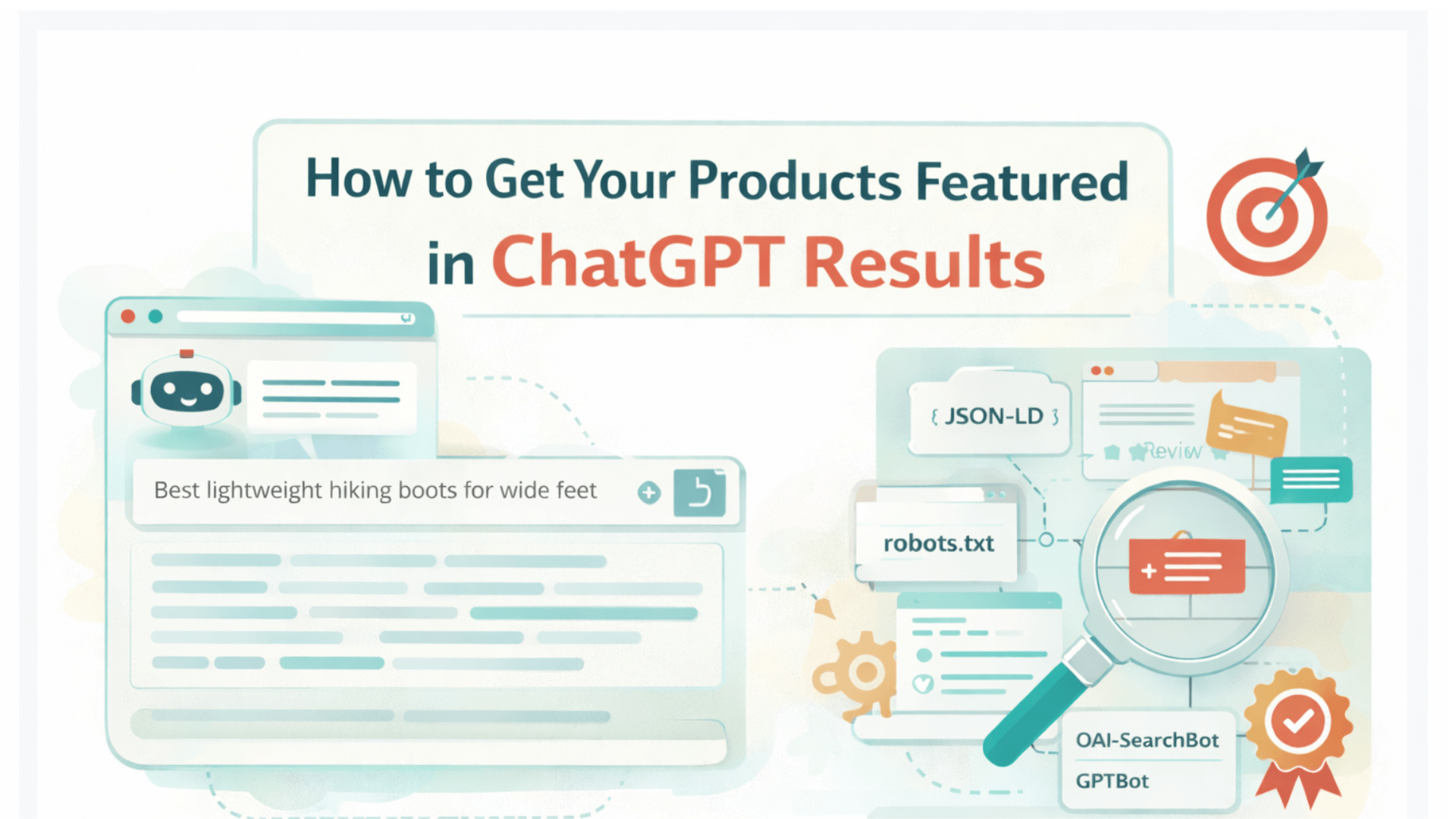
How to Get Your Products Featured in ChatGPT Results
Search behavior changed fast. Not long ago you chased keywords, optimized landing pages, and measured success by organic clicks. Now buyers start with a conversation. They ask ChatGPT things like “best lightweight hiking boots for wide feet” and expect product options right there in the chat, with images, prices, and short review summaries.
That shift creates a real opportunity. ChatGPT and similar conversational interfaces show a visual product ribbon inside the chat instead of just links. Those product cards can drive discovery and direct purchases without the user ever leaving. The problem? Traditional SEO tactics alone rarely trigger these rich, AI-driven recommendations. You need a two-part approach (technical plus content) to get indexed, matched to intent, and trusted by the model.
In this guide you’ll learn how ChatGPT discovers products, what technical gates you must pass, and how to write product content that answers real conversational queries. We’ll cover feed and schema requirements, robots rules to check, and practical content patterns that increase the chance your items show up in the visual product ribbon.
Key takeaways
- ChatGPT shifted from text-only answers to a visual product ribbon that displays images, prices, and review snippets directly in the chat.
- Success requires a dual strategy: technical feed optimization and conversational content that answers specific user problems.
- The AI uses a reasoning engine to parse intent and a perception layer to match that intent with structured product data.
- A critical first step is verifying your robots.txt doesn’t block AI-SearchBot or GPTBot from crawling your product pages.
- Optimizing for conversational commerce now gives an early-mover advantage before the channel becomes as competitive as traditional shopping platforms.
What is the ChatGPT shopping experience?
Picture a chat where the AI asks a quick clarification question, then replies with a compact, horizontal ribbon of product cards. Each card shows a high-resolution image, price, merchant name, and a short review summary or rating. The ribbon sits under the text answer so users can scroll and pick items visually. Often there are direct purchase or checkout options for integrated merchants.
Users approach the system in natural language. Instead of typing a keyword phrase, they ask a problem: “I need a rain jacket for urban commuting that fits over layers.” ChatGPT interprets that intent and returns a buyer guide plus product cards tailored to fit, style, insulation, and price sensitivity. The experience blends conversational guidance with visual shopping. Product discovery is immediate and contextual.
Two primary sources feed the results. First, direct feed partnerships and platform integrations, where merchants push structured product data into the system. Second, organic crawling, where OpenAI’s search crawlers index public product pages and extract structured data. Both routes can surface your products, but they behave differently when it comes to freshness, control, and how your product gets matched to conversational queries.
How ChatGPT discovers and ranks products
ChatGPT uses a layered approach to go from a sentence like “best tablets for college students” to a set of product cards you can browse. Think of it in two parts: Reasoning and Perception.
- Reasoning is the AI’s high-level intent engine. It parses the user prompt, asks follow-ups if needed, and decides the search scope. Is the user price-sensitive? Do they want durability over portability? Reasoning translates natural language into product attributes.
- Perception is the data-matching layer. It looks for product records that include the attributes Reasoning expects. Perception prefers well-structured, authoritative product data over vague marketing language. The clearer your data, the easier the match.
Discovery happens through two main channels. Direct feeds and platform integrations supply clean, up-to-date product records. These feeds often include verified identifiers, inventory, and exact prices, so they’re preferred for accuracy. Organic crawling is the fallback. Crawlers index your public pages and attempt to extract schema, images, and review data.
OpenAI’s web crawlers (including OAI-SearchBot and GPTBot) collect and index page content to power search results. If your pages are accessible, these bots can extract the JSON-LD or microdata you provide and make your products discoverable for conversational queries.
A final piece is authority. The Reasoning engine looks for third-party validation. Mentions on reputable review sites, inclusion in “best of” roundups, and consistent customer review sentiment help the model trust your product. The AI behaves more like a buyer’s agent than a link-sorting engine. Products with full, transparent data and external signals tend to be prioritized.
Direct feeds vs. organic crawling
Direct feeds
- Pros: Fast updates for price and inventory, richer fields, explicit merchant relationships.
- Cons: Requires setup and maintenance, sometimes platform-specific.
Organic crawling
- Pros: No integration required, relies on existing product pages and schema.
- Cons: Slower to reflect changes, depends on on-page SEO and site authority, extraction can fail if schema is missing or malformed.
The role of brand authority
ChatGPT ranks entities, not just pages. When the AI compiles recommendations, it looks for consensus across trusted sources. If a product appears on multiple authoritative lists, with consistent specs and strong reviews, the entity gains authority. That increases the chance the product will be recommended as “best for” a particular use case.
From a practical standpoint, consistent product metadata across your site and partner sites, plus coverage on reputable publications, raises your entity authority. The AI values that consistency because it reduces ambiguity when matching detailed user intent with product records.
Step 1: Master the technical requirements
Before you rewrite descriptions, confirm the plumbing works. If crawlers and feed systems can’t read your product data, the rest is noise. These are the foundational steps to make sure your products are discoverable by ChatGPT’s indexing systems.
Technical readiness checklist
- Check robots.txt to ensure OAI-SearchBot and GPTBot are allowed
- Validate product schema (JSON-LD) on all product pages
- Include GTINs, SKUs, and consistent brand fields
- Make sure offers include price, currency, and availability
- Activate and monitor merchant feeds where available
- Keep inventory and pricing feeds in sync to avoid stale listings
Check your robots.txt and crawler access
Open your site’s robots.txt and look for any Disallow lines that mention OAI-SearchBot or GPTBot. If you’re explicit about allowed crawlers, the user-agent strings to check are exactly OAI-SearchBot and GPTBot. A safe approach is to allow both user agents or at least avoid blocking them. Blocking these crawlers prevents your product pages from being indexed for organic conversational results.
Also check for meta robots noindex tags on product pages and any site-level rules that might inadvertently block crawlers, like rate-limit rules on CDNs. If you run a large catalog, work with your infra team to ensure crawl budget and response headers are stable.
Implement comprehensive product schema
Structured data is the single most reliable way to tell an AI what each product is. Use JSON-LD and include the critical properties that Perception expects. Minimum fields to include: name, description, image, sku, brand, offers (price and priceCurrency), availability, and aggregateRating. Add gtin, mpn, and category where relevant.
GTIN matters because it gives the AI a globally recognized identifier for matching identical SKUs across retailers and review sources. If you sell branded items, GTIN is often the bridge that connects your product to vendor pages and authoritative reviews.
Keep your schema free from marketing fluff and ensure fields are machine-readable. Run structured data tests regularly to catch errors.
Leverage merchant feeds and integrations
If your platform supports it, enable the relevant merchant integration. Shopify merchants should check for official ChatGPT or OpenAI commerce integrations and enable them if available. For non-Shopify platforms, use merchant feeds in data aggregators like merchant centers that your platform recommends.
Direct feeds are especially useful for fluctuating items or limited inventory because they propagate price and availability changes quickly. If you can’t use direct feeds, prioritize clear, accurate schema and consider push mechanisms like IndexNow where supported to accelerate reindexing.
Step 2: Optimize product content for conversion.
Writing for an AI that answers questions means changing how product pages read. Keyword density and promotional copy don’t help when the model’s trying to match user intent. What helps is clarity, context, and problem-solution language.
Compare the copy styles below to see the difference.
| Element | Traditional SEO Copy | ChatGPT-Optimized Copy |
|---|---|---|
| Title | Lightweight Hiking Boots – Brand X | Brand X Lightweight Hiking Boots, Wide-Fit, 8mm Cushioning, Best for Long Day Hikes |
| Opening line | Our boots are durable and comfortable. | Ideal for day hikes and long walks, these wide-fit boots reduce hotspot friction and include 8mm cushion for ankle support. |
| Feature list | Waterproof, Durable, Comfortable | Waterproof membrane (GORE-TEX equivalent), upper: split-grain leather, weight: 520g per shoe, drop: 6mm, best for: wide-foot hikers and cold-weather treks |
| Use case | Great for outdoors | Ideal when you need a roomy fit with strong toe protection for rocky trails and city streets after rain. |
Focus on use cases and solutions
Write descriptions that explicitly state who the product is for and what problem it solves. Phrases that work naturally: “Ideal for”, “Best used when”, “Solves X problem by”. These cues help the Reasoning engine map product attributes to conversational queries like “rain jacket for bicycle commuting” or “laptops good for video editing under $1,200”.
Include detailed product attributes
The Perception layer relies on granular facts. List materials, dimensions, compatibility notes, care instructions, and precise weights. If the product works with specific accessories, name them. If there are variations, describe how each differs and who should choose which option.
Avoid fluffy claims like “premium feel” without backing data. The AI prefers measurable attributes.
Answer common buyer questions
Turn your most common support tickets and “People Also Ask” queries into short Q&A sections on the product page. Questions like “Is this dishwasher safe?” or “Will this fit a narrow foot?” give the AI exact phrasing to cite when answering user queries. That increases the chance your page is surfaced as the authoritative answer.
Step 3: Build off-page trust signals
The Reasoning engine rewards consensus. Your product has a much better shot of being recommended if independent sites corroborate your claims. Off-page trust isn’t vanity. It’s the signal ChatGPT uses to verify quality when multiple choices exist.
Start with targeted PR to get onto reputable “best of” lists in your niche. Reach out to category reviewers and offer samples. Work to ensure consistent metadata and product naming across partners so the AI can stitch mentions together into a single entity profile.
Get featured on authoritative lists
Identify publishers and reviewers that cover your category and pitch product reviews that focus on user problems and tests. A single inclusion in a high-authority roundup can be the difference between getting indexed and being invisible when the AI compiles recommendations.
Curate authentic customer reviews
Prioritize detailed reviews that mention specific features and use cases. Encourage customers to describe how they used the product, what they liked, and what they didn’t. The AI uses sentiment signals to build pros and cons lists, so nuanced reviews help. On the flip side, a pattern of negative mentions about a key attribute can exclude a product from “best for” recommendations.
How to track your success
ChatGPT referrals will look different from standard search traffic, but you can still monitor them. In Google Analytics 4, filter by source and look for chatgpt.com as a referral. Set up an event or conversion that tracks visits from this source and monitor downstream behavior like view-to-add-to-cart and conversion rate.
Because the visual ribbon can send users directly to a product or to an in-chat checkout, conversions may not always follow traditional click paths. Keep an eye on assisted conversions and experiment with UTM parameters for your feed links to capture more detail.
Conclusion
Getting your products featured in ChatGPT results requires work on three fronts: technical feeds and crawl access, product pages written for conversational intent, and off-site authority signals that prove your product is trustworthy. Start with the easy wins: audit robots.txt to make sure OAI-SearchBot and GPTBot can crawl your product pages, validate your schema, and then rewrite your descriptions to answer real buyer questions.
This is still early. The companies that sort their technical plumbing and write product pages that speak in problems and solutions will enjoy a real early-adopter advantage as conversational commerce grows. Audit your feed and product descriptions today. You’ll be in a much better position when more volume flows through the visual product ribbon.
FAQs
1. How do you get your products listed on ChatGPT?
Make your product pages crawlable and machine readable. Allow OAI-SearchBot and GPTBot in robots.txt, publish complete JSON-LD schema with GTINs and offers, and use merchant feeds or platform integrations where available. Also earn external mentions and reviews so the AI can validate quality.
2. How to get product discovery on ChatGPT?
Combine technical indexing with content that answers conversational queries. Improve schema, provide use-case language on product pages, and pursue featured placements on reputable review sites. Direct feeds speed discovery, while organic crawling works if your on-page data is precise.
3. How to make your brand visible on ChatGPT?
Build consistent product data across your site and partner channels, get on industry roundups, and collect detailed customer reviews. Entity visibility is about repetition and consistency across authoritative sources.
4. How to optimize for ChatGPT search?
Write for intent. Use natural, problem-focused language, list explicit attributes, and include common buyer questions and answers on the page. Make sure your schema is complete and up to date.
5. What’s the difference between direct product feeds and organic crawling?
Direct feeds are pushed to the platform, giving you fast, accurate updates for price and inventory. Organic crawling relies on bots reading your public pages, which is lower control and slower to reflect changes. Both can surface products, but feeds are preferred for freshness.
6. How do I check if my robots.txt is blocking OpenAI crawlers?
Open yourdomain.com/robots.txt and look for Disallow lines referencing OAI-SearchBot or GPTBot. If you see those user agents blocked, remove the rule or add an Allow directive. Also check for meta noindex tags on product pages.
7. Which schema markup properties are essential for ChatGPT product cards?
Include name, description, image, sku, brand, offers (price and priceCurrency), availability, aggregateRating, and gtin when available. Use JSON-LD and validate regularly.
8. How can I track traffic from ChatGPT in Google Analytics?
Filter Traffic Acquisition by source and look for chatgpt.com or chatgpt as a referral. Use UTMs in your feed links to capture more detail and set up conversion events for product clicks and purchases.
9. Does ChatGPT use Google Merchant Center data for rankings?
ChatGPT can draw on multiple data sources. Merchant center feeds that are public and indexed may be one input among others. Direct integrations and crawled schema play larger roles when merchant feeds aren’t available.