Zero-Click Searches: How to Win in a No-Click SERP
If your analytics dashboard looks like a flatline while your rankings keep climbing, you are not alone. Organic traffic has been slipping for many brands, even when they rank well. The culprit is a shift in how search works: more queries are being answered directly on the search results page, so users never click through to a site.
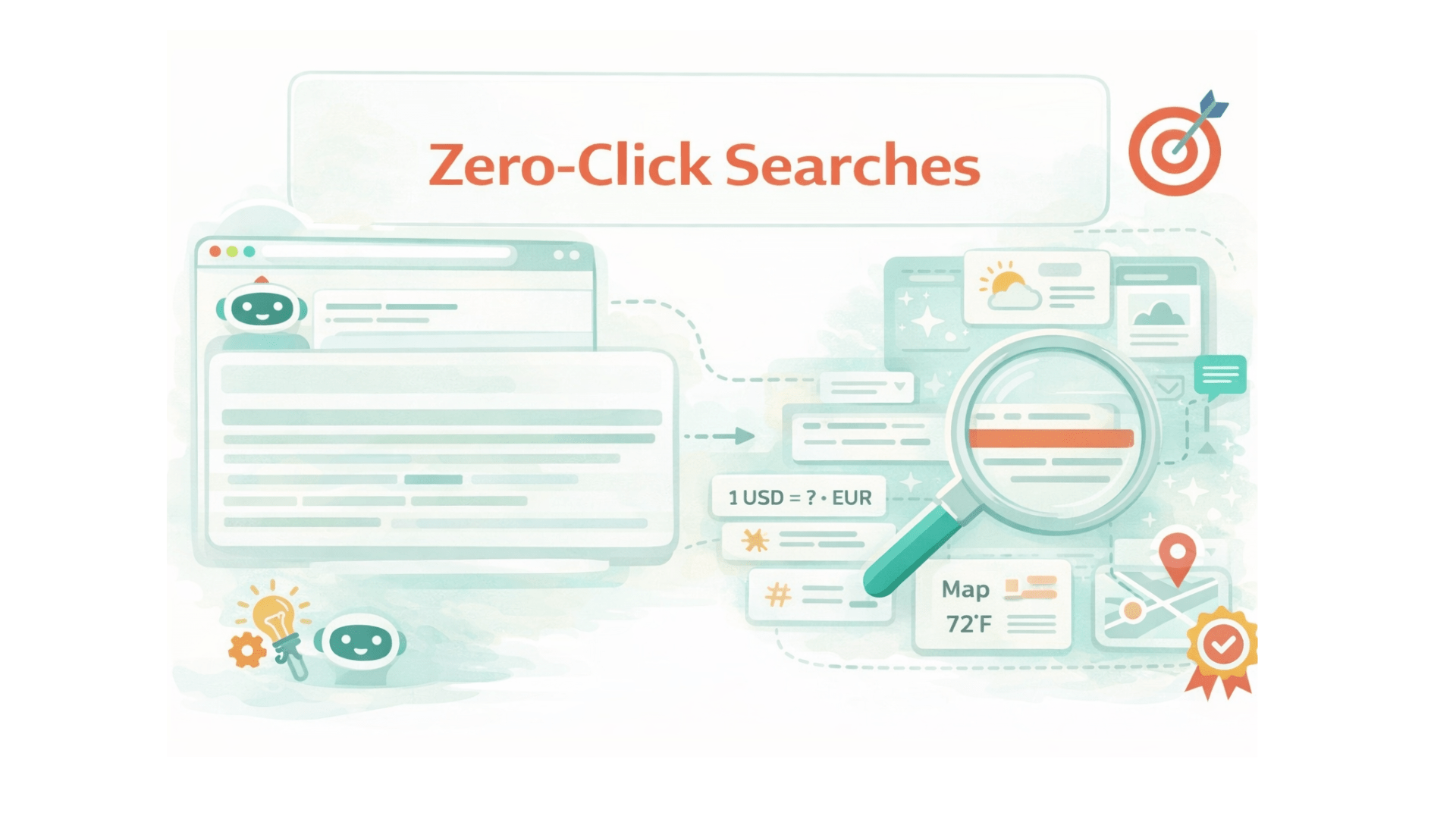
A zero-click searches is a query that gets fully answered on the SERP itself. This might happen through an AI Overview, a featured snippet, a knowledge panel, or another rich result. Over 60 percent of Google searches now end without a click, and some industry reports put that figure even higher for certain query types since AI Overviews became widespread. What counts as SEO success has fundamentally changed.
This post gives you a practical framework for a zero-click world. Instead of only chasing clicks, you will learn how to win visibility on the SERP, shape the user journey before a click ever happens, and measure impact with the right KPIs. If your SEO strategy still treats the SERP as just a gateway, it is time to rethink the whole funnel.
Key takeaways
- A zero-click search answers the user directly on the search results page, removing the need to visit a website.
- With over 60% of searches resulting in zero clicks due to AI Overviews and rich SERP features, SEO must shift from chasing clicks to capturing on-SERP visibility.
- Success in this environment is measured by new KPIs like impression volume, SERP feature ownership, share of voice, and branded search lift rather than only organic traffic.
- Adopt an Answer-First content structure, use question-based headings, and deploy schema markup to increase the chance your content is surfaced on the SERP.
What are zero-click searches?
A zero-click search is a query where the user gets the answer they need directly on the search engine results page, without clicking through to any external site.
In practice that means search features serve up the information: a short definition in a featured snippet, a currency conversion box, a knowledge panel for a public figure, or a generated AI Overview that synthesizes multiple sources. The user reads the answer on the SERP and either moves on or reformulates their query.
Why zero-click searches keep increasing
Search engines have quietly changed their job description. Ten years ago the primary role of a search engine was to be a gateway to the open web. Today many engines, especially Google, aim to be destinations. They want users to get the complete answer on the SERP.
A few forces drive this shift:
- Changing user expectations. People want fast, concise answers. For many queries, speed beats exploration.
- Advances in AI. Large language models can synthesize and summarize multiple sources into a single, coherent answer.
- Business incentives. Keeping users on the search property increases ad opportunities and control over the experience.
Those forces combine to reshape user behavior. When the SERP reliably provides a high-quality answer, users stop clicking through. That changes the economics of discovery and the rules for how brands show up in search.
The impact of AI Overviews
Generative AI powers many of the new answer formats on the SERP. AI Overviews synthesize content from multiple pages and present a single, readable answer at the top of results. This produces several immediate effects.
AI Overviews reduce click-through to traditional organic listings for informational queries. Publishers and sites cited as sources may see large CTR drops when an Overview is present, especially for non-branded searches. Overviews tend to be strongest for research-style queries, which reshapes the early-stage research experience in the customer journey. When a user finds what they need in the Overview, the incentive to click drops sharply. Your content may still be used as a source, but the referral traffic can evaporate.
How rich SERP features keep expanding
Search results today are a collection of widgets and modules that often answer the question without a click:
- Featured Snippets: concise answers extracted from a single webpage, often placed above organic results.
- Knowledge Panels: entity-focused summaries for people, brands, places, and things that give quick facts and context.
- Local Packs: maps and business listings that show contact details, hours, and directions right on the SERP.
- People Also Ask (PAA): expandable questions with short answers, which often surface additional relevant queries.
- Answer Boxes and Conversion Tools: direct-value tools such as currency converters, calculators, and definitions.
Each of these features replaces the need for a click in its own way. Combined with AI Overviews, they make the SERP into a full-service answer engine rather than a table of links.
How to adapt your SEO strategy for a zero-click future
If SEO used to be about rank, then click, then convert, the new model flips the priority. Visibility comes first. You need to win the user at the point of impression, whether or not they ever click. That requires a deliberate shift in priorities and tactics.
Think in three stages: Visibility, Influence, Convert. Visibility means you show up in the right places on the SERP. Influence means your content establishes trust and brand recognition while it is on the SERP. Convert means capturing that attention downstream, even if not immediately.
The pillars of this strategy are straightforward: find keywords that present SERP feature opportunities, structure content so it can be the answer the engine chooses, and use schema and content design to make it easy for machines to parse and surface your expertise. Below are actionable steps for each pillar.
Find target keywords that win SERP feature opportunities
Start by doing a SERP analysis for your target terms. Look at each keyword and note which features appear: snippets, PAA, AI Overviews, knowledge panels, local packs, and so on. Your goal is to identify queries where a feature surfaces an answer you could provide more clearly.
Prioritize next. Not all impressions carry equal weight. Focus on queries with high impression volume or strategic relevance to your brand. Even if clicks are unlikely, impressions build brand awareness and can drive branded search later.
Audit the current features for each opportunity keyword. Capture the snippet or overview text. Can we answer this more directly? More authoritatively? With fresher data?
Tools that make this efficient include Semrush or Ahrefs for SERP feature tracking and keyword impressions, SparkToro or Similarweb for broader search behavior trends, and rank-tracking tools that show feature ownership across your target set.
Structure your content to become the answer Google shows
Answer-First content is the most effective format in a zero-click world. That means the direct, concise answer appears near the top of the page in plain language, then supporting details follow.
Formatting tips that help both users and search engines include leading with a one- or two-sentence answer to the primary question inside the first 40 to 60 words. Use question-based H2s and H3s that mirror how people search, matching phrasing when it reads naturally. Use bullet points, numbered steps, and short paragraphs to make content scannable. Apply the inverted pyramid: put the most important information first, then expand with context, examples, and data.
A well-structured piece often wins the featured snippet or PAA entry because it provides a clean, machine-parseable answer right where the engine looks for it.
Put strategic schema markup to work
Schema is the language search engines use to understand context. It does not guarantee a rich result, but it increases the chance your content is eligible and correctly interpreted.
Key schema types to prioritize for zero-click SEO:
- FAQPage Schema: structure Q&A content so it can appear in People Also Ask or FAQ-rich displays.
- HowTo Schema: mark up step-by-step instructions to be eligible for how-to rich results.
- LocalBusiness Schema: ensure accurate local data feeds into Local Packs and knowledge panels.
- Article and WebPage Schema with clear metadata: help engines understand author, date, and publication credibility.
Implement schema carefully and test with structured data validators. Correct markup increases the odds that your content will be selected as the cited source for an AI Overview or rich snippet.
How do you measure SEO success without clicks?
If clicks fall, what metrics tell you whether SEO is working? Measure visibility and influence, not just downstream visits. When your content is answerable on the SERP, the business value shows up in impressions, brand lift, and future intent.
The KPIs that matter in a zero-click world include impression volume and growth. Track how often your pages appear in results. An increase in impressions means more eyes on your brand.
SERP feature ownership tells you the percentage of target keywords where you own a snippet, PAA answer, or knowledge panel. Share of voice estimates your visibility versus competitors for priority topics by comparing impression shares. Branded search lift monitors rises in searches that include your brand name, which often follow strong non-click visibility.
| The evolution of SEO KPIs | |
|---|---|
| Traditional metrics | Modern metrics |
| Rankings, Organic Traffic, CTR | Impressions, SERP Feature Ownership, Share of Voice, Branded Search Lift |
These modern KPIs are directly linked to awareness and later-stage intent, which is where zero-click visibility pays off.
How to turn on-SERP visibility into real business value
Think of being the quoted expert in a major publication. Even if readers never buy immediately, your name becomes shorthand for authority. On the SERP, the same dynamic plays out. Being the answer establishes trust and brand recognition at scale.
Visibility on an AI Overview or featured snippet accomplishes three things for your business. First, it builds authority. Users see your brand associated with the answer and begin to remember it. Second, it creates informational touchpoints that influence the customer journey upstream. People researching a topic now will recognize your brand later when they move deeper in the funnel. Third, it increases the likelihood of branded searches and navigational clicks down the line, which are higher-intent and convert better.
Treat on-SERP visibility as a long-term investment in the customer journey. You may not capture the immediate click, but you can harvest the attention you gain. Practical ways to convert that attention into value include aligning on-SERP answers with a clear brand voice so users remember who answered the question. Include subtle calls to action or brand cues inside the answer content so the SERP acts like a billboard for your expertise. Track how informational impressions correlate with later branded visits, sign-ups, or conversions.
Zero-click results are not the end of the funnel. They are the start of a different kind of funnel, one that begins with trust and recall rather than an immediate click.
Conclusion
Search is becoming an answer engine. That change is real and likely permanent. SEO is no longer only about driving clicks from the SERP to your pages, but about winning attention and influence where people already look.
The best response is practical and pragmatic. Focus on being the clearest, most authoritative answer for the queries that matter. Structure your content to be machine-friendly, use schema smartly, and measure the right signals: impressions, feature ownership, share of voice, and branded search lift.
Adapting your SEO strategy to this reality does not mean giving up on conversions. It means widening your view of what counts as value, and investing in influence at scale. The brands that do this will own more of the customer journey, even when the user never clicks.
FAQs
What is the zero click effect?
The zero click effect is when a growing number of searches are answered directly on the SERP, so users do not click through to a website. It reduces referral traffic but raises the value of on-SERP visibility for brand building.
What percent of searches are zero click?
Estimates vary by study and query type, but the commonly cited range is roughly 58 to 69 percent of Google searches now end without a click, particularly for informational queries since AI Overviews have been rolled out.
What is the zero-click era?
The zero-click era describes the period when search engines routinely provide full answers on the SERP itself. It is marked by increasing use of featured snippets, knowledge panels, and AI-generated overviews that satisfy user intent without further clicks.
What is a zero-click Google search?
A zero-click Google search is any query where the search results page contains the final answer or tool the user needs, such as a snippet, conversion tool, or generated summary, eliminating the need to visit another site.
How do AI Overviews affect branded search traffic?
AI Overviews can both help and hurt branded traffic. They may reduce clicks for generic queries, but by positioning your brand as a trusted source they can increase branded search lift later. The net effect depends on coverage, citation, and how recognizable your brand appears in the answer.
Can FAQPage Schema help capture on-SERP visibility?
Yes. FAQPage Schema helps search engines identify Q&A content and makes it eligible for PAA or FAQ-rich displays. Well-marked FAQs increase the chance your answers appear directly on the SERP.
Is it still valuable to target keywords that result in zero clicks?
Yes. High-impression, zero-click keywords can build brand awareness and trust at scale. Those impressions often translate into later branded searches and conversions, so targeting them remains strategic.
What is the main difference between optimizing for clicks and optimizing for visibility?
Optimizing for clicks focuses on enticing users to leave the SERP and visit your site. Optimizing for visibility focuses on being the answer on the SERP itself, building authority and recall even when no click occurs. Both matter, but the latter is essential in a zero-click world.

Mansi Jain
Senior AI SEO Specialist @ Opositive.io
GEO, AEO & LLM Optimization Specialist · 6.5+ yrs Technical SEO
About Mansi
Mansi Jain is a Senior SEO Specialist with 6.5+ years of experience in technical SEO, content strategy, ecommerce SEO, and AI-powered search optimization. At Opositive.io, she helps businesses improve their visibility across traditional search engines and emerging AI platforms through data-driven SEO strategies.
Her expertise includes technical audits, keyword research, schema implementation, content clustering, and AI SEO (GEO/AEO). Passionate about staying ahead of search trends, Mansi shares practical insights and actionable strategies that help marketers, founders, and businesses achieve sustainable organic growth.
“Practical, data-driven SEO that helps businesses grow sustainably across both traditional search and AI platforms.
Specialization
Technical SEO, Ecommerce SEO & AI SEO (GEO/AEO)
Education
B.Tech, Information Technology
College of Technology and Engineering, Udaipur · 2015 – 2019
Experience
Senior SEO Specialist, Opositive.io
3+ years at Opositive · 6.5+ years in SEO & AI-powered search
Skills
Technical audits, keyword research, schema, content clustering