Why Every Business Needs SEO, GEO & AI SEO in the Age of AI Search
Key takeaways
- Search now happens across Google, ChatGPT, Gemini, Perplexity and AI Overviews – one strategy must cover all of them
- Rankings and AI citations run on different signals; page-one positions do not guarantee AI mentions
- SEO, GEO and AI SEO work as connected layers, not competing tactics
- Brands that build entity strength and citation footprints now will be the ones AI agents recommend later
Think about the last time you researched a product. Chances are you didn’t scroll through ten blue links. You asked ChatGPT for a comparison, checked what Google’s AI Overview said, or let Perplexity summarise the options for you.
Your customers do the same thing. Pew Research found that when an AI summary appears on Google, only 8% of users click through to a website – down from 15% on pages without one. The search journey now often starts, and ends, inside an AI-generated answer.
That changes the game for brands. You are no longer competing only for rankings. You are competing to become the source AI engines trust and cite. If ChatGPT recommends your competitor and never mentions you, no ranking report will fix that.
This is where SEO, GEO and AI SEO consulting comes in. At Opositive.io, we work as an AI-first search consultancy, helping brands stay visible across Google, ChatGPT, Gemini, Claude, Perplexity and every surface where buying decisions now happen.
Get a Free AI Visibility Assessment to see where your brand stands today.
Why Traditional SEO Alone No Longer Delivers Complete Search Visibility
Google still matters. But the environment around it has shifted:
- Zero-click searches dominate. Users increasingly get answers without visiting any website.
- AI Overviews appear on a growing share of informational and commercial queries, pushing organic results further down the page.
- Multiple search ecosystems exist now. ChatGPT, Perplexity, Gemini and Bing Copilot each carry their own audiences and their own selection logic.
- Brand discovery happens inside AI conversations. A founder asking “best CRM for a 10-person team” gets a shortlist from an AI assistant, not a search results page.
A page-one ranking no longer guarantees your brand appears where decisions get made. Businesses need visibility across all of these systems, not just one.
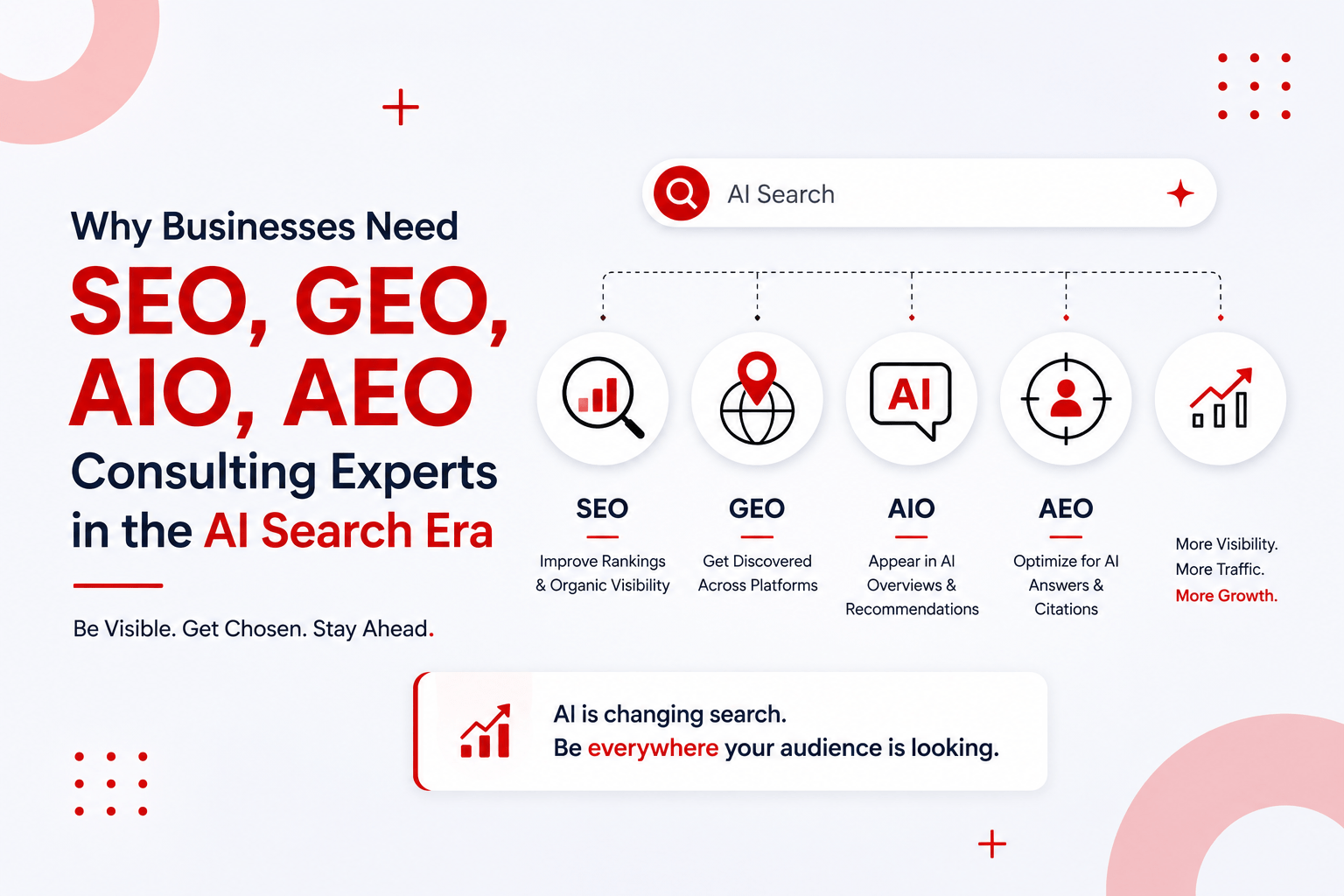
Understanding the Three Pillars of Modern Search Optimization
Modern search visibility rests on three connected disciplines. Here is how they compare at a glance:
| Pillar | Main goal | Core work |
|---|---|---|
| SEO | Rank in traditional search | Technical health, keyword-mapped content, links |
| GEO | Get cited in AI-generated answers | Entity signals, citations, structured content |
| AI SEO | Build brand-level AI trust | SEO + GEO + authority, Knowledge Graph, digital PR |
Search Engine Optimization (SEO)
SEO remains the foundation. Its purpose is to make your site discoverable and rankable in traditional search engines. Core activities include technical SEO, on-page optimization, keyword-mapped content and link acquisition. The expected outcome is qualified organic traffic and stable rankings for commercial and informational queries.
Generative Engine Optimization (GEO)
GEO focuses on how AI engines find and trust information. Large language models pull from sources they consider credible: pages with clear structure, consistent entity data, third-party citations and verifiable facts. GEO work includes building citation footprints, strengthening entity recognition (making sure AI systems know exactly who your brand is and what it does), and structuring content so machines can extract and quote it accurately. For a deeper primer, read our complete guide to Generative Engine Optimization.
AI SEO
AI SEO is the umbrella that combines both, plus everything AI engines use to judge a brand: SEO fundamentals, GEO, brand authority, Knowledge Graph optimization, AI citation building, content intelligence and digital PR. It treats your brand as an entity to be understood, not just a website to be ranked.
Where Your Customers Search Today
Different platforms reward different signals:
- Google Search – classic rankings still drive traffic. Technical SEO and content depth matter most.
- Google AI Overviews – pulls from well-structured, authoritative pages. Schema markup and clear answers help. Here is how to rank in AI Overviews.
- ChatGPT – relies on training data plus live web search. Citations, Reddit presence and brand mentions influence what it recommends. Our ChatGPT SEO services target exactly this.
- Gemini – tightly linked to Google’s index and Knowledge Graph, so entity consistency is critical. See our Gemini SEO services.
- Claude – favours accurate, well-sourced content with clear factual grounding.
- Perplexity – cites sources directly, so being a citable page with specific data wins visibility. That is the focus of our Perplexity SEO services.
- Bing Copilot – draws on Bing’s index, so indexation there matters more than most teams realise.
One brand, seven surfaces, one connected LLM SEO strategy.
What Makes AI Recommend One Brand Instead of Another?
Traditional search ranks pages. AI engines evaluate brands. That distinction drives everything.
When an AI assistant answers “which agency should I hire for AI SEO”, it weighs:
- Brand authority – how often credible sources discuss you
- Entity consistency – identical names, descriptions and facts across your site, LinkedIn, directories and Wikipedia-grade sources
- Third-party mentions – reviews, press coverage, Reddit threads, industry lists
- Structured content – clear headings, direct answers, schema markup
- Fresh information – updated pages signal an active, current brand
- Topic expertise – depth across a subject, not one thin page
- Trust signals – author credentials, transparent data, real case studies
A search engine asks “does this page match the query”. An AI engine asks “do I believe this brand enough to put my name behind recommending it”. That is a higher bar, and it rewards brands that invest in reputation, not just pages.
Signs Your Business Needs SEO, GEO & AI SEO Consulting
- Organic traffic has been flat for two or more quarters despite regular publishing
- Your brand rarely appears when you test buyer prompts in ChatGPT or Perplexity
- Competitors show up in AI citations for your core categories
- Content generates traffic but not leads
- AI Overviews never mention your business, even for queries you rank on
- Your site covers topics thinly instead of owning them
- Multiple teams publish content with inconsistent messaging and entity data
If three or more of these apply, you have an AI visibility gap – and it widens every month competitors invest first. A quick SEO audit will show you exactly where you stand.
The Opositive.io AI Visibility Framework
We run a six-stage framework built specifically for AI-era search:
- Discover – full audit of your current visibility across Google, AI Overviews, ChatGPT, Gemini, Perplexity and Claude, benchmarked against competitors.
- Diagnose – technical SEO review, AI visibility gap analysis and citation mapping to find exactly why AI engines skip your brand.
- Design – topic clusters, entity architecture and a content roadmap that assigns one clear target to every page.
- Develop – AI-first content, knowledge assets and landing pages built to be cited, not just ranked.
- Distribute – digital PR, Reddit and community platform presence, and industry mentions that build the third-party footprint AI engines check.
- Dominate – continuous monitoring, AI visibility tracking and reporting so gains compound instead of fading.
Every recommendation traces back to real data – no assumed numbers, no generic playbooks.
Business Benefits Beyond Rankings
- Better AI discoverability – your brand appears when buyers ask AI assistants for options
- Higher brand trust – consistent citations make you the safe recommendation
- More qualified traffic – visitors arrive pre-informed by AI summaries of your strengths
- Increased AI mentions – measurable growth in how often engines cite you
- Stronger market authority – topical depth that competitors cannot copy quickly
- Future-ready presence – positioned for AI agents and conversational commerce before they peak
- Improved conversions – trust built upstream shortens the decision downstream
Common Misconceptions About AI SEO
“My website already ranks, so AI will mention it.” Rankings and citations use different signals. Plenty of page-one sites never appear in AI answers because they lack entity clarity and third-party trust.
“Publishing AI-generated blogs is enough.” Volume without accuracy, sourcing and structure gets ignored by both Google and LLMs.
“Backlinks alone improve AI visibility.” Links help, but AI engines weigh unlinked mentions, reviews and community discussions heavily.
“GEO replaces SEO.” GEO builds on SEO. A technically broken site cannot earn AI citations.
“AI SEO is only for large enterprises.” Smaller brands often win faster because AI answers reward specificity, and niche authority is easier to establish than broad dominance.
Industries Seeing the Biggest Impact from AI Search
- Fashion & D2C – shoppers ask AI for product comparisons before ever seeing a store. Our D2C SEO playbook covers this shift.
- Healthcare – patients query symptoms and treatments conversationally; cited sources shape decisions
- Finance – “best term insurance for…” style prompts now start in ChatGPT, not Google
- Education – students compare courses and institutions through AI summaries
- Travel – AI builds itineraries and recommends stays directly
- Real Estate – locality and project research increasingly runs through AI assistants
- B2B SaaS – shortlists form inside AI conversations before a demo request ever happens. See our B2B SEO and SaaS SEO approaches.
- Professional Services – reputation and citations decide who AI names as an expert
Choosing an AI SEO Consulting Partner
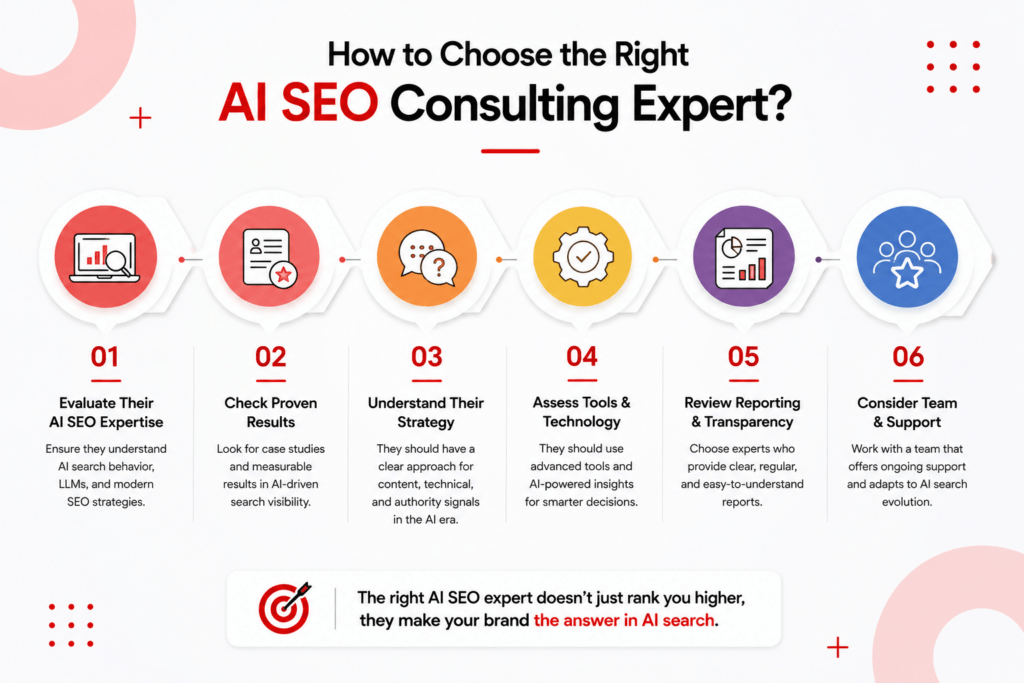
Evaluate any partner – including us – on these criteria:
- Demonstrated experience with AI search, not repackaged SEO decks
- Entity optimization and Knowledge Graph expertise
- Content engineering built for citation, not word count
- Strong technical SEO fundamentals
- Prompt visibility tracking – can they show how your brand performs on real buyer prompts?
- AI citation monitoring across ChatGPT, Gemini, Perplexity and AI Overviews
- Transparent reporting tied to source data
- Workflows that scale across hundreds of pages
Opositive.io builds and runs its own AI visibility tracking tools, which means our reporting comes from live platform data rather than screenshots and guesswork. Our case studies show the numbers behind that claim.
The Next Evolution of Search Is Already Here
AI agents will soon research, compare and even purchase on behalf of users. Conversational commerce, autonomous search assistants, personalized AI recommendations, richer knowledge graphs and voice plus multimodal search are all moving from experiment to default. Our Agentic AI SEO services prepare brands for exactly this shift.
Brands that build entity strength, citation footprints and structured knowledge today will be the ones AI agents select tomorrow. Waiting means starting from behind.
Why Opositive.io Is Built for the AI Search Era
We started as an AI-first agency, not a traditional agency retrofitting AI into old services. Our stack covers AI-first SEO methodology, GEO expertise, LLM optimization, proprietary AI visibility tracking, Reddit and community authority building, entity optimization, technical SEO, agentic workflows and performance measurement tied to real source data. Learn more about our team.
Book a Free AI Search Strategy Session and see exactly where your brand stands in AI search.
FAQs
How is AI SEO different from traditional SEO?
Traditional SEO optimizes pages for rankings. AI SEO optimizes your entire brand – entity, citations, reputation – so AI engines recommend you.
Does GEO replace SEO?
No. GEO extends SEO. Strong technical and content foundations remain prerequisites for AI visibility.
What are AI citations?
Instances where AI engines reference or link your brand as a source in generated answers.
Why isn’t my website appearing in ChatGPT? Usually weak entity signals, few third-party mentions, or content that isn’t structured for extraction. An AI visibility audit pinpoints the exact gap.
How does Google AI Overview select websites?
It favours authoritative, well-structured pages with clear answers, strong E-E-A-T signals and relevant schema.
Can small businesses benefit from AI SEO?
Yes. Niche authority is easier to build than broad dominance, and AI answers reward specific expertise.
How long does AI SEO take to show results?
Early citation movement typically appears in 8-12 weeks. Meaningful visibility shifts usually take 4-6 months.
What metrics should I track for AI visibility?
Prompt-level brand mentions, AI citation share versus competitors, AI referral traffic, and entity accuracy across platforms.
What industries benefit the most?
High-consideration categories – SaaS, finance, healthcare, education, D2C – where buyers research before purchasing.
Why hire an AI SEO consultant?
The space changes monthly. A specialist brings tested frameworks, tracking tools and cross-platform data your in-house team would take a year to build.
Do I need separate strategies for ChatGPT, Gemini and Perplexity?
One core strategy with platform-specific adjustments. The foundations – entity, citations, structure – carry across all engines.
Is Reddit really important for AI visibility?
Yes. LLMs weight Reddit discussions heavily for recommendation-style queries, which is why community authority sits inside our framework.

Mansi Jain
Senior AI SEO Specialist @ Opositive.io
GEO, AEO & LLM Optimization Specialist · 6.5+ yrs Technical SEO
About Mansi
Mansi Jain is a Senior SEO Specialist with 6.5+ years of experience in technical SEO, content strategy, ecommerce SEO, and AI-powered search optimization. At Opositive.io, she helps businesses improve their visibility across traditional search engines and emerging AI platforms through data-driven SEO strategies.
Her expertise includes technical audits, keyword research, schema implementation, content clustering, and AI SEO (GEO/AEO). Passionate about staying ahead of search trends, Mansi shares practical insights and actionable strategies that help marketers, founders, and businesses achieve sustainable organic growth.
“Practical, data-driven SEO that helps businesses grow sustainably across both traditional search and AI platforms.
Specialization
Technical SEO, Ecommerce SEO & AI SEO (GEO/AEO)
Education
B.Tech, Information Technology
College of Technology and Engineering, Udaipur · 2015 – 2019
Experience
Senior SEO Specialist, Opositive.io
3+ years at Opositive · 6.5+ years in SEO & AI-powered search
Skills
Technical audits, keyword research, schema, content clustering