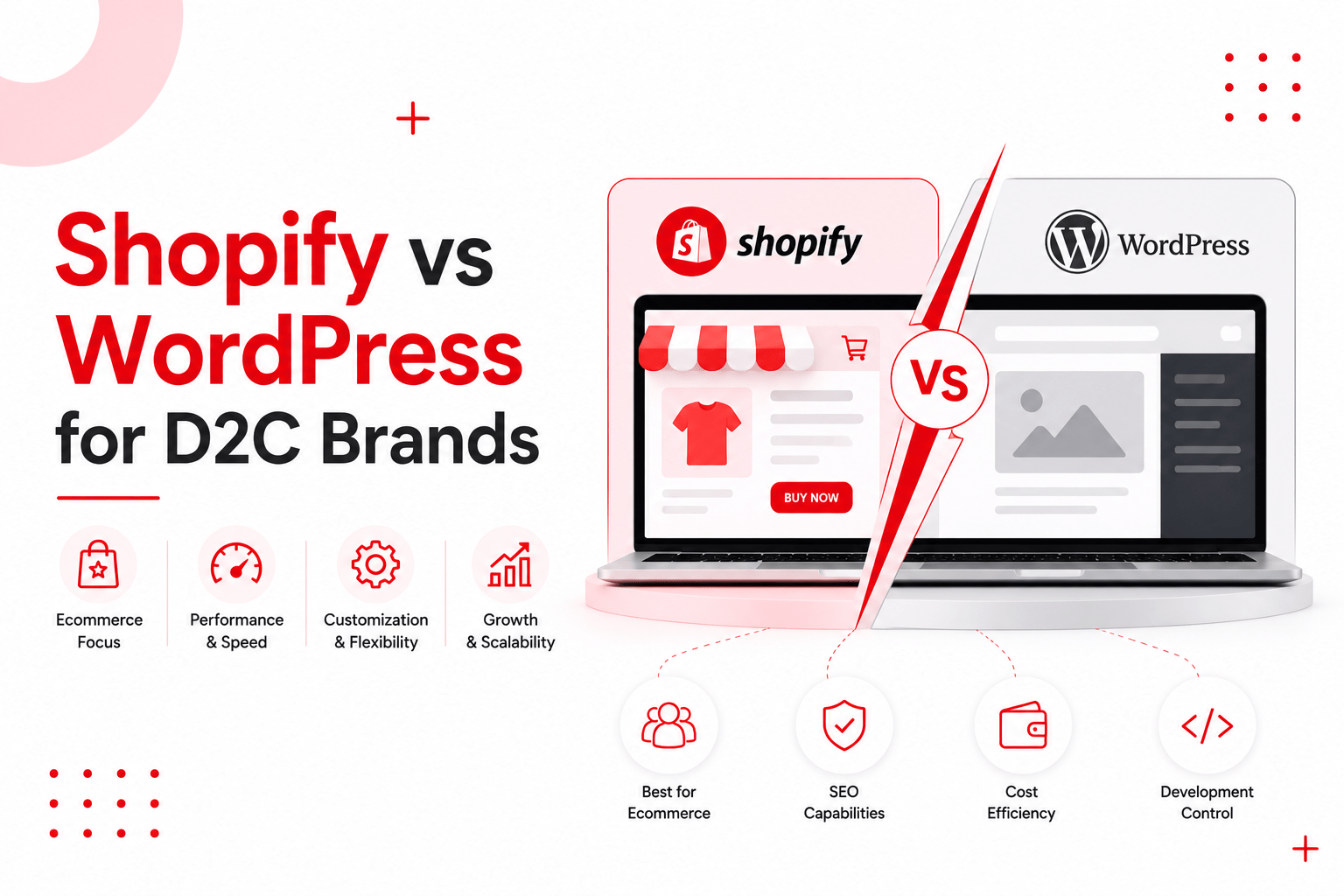
Shopify vs WordPress for D2C Brands: Which Platform Should You Choose?
This guide compares Shopify and WordPress specifically for D2C brands – SEO, ease of use, customization, scalability, content marketing and international selling – so you can pick the platform that fits your stage, team and growth plan rather than the one with the loudest fans.
Key takeaways
- Shopify wins on speed to launch, reliability and zero maintenance; WordPress wins on content depth, flexibility and control
- For most early-stage D2C brands, Shopify’s simplicity outweighs WordPress’s flexibility
- Content-led D2C brands – where blogs, guides and education drive sales – get more from WordPress + WooCommerce
- Shopify’s 2026 plan changes matter: staff access and international market flexibility now depend on your plan tier
- Neither platform ranks itself – SEO and AI visibility outcomes depend on strategy, not the CMS badge
Every D2C founder hits this fork in the road. You’ve got the product, the packaging, maybe your first thousand Instagram followers – and now you need a store. Half your network says “just use Shopify,” the other half swears their WordPress site gives more control and ranks better.
Both sides are right, for different businesses. We manage SEO for D2C brands on both platforms, and the honest answer is that the best ecommerce platform for D2C depends on three things: how your customers buy, how your team works, and how much of your growth will come from content. Let’s break it down properly.
Shopify vs WordPress: What’s the Difference?
Shopify is a hosted, all-in-one commerce platform. You subscribe, and Shopify handles hosting, security, checkout, payments and updates. Over 4 million stores run on it. You rent a fully serviced shop.
WordPress is open-source software that powers roughly 43% of all websites. Add the free WooCommerce plugin and it becomes an ecommerce store. You own everything – and you manage everything: hosting, security, updates, backups. You build your own shop on land you control.
That ownership difference drives almost every trade-off below. So when people say “Shopify vs WordPress,” for a D2C brand the real comparison is Shopify vs WooCommerce – WordPress alone doesn’t sell anything.
Quick Comparison Table
| Factor | Shopify | WordPress + WooCommerce |
|---|---|---|
| Setup time | Days | Weeks (with a developer) |
| Ease of use | Very high – built for non-technical founders | Moderate – needs comfort with WordPress |
| SEO control | Good, some structural limits | Full control |
| Content marketing | Basic blog | Best-in-class |
| Customization | Theme + app based; checkout locked below Plus | Unlimited |
| Maintenance | Zero – Shopify handles it | Yours – updates, security, backups |
| Scalability | Excellent, plan-tier based | Excellent, engineering based |
| International selling | Built-in, but custom markets limited on lower plans | Unlimited, via plugins and setup |
| Ownership | Rented platform | Fully owned |
| Best for | Fast-moving product-led D2C | Content-led, control-focused D2C |
Shopify vs WordPress for D2C Startups
If you’re pre-launch or in your first year, the platform decision is really a focus decision. Every hour spent debugging a plugin conflict is an hour not spent on product, ads or customer conversations.
Shopify’s pitch to startups is simple: subscribe, pick a theme, and you’re selling this week. Checkout, payments, abandoned cart recovery – all handled, with current plan details on Shopify’s pricing page.
One 2026 catch worth knowing: the entry-level Basic plan now includes zero staff accounts – only the owner can log in. If a co-founder or freelancer needs full store access, you’ll be moving up to the Grow plan sooner than you’d expect.
WooCommerce makes startup sense in one scenario: you already know WordPress, or your growth plan starts with content. A founder writing three buying guides a week has different needs than one running Meta ads to a product page.
Verdict for startups: Shopify, unless content is your engine from day one.
Shopify vs WordPress for Growing D2C Brands
Once you have a team, a content calendar and international ambitions, the trade-offs flip around.
Shopify’s tier-to-scale model starts to show: your app stack grows alongside your feature needs, and customization walls appear – checkout customization stays locked until Shopify Plus, the enterprise tier.
WooCommerce at this stage rewards brands with a developer (in-house or agency). There are no platform-imposed feature tiers and no ceiling on customization – the constraint is simply the technical capacity you bring.
Verdict for growth stage: depends on your team. No technical resource – stay on Shopify and treat the app stack as part of the operating model. Solid dev support and a content-led model – WooCommerce starts paying dividends.
Shopify vs WordPress SEO: Which Ranks Better?
Neither. Google doesn’t rank platforms; it ranks pages. We’ve audited fast-ranking Shopify stores and disastrous WordPress sites, and the reverse. What differs is where the SEO effort goes.
Shopify SEO strengths and limits: clean hosting, fast global CDN, automatic sitemaps and solid mobile performance out of the box. The limits are structural – forced /collections/ and /products/ URL paths, duplicate URLs when a product sits in multiple collections (canonical tags handle this, but you need to check), and limited control over technical files on lower plans.
WooCommerce SEO strengths and limits: total control – URL structures, schema, robots.txt, server-level speed work, anything. The limit is that nothing is done for you. A neglected WooCommerce site accumulates plugin bloat, slow queries and crawl waste faster than Shopify ever could.
For AI-era search there’s a genuine wrinkle: both platforms need fact-dense product content, complete product structured data and open access for AI crawlers. WooCommerce gives you direct control over all three; Shopify handles most of it through apps and theme edits. Interestingly, Shopify launched an Agentic plan in 2026 that pushes your catalog directly into AI assistants like ChatGPT and Gemini – a signal of where commerce discovery is heading, something we’ve written about in our guide to ranking in Google’s AI Overviews.
Verdict on SEO: tie on outcomes, different on effort. Shopify needs workarounds; WooCommerce needs discipline. Either way, the strategy matters more than the software – which is exactly what our ecommerce SEO work covers on both platforms.
Ownership & Operating Model: The Real Trade-Off
Strip away the feature lists and the two platforms represent two operating models.
Shopify bundles everything into one predictable subscription – infrastructure, security, checkout, support. What you give up is control: features arrive when Shopify ships them, limits change when Shopify changes them, and you build on rented land.
WooCommerce unbundles everything – you assemble hosting, plugins and development yourself. What you gain is ownership: no platform can reprice your stack, restrict a feature you rely on, or change your terms. What you take on is responsibility for every moving part.
Neither model is cheaper or better in the abstract. Product-led teams that want to move fast tend to value the bundle; content-led teams that want control tend to value ownership. Decide which describes you before comparing anything else.
Customization & Flexibility
Shopify customizes within guardrails – themes, app stack, Liquid template edits. For 90% of D2C stores that’s plenty. The walls show up at checkout (locked below Plus), unusual product logic (custom bundles, configurators, subscriptions with odd rules) and design ideas your theme fights.
WooCommerce has no guardrails. Custom checkout flows, quiz-to-product funnels, membership-plus-commerce hybrids, integrations with anything that has an API. The price of that freedom is that someone technical has to build and maintain it.
Performance & Scalability
Shopify’s infrastructure absorbs traffic spikes without you thinking about it – a sale featured on national TV won’t crash your store. Speed depends mostly on your theme and app weight, so store hygiene still matters.
WooCommerce performance is entirely yours: great hosting plus caching plus a lean plugin stack beats Shopify’s speed; a weak hosting setup with 40 plugins produces the slow WordPress stores that gave the platform its reputation. Scaling for a big sale means capacity planning, not luck.
Security & Maintenance
Shopify: handled. SSL, PCI compliance, patching, backups – included in the subscription. This is genuinely valuable for a lean team.
WooCommerce: yours. Updates weekly, security plugins, backups, and a plan for when a plugin update breaks something at 11 pm before a launch. An agency maintenance retainer removes the burden but adds another vendor to manage.
Content Marketing & CRO
Here’s where WordPress earns its D2C reputation. If your brand grows through education – skincare routines, supplement science, fabric guides – WordPress is the strongest publishing platform ever built. Custom layouts, content hubs, topic clusters and internal linking at a depth Shopify’s blog simply doesn’t attempt. For brands whose SEO strategy leans on topical authority and AI citations, that content muscle compounds – the same principle behind GEO.
Shopify’s blog is functional, not powerful. Many content-serious Shopify brands run a WordPress blog on a subdirectory alongside the Shopify store – workable, but it needs careful technical SEO to keep the two halves working as one site.
On CRO, Shopify’s checkout converts well by default and one-click wallets are native. WooCommerce lets you test and rebuild anything, which is powerful if you actually run the experiments and dead weight if you don’t.
International D2C: An Underrated Decider
Selling to the UAE, US or UK from India? Check this before choosing.
Shopify’s Markets feature handles currencies, localized domains and translated storefronts elegantly – but 2026 plan changes capped custom markets at 3 on non-Advanced plans, with further expansion reserved for higher tiers. For a brand targeting five countries with tailored pricing and positioning, that constraint deserves a hard look before committing.
WooCommerce handles international through plugins and configuration – unlimited markets, full control over regional pricing and tax logic, no platform-imposed caps. More setup work, no toll booth.
Real D2C Examples
- A single-product skincare launch running Instagram ads – Shopify. Speed and checkout quality decide everything; content can wait.
- A supplement brand whose growth engine is search content – WooCommerce. Fifty in-depth guides linked to products is the moat, and WordPress builds it best.
- A fashion label scaling fast with a 6-person team and no developer – Shopify Grow. Reliability beats flexibility when nobody’s there to maintain flexibility.
- A pet-care brand selling in India, UAE and the US with regional pricing – lean WooCommerce, or plan for Shopify’s higher tiers with eyes open.
- An established D2C brand wanting custom checkout and deep automation – Shopify Plus or headless WooCommerce; at this level it’s an engineering decision, not a plugin decision.
Migration Considerations
Switching later is possible but never free. Products and customers move easily with migration tools; order history, app-specific data and URL structures don’t. The SEO risk sits in URLs – Shopify forces its /products/ paths, so a WooCommerce-to-Shopify move changes every product URL and demands a complete 301 redirect map. Run a full SEO audit before and after any migration; we’ve seen brands lose 30-40% of organic traffic to careless moves that a redirect plan would have prevented.
Practical rule: pick for the next three years, not the next three months – but don’t let migration fear force a bad first choice either.
Shopify vs WordPress: Which Should You Choose?
Choose Shopify if: you’re launching fast, your team is non-technical, ads and social drive your sales, you want zero maintenance, and a predictable bundled platform beats assembling your own stack. This is most early and mid-stage D2C brands, honestly.
Choose WordPress + WooCommerce if: content is your primary growth channel, you have reliable developer support, you sell across many international markets, your product logic is unusual, or full ownership of your stack matters to how you operate.
And whichever you choose – the platform gets you a store, not customers. Rankings, AI visibility and organic revenue come from what you build on top of it. That’s the part we handle for D2C brands on both platforms.
Get a free platform-and-SEO consultation for your D2C brand
FAQs
Is Shopify or WordPress better for D2C brands?
Shopify for speed, reliability and non-technical teams; WordPress + WooCommerce for content-led growth, deep customization and full ownership. Most early-stage D2C brands are better served by Shopify.
Can I run a blog on Shopify like WordPress?
Shopify has a basic blog, but it’s far behind WordPress for serious content operations. Content-heavy Shopify brands often pair the store with a WordPress blog in a subdirectory.
Is WooCommerce good for international D2C selling?
Yes – unlimited markets and full regional control without platform caps. Shopify handles international elegantly too, but current plans limit custom markets on lower tiers.
Can I migrate from Shopify to WooCommerce later (or the reverse)?
Yes, but URL changes make it an SEO project, not just a data export. A complete redirect map and pre/post audit protect your rankings.
Does the platform affect AI search visibility?
Only indirectly. AI engines care about crawlable, fact-dense product data and brand trust signals – achievable on both platforms with the right setup.

Mansi Jain
Senior AI SEO Specialist @ Opositive.io
GEO, AEO & LLM Optimization Specialist · 6.5+ yrs Technical SEO
About Mansi
Mansi Jain is a Senior SEO Specialist with 6.5+ years of experience in technical SEO, content strategy, ecommerce SEO, and AI-powered search optimization. At Opositive.io, she helps businesses improve their visibility across traditional search engines and emerging AI platforms through data-driven SEO strategies.
Her expertise includes technical audits, keyword research, schema implementation, content clustering, and AI SEO (GEO/AEO). Passionate about staying ahead of search trends, Mansi shares practical insights and actionable strategies that help marketers, founders, and businesses achieve sustainable organic growth.
“Practical, data-driven SEO that helps businesses grow sustainably across both traditional search and AI platforms.
Specialization
Technical SEO, Ecommerce SEO & AI SEO (GEO/AEO)
Education
B.Tech, Information Technology
College of Technology and Engineering, Udaipur · 2015 – 2019
Experience
Senior SEO Specialist, Opositive.io
3+ years at Opositive · 6.5+ years in SEO & AI-powered search
Skills
Technical audits, keyword research, schema, content clustering