Agentic Search Optimization: The Future of AI-Driven Search
Objective
This guide explains what Agentic Search Optimization is, how AI agents discover, evaluate and recommend brands, and what it takes to become the business an AI agent picks. You will learn the trust signals agents check, a readiness checklist for your website, and a phased roadmap to build AI search visibility before your competitors do.
Key takeaways
- AI agents don’t show ten links – they research, compare and recommend, often completing the task themselves
- Getting recommended depends on machine-readable trust signals, not just rankings
- Agentic Search Optimization builds on SEO, GEO and AEO rather than replacing them
- Brands that structure their entity, content and citations now will be the ones AI agents pick later
Imagine asking an AI assistant to find the best CRM for your team, book a hotel in Jaipur, or shortlist three marketing agencies under a set budget. It doesn’t show you ten blue links. It researches, compares dozens of sources, filters by your requirements, and hands you one recommendation – sometimes it even completes the booking.
Now flip the scenario. If your brand isn’t structured for AI agents to find, understand and trust, you were never in that comparison. The buyer didn’t reject you. The agent never surfaced you.
This is the problem Agentic Search Optimization solves. It is the next stage of search visibility, and at Opositive.io we treat it as a discipline in its own right, not a footnote to SEO.
Get Your Free AI Search Readiness Audit
Search Is Becoming Autonomous: Here’s What That Means for Your Business
Three shifts are happening at once:
From search engines to AI assistants. Users increasingly start with ChatGPT, Gemini, Perplexity or Claude instead of a search bar. Pew Research found that when an AI summary appears on Google, users click traditional result links in only 8% of visits – nearly half the 15% rate on pages without one. Semrush projects that AI-driven search visitors will overtake traditional search visitors by 2028.
From clicks to completed tasks. The old funnel was search, click, browse, decide. The agentic funnel is ask, receive, act. There is no browsing step for your landing page to win.
From keyword matching to intelligent decision-making. AI agents don’t match strings. They interpret intent, decompose a goal into sub-questions, cross-check multiple sources, weigh trust, and make a judgment call – the same way a diligent human researcher would, only in seconds.
An AI agent evaluating “best contract management software for a 50-person legal team” might check review platforms, Reddit threads, comparison articles, vendor documentation and pricing pages before naming two or three options. Every one of those touchpoints is now an optimization surface.
How AI Agents Discover, Evaluate, and Recommend Brands
Before defining the discipline, it helps to see the machine’s decision journey:
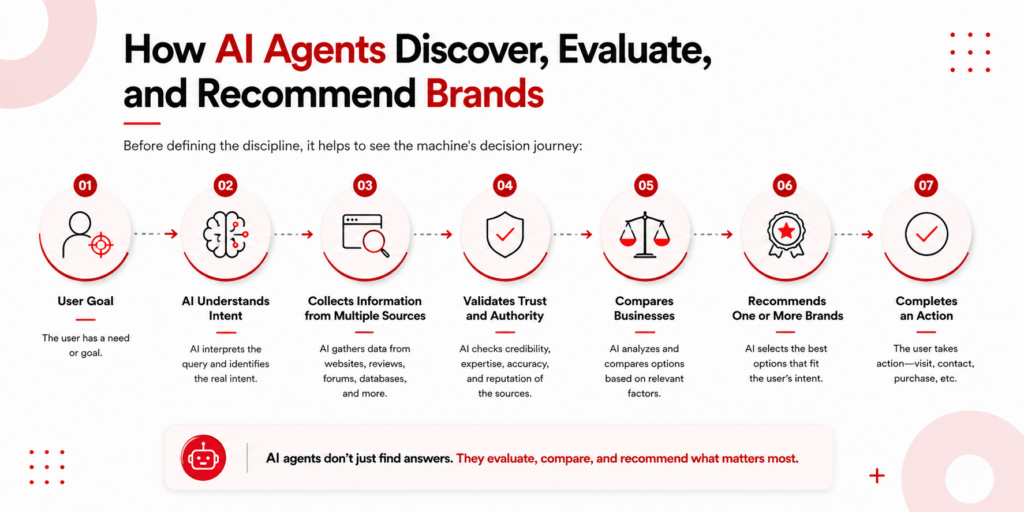
Here is what the agent checks at each stage:
- Intent understanding – the agent breaks the goal into sub-questions: budget, use case, location, constraints
- Information collection – it pulls from your site, review platforms, communities, news coverage and knowledge graphs
- Trust validation – it checks entity consistency, source credibility, freshness and whether independent sources corroborate your claims
- Comparison – it weighs features, pricing, reputation and fit against alternatives
- Recommendation – it names brands it can defend, because a wrong recommendation damages the AI’s usefulness
- Action – where APIs and integrations exist, the agent books, buys or signs up directly
A gap at any stage removes you from the shortlist. Thin content fails collection. Conflicting NAP data fails validation. No third-party mentions fails comparison.
What Is Agentic Search Optimization?
Agentic Search Optimization is the practice of structuring your brand, content and digital footprint so autonomous AI agents can discover you, verify your credibility, and confidently recommend or transact with you.
It differs from traditional optimization in three ways:
- The audience is a machine acting for a human. You optimize for how an agent reads, reasons and decides, not for how a person scans a results page.
- The unit of success is a recommendation, not a ranking. There is no position two in an agent’s answer. You are either recommended or invisible.
- Trust is the ranking factor. Agents put their credibility behind every recommendation, so they favour brands with verifiable, consistent, well-corroborated information.
In short: machine understanding, trust and decision support replace keywords and rankings as the core optimization targets.
The Evolution of Search: From SEO to AI Decision Engines
Search visibility has moved through five stages, each building on the last:
Traditional SEO – Objective: rank pages for keywords. User behavior: type, scan, click. Optimization focus: keywords, links, technical health.
Semantic Search – Objective: understand meaning, not strings. User behavior: longer, natural queries. Optimization focus: topics, entities, intent.
Generative Search (GEO) – Objective: get cited inside AI-generated answers. User behavior: read the summary, rarely click. Optimization focus: citability, structure, source trust.
Answer Engines (AEO) – Objective: be the direct answer in snippets and voice. User behavior: ask a question, accept one answer. Optimization focus: concise answers, schema, FAQs.
Agentic Search Optimization – Objective: be the brand an autonomous agent selects and acts on. User behavior: delegate the whole task. Optimization focus: entity trust, machine-readable data, cross-platform reputation, transactional readiness.
Each stage still matters. Agents lean on the same signals search engines and LLMs built before them – the stack compounds.
What Signals Influence AI Agent Decisions?
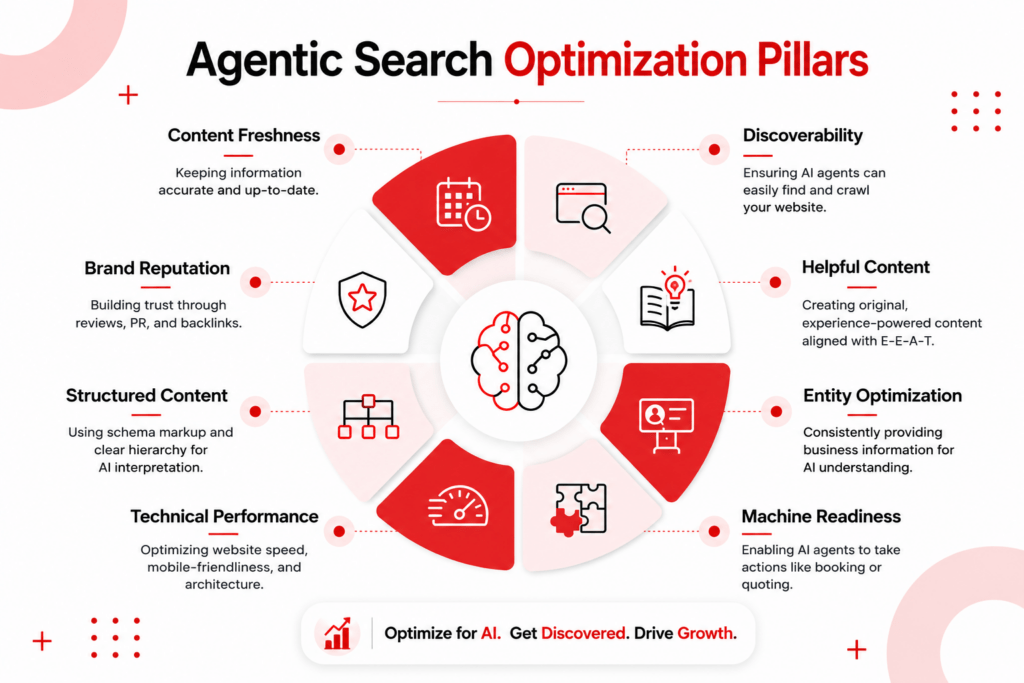
Content Depth & Expertise
Agents prefer sources that cover a topic completely – specifications, pricing logic, use cases, limitations. One thorough page beats five thin ones.
Brand Reputation Across the Web
Agents cross-reference. If your site says one thing and the wider web says nothing, that silence reads as risk. Reviews, press mentions and community discussions all count.
Structured Website Information
Schema markup (Organization, Product, FAQPage, Review) turns prose into data an agent can extract without guessing. Machine-readable beats machine-inferred.
Entity Consistency
Your name, description, address, offerings and facts must match across your site, LinkedIn, directories, Google Business Profile and knowledge bases. Conflicts break validation.
Reviews & Third-Party Validation
Agents weight independent voices heavily. Reddit is a standout: it consistently ranks among the most-cited sources in AI answers alongside Wikipedia and YouTube. Our Reddit marketing work exists precisely for this reason.
Technical Accessibility
If AI crawlers can’t render your pages, nothing else matters. Clean HTML, fast loads, open crawler access and no client-side-only content.
Fresh & Accurate Information
Stale pricing, dead pages and outdated claims get you filtered out. Agents prefer sources with recent, verifiable updates.
Digital Authority
Sustained topical coverage, credible authors and citations from respected sources signal that recommending you is safe.
Is Your Website Ready for Agentic Search?
Run through this checklist honestly:
- Clear site architecture an agent can traverse in a few hops
- Schema implemented on organization, service, product and FAQ content
- Service pages updated within the last six months
- Strong entity signals – consistent naming and facts everywhere
- Author profiles with real credentials on expert content
- Active review ecosystem across relevant platforms
- Identical business information on every listing and profile
- Fast performance on mobile and desktop
- AI-friendly formatting – direct answers, clean headings, TL;DR blocks, extractable facts
Five or more gaps means agents are likely skipping you today. A structured audit will confirm exactly where.
Building an Agentic Search Strategy: A Practical Roadmap
Phase 1 – Assess Current AI Visibility. Test real buyer prompts across ChatGPT, Gemini, Perplexity and AI Overviews. Log where you appear, where competitors do, and why.
Phase 2 – Strengthen Technical Foundations. Fix crawlability, rendering, speed and schema so every agent can read you. This is technical SEO with an AI-crawler lens.
Phase 3 – Improve Content Intelligence. Restructure key pages for extraction: direct answers up top, evidence below, sub-questions covered, facts stated plainly.
Phase 4 – Expand Brand Authority. Build third-party presence through digital PR, community platforms and industry mentions – the corroboration agents check.
Phase 5 – Increase AI Citations. Target the prompts that matter commercially and earn citations inside the answers agents draw from.
Phase 6 – Track & Refine. Monitor mention rates, citation share and competitor movement with AI visibility tracking, then reinvest in what moves.
Common Roadblocks Preventing AI Visibility
- Thin content that answers nothing completely
- Weak topical authority – one page per topic instead of a cluster
- Missing structured data, forcing agents to guess
- Conflicting business information across platforms
- Outdated pages with stale pricing or dead offerings
- Poor internal linking that hides your best resources
- No external mentions to corroborate your claims
- No AI visibility tracking – you can’t fix what you don’t measure
Most of these are fixable in one focused quarter. The expensive mistake is not knowing they exist.
Where Agentic Search Creates the Biggest Business Impact
- Higher AI recommendations – your brand gets named when buyers delegate research
- Better brand discoverability – visibility across every AI surface, not one results page
- Improved lead quality – prospects arrive pre-qualified by the agent’s own filtering
- Greater trust – being the AI’s pick carries implicit endorsement
- Reduced dependency on paid acquisition – recommendations compound; ad spend doesn’t
- Long-term search resilience – you’re positioned for wherever search goes next, not just where it is
We’ve measured this compounding in client work. A luxury villa rental brand grew AI Overview keyword visibility by 33.4% through LLM optimization, and a data analytics education brand achieved 4x AI citation volume by pairing Reddit visibility (26 threads, 30,000+ views) with SERP work.
Industries That Should Prioritize Agentic Search Optimization
- SaaS – software shortlists now form inside AI conversations before any demo request
- Healthcare – patients delegate provider and treatment research to assistants
- Financial Services – “best term plan for a 35-year-old” is an agent task, not a browse
- Ecommerce – AI shopping assistants compare products and complete purchases
- Education – course and institution comparison is a natural agent workflow
- Travel – agents build itineraries and book directly
- Professional Services – agents name the expert; reputation decides who
- B2B Technology – long, multi-criteria evaluations are exactly what agents excel at
- Real Estate – locality research and project comparison increasingly run through AI
The common thread: high-consideration decisions with many comparable options. That is where users delegate, and where agents decide.
How Opositive.io Helps Businesses Prepare for AI-Powered Search
Our agentic methodology runs six connected stages:
- Discover – measure your current AI visibility across engines and buyer prompts
- Structure – fix technical accessibility, schema and machine-readable data
- Build – create authority-driven content engineered for extraction and citation
- Expand – strengthen entity recognition and third-party corroboration
- Validate – monitor AI citations and recommendations against competitors
- Optimize – continuously refine based on live visibility data
The service stack behind it: Agentic AI SEO, AI SEO, GEO, LLM SEO, Technical SEO, AI Visibility Tracking, entity optimization, Reddit SEO and AI content engineering. Across engagements, clients average 3.8x organic traffic growth and a 190% lift in AI citations – full numbers in our case studies.
Preparing for the Next Generation of Search
What’s coming next is already visible at the edges:
- AI shopping assistants that compare, negotiate and buy
- Autonomous buying decisions for repeat and low-risk purchases
- AI-powered research workflows replacing hours of manual comparison
- Personal AI agents that know a user’s preferences and filter accordingly
- Multi-agent ecosystems where one agent consults others before deciding
- Zero-click commerce completed entirely inside the AI interface
- Voice and multimodal search as default input methods
AI systems are shifting from answering questions to completing tasks. That makes brand trust and machine-readable information more valuable every quarter, because agents cannot recommend what they cannot verify. Brands that adapt now set the baseline agents learn from. Brands that react later will be optimizing against competitors who are already the default answer.
Why Opositive.io Is Your Agentic Search Optimization Partner
We built for this era from day one: AI-first search expertise, tested agentic SEO frameworks, proprietary AI visibility monitoring, entity optimization, deep technical SEO, AI content strategy, GEO and LLM SEO expertise, and data-driven reporting tied to live platform signals – refined continuously, not set and forgotten.
Schedule a Free Agentic Search Strategy Consultation
FAQs
What is Agentic Search Optimization?
The practice of structuring your brand, content and data so autonomous AI agents can discover, verify and confidently recommend you – or transact with you directly.
How is Agentic Search Optimization different from SEO?
SEO optimizes pages for human clicks on results pages. Agentic optimization targets machine decision-making: trust signals, structured data and cross-platform reputation that lead to a recommendation.
Is Agentic Search Optimization the same as GEO?
No. GEO earns citations inside AI-generated answers. Agentic optimization goes further – it prepares your brand for agents that compare options and complete tasks, not just write summaries.
How do AI agents decide which brands to recommend?
They decompose the user’s goal, gather information from multiple sources, validate trust and consistency, compare options against the criteria, and recommend brands they can defend.
Can small businesses benefit from Agentic Search?
Yes. Agents reward specificity and verifiable expertise, which niche businesses can build faster than broad market dominance.
Does structured data help AI agents?
Significantly. Schema turns your content into extractable facts, removing the guesswork that causes agents to skip ambiguous sources.
Which AI platforms should businesses optimize for?
ChatGPT, Gemini, Perplexity, Claude, Google AI Overviews and Bing Copilot – with one core strategy and platform-specific adjustments.
How do I measure AI search visibility?
Track prompt-level brand mentions, citation share versus competitors, AI referral traffic, and entity accuracy across platforms.
What industries benefit the most?
High-consideration categories – SaaS, finance, healthcare, travel, education, B2B tech – where buyers naturally delegate research.
How long does Agentic Search Optimization take?
Early citation movement typically shows in 8-12 weeks. Meaningful recommendation share takes 4-6 months of sustained work.
Does Agentic Search replace traditional SEO?
No. Agents rely on many of the same signals search engines built. Strong SEO is the foundation agentic work compounds on.
Why should businesses invest in Agentic SEO now?
Agent recommendations compound and early movers become the default answer. Catching up later means displacing an incumbent the AI already trusts.
What services does Opositive.io provide for AI search optimization?
Agentic AI SEO, AI SEO, GEO, AEO, LLM SEO, ChatGPT/Gemini/Perplexity SEO, AI visibility tracking, AI citation building, Reddit marketing and technical SEO.