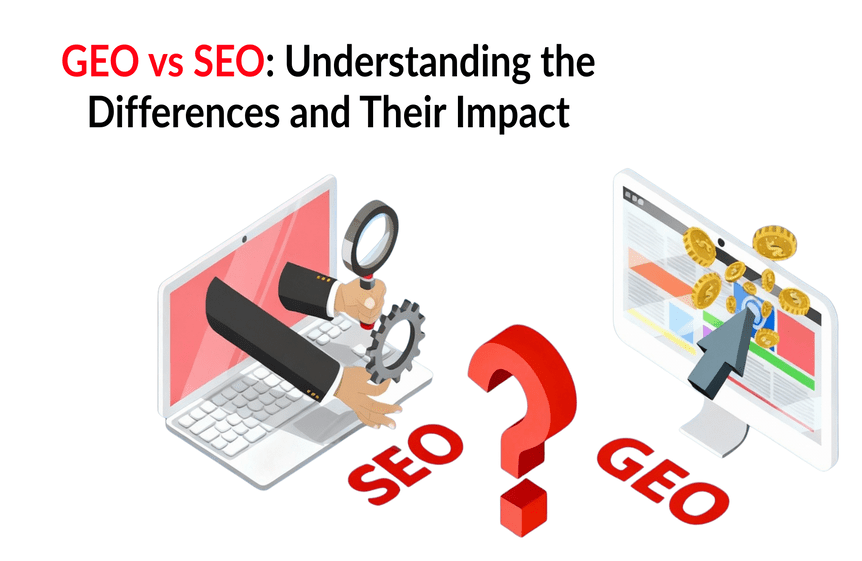
GEO vs SEO: Understanding the Differences and Their Impact
If you run marketing or product-led growth today, you’re not just competing for rankings – you’re competing for answers.
On one side, you have classic SEO, which still drives clicks from Google and Bing. On the other, you now have GEO – Generative Engine Optimization – which decides whether tools like ChatGPT, Gemini, Perplexity, Copilot and Google’s AI Overviews pick your content when they build AI answers.
This isn’t “either/or”. The real question in 2025 is how to design a practical geo vs seo strategy so your brand shows up in both search results and AI responses, without doubling your workload.
What Is GEO in SEO? Understanding the Concept of GEO Search
When people ask what is GEO in SEO, they’re usually talking about Generative Engine Optimization, not geo-targeted local SEO.
GEO (Generative Engine Optimization) is the practice of structuring and publishing content so it gets pulled into AI-generated answers across tools like ChatGPT, Perplexity, Gemini, and AI Overviews.
Instead of fighting for position #1 on a SERP, GEO asks:
“When someone asks an AI tool a question in my category, does the model quote my brand or my competitors?”
How GEO focuses on AI-driven answers
Generative engines work differently from classic search:
- They interpret natural language prompts, not just keyword strings.
- They fetch passages from multiple sources.
- They synthesize one coherent answer.
- Then they show a small set of citations or brand mentions.
GEO aims to make your content:
- Easy to understand for models (clean, structured, entity-rich).
- Safe to cite, because claims are backed by evidence.
- Useful in chunks, so short definitions, steps, or FAQs can be reused directly.
That’s the real bridge between geo and seo: SEO makes you discoverable; GEO makes you quotable.
Why GEO matters as AI Overviews reshape search behaviour
AI Overviews and chat-style search reduce the number of organic clicks, especially for informational queries. Users skim the AI answer, look at a couple of citations, and move on. Multiple studies and industry guides now show that top Google rankings and top AI citations overlap far less than they used to.
If you only optimize for traditional SEO, you may own the SERP but lose visibility inside AI-generated answers. That’s the core difference between GEO and SEO in terms of outcomes.
How GEO complements traditional SEO instead of replacing it
It’s important to stress: leading frameworks agree that GEO does not replace SEO. It sits on top as a new layer.
- SEO still drives organic traffic, qualified leads, and revenue from Google and Bing.
- GEO ensures you show up inside AI answers wherever your buyers search or research.
Done well, GEO reuses your SEO foundations – strong content, artificial intelligence search engine optimization workflows, internal links, and EEAT signals – and adapts them for AI reasoning rather than just ranking algorithms.
What Is SEO? How Traditional SEO Works in 2025
SEO is still the base layer of your online presence. If that foundation is weak, every other channel—ads, social, email—has to work harder.
Most teams think of SEO in three parts:
- On-page SEO: how clearly you explain the topic, how naturally you use keywords, your headings, and how well pages link to each other.
- Off-page SEO: links from other sites, brand mentions, PR, and reviews that show others trust you.
- Technical SEO: whether your site loads fast, works on mobile, and can be crawled and indexed properly.
Google and Bing still prefer sites that are quick, safe, easy to understand, and backed by genuine, relevant links.
Keywords, backlinks & content depth
Classic SEO relies on:
- Keywords and topics: mapping what your audience searches for and building content hubs.
- Backlinks and authority: earning references from other reputable sites.
- Content depth: answering the full question better than competing pages.
This is where services like a detailed seo website audit services engagement help teams find technical leaks and content gaps before they even think about GEO.
How SEO impacts visibility on traditional search engines like Google & Bing
SEO decides where and how often your pages show up when someone types a query into Google or Bing. Strong on-page work (content, keywords, UX), backed by trusted links and solid technical health, helps your site appear higher in organic results, win features like snippets or People Also Ask, and capture more qualified clicks without paying for ads.
SERP features still matter
People Also Ask, Featured Snippets, Top Stories, and local packs still drive a large share of organic clicks. Owning these features is often the first step before you worry about how AI systems reinterpret the same topics.
GEO vs SEO: Key Differences Explained Clearly
Difference Between GEO and SEO in Ranking Mechanisms
At a high level:
- SEO optimises for search engine ranking systems – signals like relevance, authority, and technical quality.
- GEO optimises for AI reasoning systems – entity understanding, claim consistency, and conversational relevance.
In other words, SEO asks, “How does Google rank this page for keyword X?” GEO asks, “When a model answers this question, whose explanation does it trust enough to echo?”
GEO vs SEO Content Format Differences
For SEO, you usually:
- Build structured articles with H2/H3 headings.
- Target keyword clusters and semantic variations.
- Optimise snippets, meta tags, and schema for SERPs.
For GEO, you also:
- Add conversational intros and summaries that sound like a natural answer.
- Include one-paragraph definitions, short TL;DRs, and step-by-step sections.
- Design content blocks that AI can lift directly into its response.
GEO vs SEO User Intent Differences
Traditional SEO is usually query-first: you map keywords to pages and match query intent (informational, commercial, transactional).
GEO is prompt-first:
- Queries are longer, messier, and more contextual.
- Users blend multiple sub-intents (“Compare geo vs seo for B2B SaaS and give me a content plan”).
- Models need content that’s rich enough to support multi-layer answers, not just one keyword.
This is why many teams now treat what is geo in seo as a strategy question, not just a definition query.
GEO vs SEO Speed & Visibility Differences
- SEO visibility = your presence and position on SERPs (including snippets and other features).
- GEO visibility = your presence inside AI answers, plus how often your brand or domain is cited.
You might rank #1 on Google and still never appear in AI chat responses – or vice versa. Measuring both is the only way to understand the true difference between GEO and SEO in your funnel.
How GEO and SEO Work Together (Not Against Each Other)
Building a Dual Strategy for Geo and SEO
Modern brands need both geo and seo strategies aligned:
- SEO gives you stable, compounding organic traffic.
- GEO opens a new surface of demand from AI research and recommendation flows.
Strong SEO (clear architecture, consistent branding, well-structured content) makes it easier for AI models to parse and trust your site. GEO then teaches you how to present the same expertise in answer-friendly formats.
Shared Optimization Signals Between GEO and SEO
The good news: you don’t start from zero.
Signals that help both:
- EEAT (Experience, Expertise, Authoritativeness, Trustworthiness).
- Consistent entity reinforcement (same brand, product, and person names everywhere).
- Topic clusters that show depth instead of scattered one-off posts.
- Genuine brand mentions and digital PR across industry sites, not just directory links.
If you already invest in artificial intelligence search engine optimization and AI-assisted content, GEO becomes a natural extension of that work.
Benefits of GEO vs SEO: When Each Strategy Wins
When GEO Performs Better
GEO tends to shine when:
- Users type AI-intent queries like “Explain geo vs seo for a fintech startup”.
- Searches are complex or multi-step, where a long-form AI explanation is more helpful than a single page.
- Buyers want high informational depth – frameworks, comparisons, step lists, and examples.
Here, being cited directly in AI answers can build trust early, even before a traditional click.
When SEO Performs Better
SEO still leads for:
- Commercial & transactional searches (“pricing”, “demo”, “buy”, “best agency”).
- Local & “near me” searches, where map packs and reviews do the heavy lifting.
- High-volume evergreen keywords that users still prefer to explore through SERPs.
Local businesses, for example, still need stronglocal seo services to win maps and local intent—GEO alone won’t replace that.
How to Optimize Your Content for GEO and SEO Together
GEO Optimization Tactics
To improve GEO performance:
- First you have to write naturally as if answering a colleague’s question.
- Use prompt-like headings (“What is GEO vs SEO?”, “How does GEO work in SEO?”).
- Then you have to add entity-rich explanations that clearly define your brand, products, industries, and audiences.
- Provide direct, clear answers before you dive into nuance, so AI can safely reuse those sections.
SEO Optimization Tactics
Keep your SEO fundamentals tight:
- Use a clear, logical keyword structure across your pages.
- Add H2/H3 subheadings that naturally include terms like “geo vs seo” and “what is geo in seo” wherever they fit the topic.
- Strengthen internal linking between pillars, clusters, and supporting articles.
- Fix technical leaks via regular seo website audit services so crawlers can fully understand and index your content.
Dual Optimization Checklist for GEO + SEO
A practical checklist for every major page:
- Mixed-intent FAQ sections that mirror both short queries and natural prompts.
- Schema markup (FAQ, HowTo, Article, Organization) for structured understanding.
- A blend of long-form detail + concise summaries, so both humans and models find what they need.
- Citations, references, and examples that reduce hallucination risk when AI tools quote you.
GEO vs SEO: Real-World Examples for Better Understanding
Example 1 — AI Search Response vs Google SERP Result
Picture this: a CMO opens an AI tool and types,
“Explain geo vs seo for a B2B SaaS brand and give me a simple content plan.”
The AI answer might:
- Give a short explanation of both concepts and how they differ.
The Google SERP for “geo vs seo” instead will list blog posts, comparison articles, and perhaps video results. Your visibility and messaging can look very different across the two surfaces.
Example 2 — Query Variation Across GEO and SEO
On Google, someone might search:
- “geo vs seo differences”
- “difference between geo and seo for marketing”
In an AI chat, the same person might say:
- “I’m confused about GEO and SEO, which one should I prioritize first?”
SEO content needs to match the explicit keyword. GEO-friendly content needs to address the conversation behind the keyword.
Example 3 — Brand Visibility Across GEO vs SEO
A brand that spends heavily on B2B SEO solutions might still own most of the page-one spots for key industry terms. But if their articles don’t spell out clear definitions, include expert viewpoints, or answer questions in a crisp, structured way, AI models may still pick a competitor’s content when generating responses.
Conversely, a smaller brand with excellent thought-leadership and answer-shaped content might earn frequent AI citations even before outranking incumbents on Google.
Common Mistakes to Avoid in GEO vs SEO Optimization
Typical pitfalls include:
- Overloading keywords for SEO, which makes content sound robotic and hurts GEO.
- Ignoring entities – inconsistent brand names, product naming, or author info that confuse models.
- Publishing thin content that neither ranks nor gets cited.
- Not updating key resources as AI Overviews and generative results evolve.
- Treating GEO as a replacement instead of a complementary layer on top of SEO and AEO.
Future of GEO and SEO: Where Search Is Headed
Over 2025–2026, most credible forecasts point to blended search:
- Chat-style answers plus traditional SERPs on the same screen.
- More interactions starting in AI tools, then moving to websites or product flows.
To adapt, businesses will need:
- Strong entities, trust, and brand authority – supported by audits, aso in seo work for apps, and classic content hygiene.
- Content that works both ways – understandable to crawlers and usable as building blocks for AI answers.
- A realistic view that artificial intelligence search engine optimization and GEO are ongoing capabilities, not one-off projects.
The winners will be teams that regularly review their content, tighten architecture, and experiment with AI visibility tracking, not brands waiting for a “final” rulebook.
Conclusion
The core message behind geo vs seo is simple:
- SEO keeps you visible where people still search in the traditional way.
- GEO makes you visible where people increasingly ask questions first and click later.
If you run growth or marketing for a serious brand, you don’t get to pick just one. You need solid SEO foundations, regular audits, and targeted b2b seo solutions – and on top of that, you need GEO-aware content that AI engines can confidently quote.
Treat GEO as a new surface where your expertise can show up, not as a trend that replaces everything you know. Start with a health check of your current site, add a GEO lens to your editorial calendar, and then test how your pages appear across both Google SERPs and AI answers. That’s how you move from theory to measurable visibility.
FAQs
Is GEO replacing SEO?
No. Most serious analyses are clear: GEO is a new layer, not a replacement. SEO still drives organic discovery, technical health, and conversion pathways on your site, while GEO improves your odds of being cited in AI answers.
How does GEO differ from traditional SEO?
Traditional SEO optimises pages to rank in search results; GEO optimises information so AI systems can understand, trust, and reuse it. GEO pays more attention to entities, answer blocks, and conversational prompts, while still building on SEO basics.
Is SEO going to be replaced by AI?
AI will reshape how search looks, but it still needs high-quality, trustworthy content to work with. Businesses will continue to rely on SEO, local work, CRO, andlocal seo services even as they add GEO and AI-focused tactics on top.
How to implement GEO in SEO?
A simple way to get started:
- Audit your top pages for definitions, answer blocks, and entity clarity.
- Add conversational summaries and FAQs around your core topics.
- Use schema, internal linking, and artificial intelligence search engine optimization workflows to keep everything technically sound.
- Monitor how your content appears in AI tools and iterate.