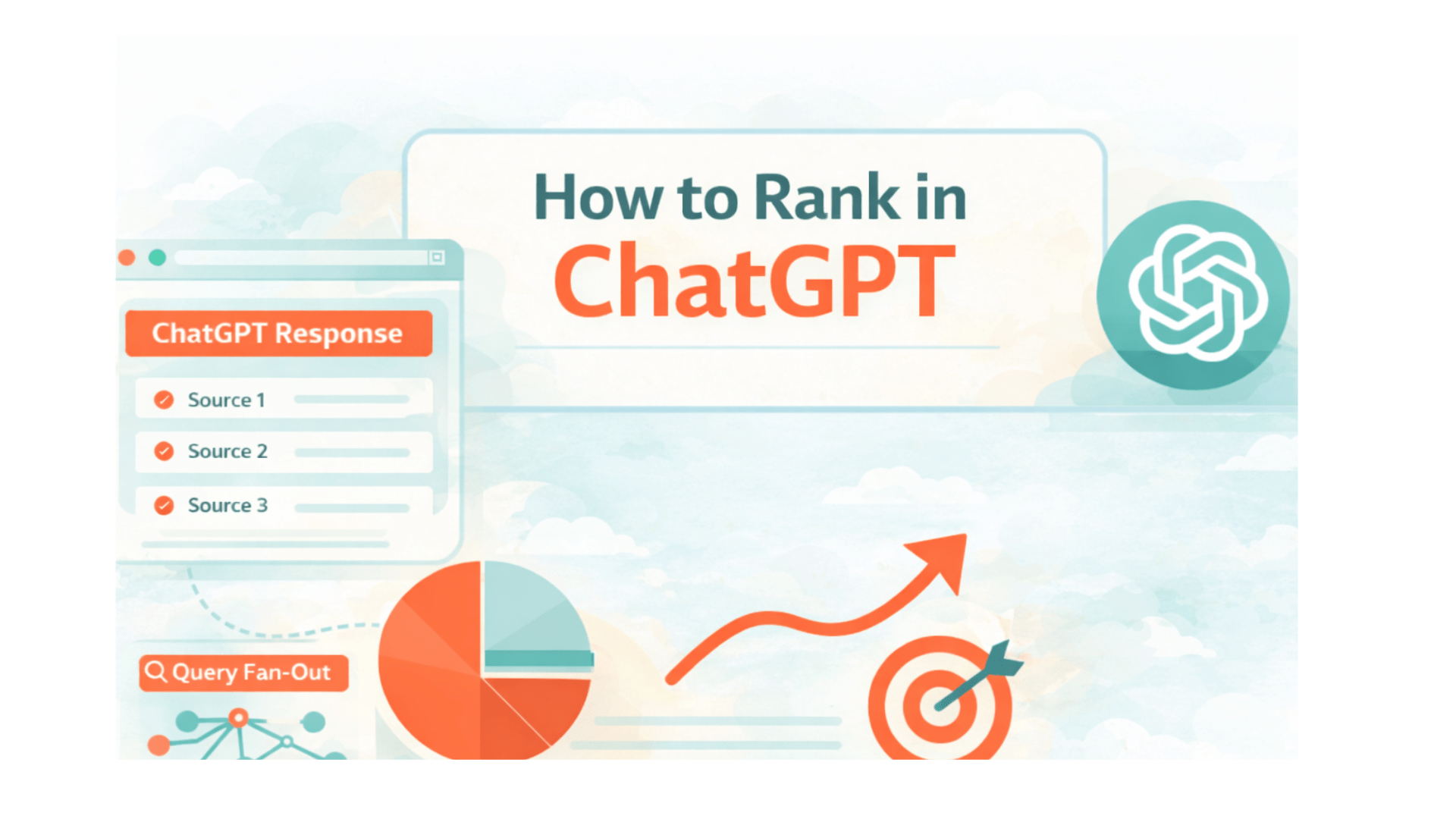
How to Rank in ChatGPT in 2026
AI search is no longer a curiosity. Tools like ChatGPT, Gemini, and Perplexity handle billions of conversational queries every month, and they are becoming the first place people go when they want answers, not links. That change rewrites how visibility works.
If you care about brand authority, trust, and incoming customer demand, appearing in AI-generated answers matters. This guide breaks down what ChatGPT SEO actually means, how ChatGPT finds and synthesizes web content, and the practical steps you should take to become a citable source in AI answers.
Key takeaways
Generative Engine Optimization, or GEO, means getting your content cited inside AI-generated answers, not just ranking on a traditional search results page. To appear in ChatGPT results you need content that is factual, well-structured, and clearly citable. Here is the technical requirement: be indexed by Bing, because ChatGPT’s live web search relies on Bing’s index as a primary source.
Build topical authority across the web, use clear structure and schema, and keep content fresh to increase the odds of being included in synthesis. Winning in GEO means changing your objective from ranking a page to being a trusted input the model chooses when it composes an answer.
What is ChatGPT SEO and why does it matter?
Generative Engine Optimization is the practice of making your content understandable, trustworthy, and citable for large language models that perform live web searches. The approach differs sharply from traditional SEO.
Traditional SEO optimizes for a ranked list of links. The business model revolves around click-throughs and page positions. GEO optimizes to be part of the answer itself. The model reads candidate sources, paraphrases them, and decides which ones to cite.
The business impact is substantial. When AI platforms cite your content, you gain brand authority at scale. Users trust cited sources, so you attract more qualified leads. Visibility grows even when users do not click through to your site.
How does ChatGPT find and rank information?
ChatGPT’s live web answers follow a two-stage process: Retrieval and Synthesis. Understanding both is the key to making content that gets cited.
Retrieval
When ChatGPT needs the web, it searches an external index for candidate sources. For ChatGPT’s live web searches, that index is Bing’s. If your pages are not discoverable by Bing, they will not enter the candidate pool. The retrieval stage favors recent, authoritative pages and returns a small set of high-relevance documents for synthesis.
Synthesis
Once the model has a pool of candidates, it reads and compresses the most credible pieces into a coherent answer. This stage is not about copying. The model selects facts, paraphrases them, and decides which sources to cite. It prefers concise, factual snippets it can reliably paraphrase and attribute.
Your content should make important facts obvious, verifiable, and easy to extract. Think of the process as a two-step assembly line: find candidates first, then compose the final result. You want your content to be both discoverable and easy to synthesize.
7 key strategies to appear in ChatGPT answers
The following strategies are the most important ways to improve your visibility in AI-generated answers. Each one is a practical area you can action this quarter.
1. Publish high-quality, citable content
AI models favor content that is specific, verifiable, and unique. Generic overviews rarely get cited.
Original research and data with clear methodology win citations. So do detailed how-to guides that include step-by-step instructions and sample outputs. Case studies showing metrics and timelines, complete with before-and-after results, perform well. Expert commentary and authored analysis that goes beyond raw facts adds value. FAQ-style sections that answer common user prompts in plain language are frequently pulled.
Thin takes and repurposed summaries offer no new facts. If your content doesn’t add something measurable or verifiable, it will likely stay invisible during synthesis.
2. Structure content for AI readability
Clear structure helps the model parse and extract information quickly. That improves your chance of being used in the synthesized answer.
Use descriptive headings that read like questions. “How long does X take?” works better than generic labels. Put the direct answer in the first sentence or two of each section, then expand. Models often pull the lead sentence for quick facts.
Break complex topics into short paragraphs and bullet lists to make facts stand out. Include tables, numbered steps, and callout boxes for critical numbers or definitions. Add schema markup such as Article, FAQ, HowTo, or Dataset to provide explicit context to crawlers and downstream systems. When the model scans a page, it is hunting for extractable facts. Make them obvious.
3. Build topical authority and trust signals
Ranking for AI synthesis is about topical authority and trust signals that extend beyond a single page. Demonstrate depth across your subject, not one-off posts.
Build clusters of content that cover the who, what, when, where, why, and how of a topic. Over time, that pattern tells models and indexes you are an expert. Earn backlinks and mentions from reputable industry publications and trade sites. Secure positive third-party reviews and testimonials on major platforms relevant to your niche.
Ensure author bylines include credentials. Where possible, create author pages with biography and links to other authoritative works. Publish repeatable datasets or tools that others reference and link to, like calculators, industry benchmarks, or open-source components. The model looks for corroboration across the web. The more independent signals pointing to your content, the higher your chance of becoming a cited source.
4. Make sure search engines can crawl and index your site
Because ChatGPT’s live web results rely heavily on Bing’s index, indexing is a hard requirement.
Submit your site and sitemap to Webmaster Tools and verify ownership. Keep an accurate, up-to-date XML sitemap and submit it to Bing. Remove accidental noindex tags and fix canonical issues that hide pages. Ensure robots.txt does not block important sections of your site. Monitor crawl errors and fix server or redirect problems promptly.
If Bing can’t see your content, ChatGPT probably won’t either. Treat indexing like hygiene: do it first, then focus on quality.
5. Update content regularly to stay relevant
AI models show a recency preference. Freshness matters for facts, stats, and best practices.
Set a refresh cadence for core pages: once per quarter for product pages, once per year for evergreen guides. When you update stats or examples, add a clear “last updated” date to signal freshness. Add short notes about recent changes in the industry or new data points instead of rewriting the whole page. Keep an eye on regulatory or standards changes and update legal or how-to content promptly.
Small, frequent updates beat infrequent major rewrites. Fresh signals make your content more attractive to retrieval systems.
6. Build authority through mentions and citations across the web
AI learns about brands from the whole web, not just your website. A distributed presence builds trust and signals authority.
Participate in community threads on relevant forums and provide useful answers with citations back to your content. Answer questions on Q and A platforms in full, helpful posts that others upvote or link to. Seek earned media placements and brief industry analysts with exclusive data or commentary. Find unlinked brand mentions and request proper attribution where appropriate.
The goal is to create corroborating signals that show multiple independent sources treat your brand as authoritative. That pattern of distributed mentions carries weight with retrieval systems.
7. Monitor what’s working and refine your approach
GEO is an ongoing practice. Measurement and iteration are essential.
Query ChatGPT and similar tools using the prompts your users might ask, and track whether your brand appears in the answers. Add tracking for referral traffic that originates from AI platforms where possible, and analyze downstream behavior. Audit which competitors the model cites, then reverse-engineer what those competitors do well and what you can improve.
Use internal analytics to track pages that show strong engagement metrics and build more content like them. Each model interaction is a small experiment. Over time you will see patterns and be able to prioritize the highest-impact actions.
Boost your AI visibility with Opositive.io
The tactics above are straightforward in concept, but executing them at scale is where most teams struggle. A specialized partner adds value. Opositive.io focuses on AI-led content creation and entity-based SEO that makes brands discoverable inside generative answers.
We design content to be citable, build topical authority across clusters of assets, and handle the technical work needed to ensure indexing and schema signals are in place. We also monitor the competitive landscape for which pages and domains models are citing, then adapt content strategy to win the synthesis.
If you want a pragmatic approach that combines creative content, technical SEO, and model-aware optimization, Opositive.io helps teams move from guessing to predictable, ad-free organic growth. Learn more about our AI SEO services or book a consultation to discuss a tailored plan.
What’s next for AI search
Search is becoming more conversational and answer-oriented, moving beyond simple keyword matching. Users expect short, well-sourced answers delivered when they ask a question conversationally. That shift favors content that is structured, factual, and clearly attributed.
Zero-click searches are rising, where users get the information they need directly from the AI result without visiting a site. Success metrics need to change too, from pure click numbers to branded impressions, downstream conversions, and assisted conversions.
AI is also integrating wider across platforms, which raises the value of a consistent brand narrative. If your explanation of a topic differs across pages and channels, models will find it harder to choose you as the trusted source. The smarter move is to own the canonical explanation for your domain and make it easy to extract.
So where does this leave marketers? Focus less on gaming a ranking position and more on winning the synthesis by producing authoritative, well-structured content, and by ensuring your signals are visible across the web.
Conclusion
Ranking in ChatGPT is not about tricks. It is about quality, authority, and structure. The model hunts for dependable facts it can synthesize, so make those facts obvious, verifiable, and easy to extract.
The shift to AI search is an opportunity for brands that adapt. Start by ensuring your site is indexable, publishing citable assets, and building distributed authority. Over time you can move from being invisible to being a trusted citation in the answers people see first.
FAQs
1. Will ChatGPT replace SEO?
No. SEO will change, not disappear. The objective shifts. Instead of optimizing only for ranked positions, you optimize to be a trusted source the model will cite. The fundamentals of good content, authority, and technical hygiene remain unchanged.
2. Can you use ChatGPT for SEO?
Yes, you can use ChatGPT as a research and drafting tool, but outputs need human verification. Use it to generate ideas, draft outlines, and test prompts, then add original data, expert input, and sourceable facts to make content citable.
3. How long does it typically take to see results from ChatGPT SEO efforts?
Expect a medium-term horizon. If your site is already indexed and you publish strong, citable content, you might see mentions in weeks to a few months. Building topical authority across multiple assets usually takes several months to a year.
5. Does traditional link building affect visibility in ChatGPT?
Yes. Third-party links and mentions are among the trust signals that help models and indexes assess credibility. Earning backlinks from reputable sources improves your chances of being included in the candidate pool.
6. Can ChatGPT cite information from non-text content like videos or podcasts?
Models can reference and cite transcribed content if the transcript or detailed show notes are available as crawlable text. Where audio or video lacks a text counterpart, it is harder for retrieval systems to extract facts.
7. Is it more important to optimize for ChatGPT or Google?
Optimize for both. Google remains a major traffic source, while AI platforms are an increasingly important discovery channel. The content that wins in AI search is often the same content that serves well in modern Google search too: clear, authoritative, and structured.
8. How do I track if my brand is being mentioned in ChatGPT?
Regularly run representative prompts in ChatGPT and similar tools and note whether your brand or pages are cited. Supplement that with monitoring for brand mentions across forums and news sites, and track referral traffic that may originate from AI-driven sources.