How to Win the People Also Ask Box for Your Target Keywords
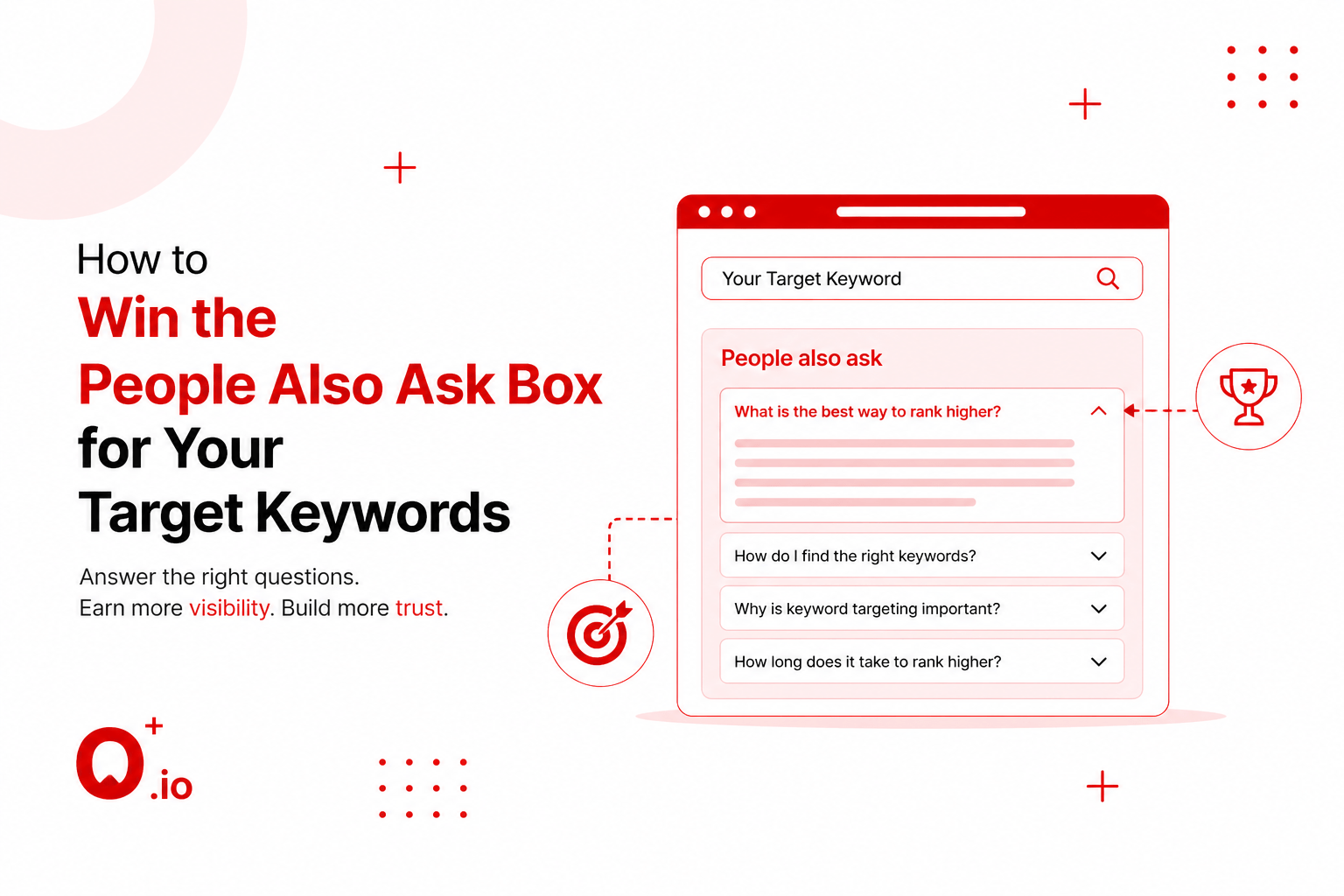
Google pulls brief answers directly into the SERP using a dynamic feature known as the People Also Ask box. When users click an entry, the list expands to show more questions, and the set often shifts to match new intent. Searchers don’t have to click through to a website to find info. One click triggers a waterfall of options.
PAA gets attention because of its central location. It will help your site stay visible.
Landing in these boxes can make a brand look like an expert. It isn’t necessary to hold the top organic spot to earn traffic if Google chooses your text for the snippet. This guide outlines a PAA ranking strategy to assist you. These steps also support AEO and help build topical authority by connecting your pages.
What is the ‘People also ask’ (PAA) box and why does it matter for PAA SEO?
Google uses PAA boxes to hand out quick answers for related queries. If a user taps on a question, they see a short text snippet and a link to the original source. Each click adds more questions to the bottom of the list. It’s like an endless scroll of information that keeps updating as you’re engaging with it.
- People can dig into a topic or sharpen their search intent without ever leaving the page.
- Since these boxes take up prime space, brand visibility usually gets a bump.
- A direct answer makes it more likely that you’ll see users click through for details.
- By appearing for common questions, your business starts looking like an authority.
- You don’t have to rank first in organic results to win this spot, so it’s a clever way to get traffic.
How google selects and ranks answers for PAA snippets
To pick the right text, Google hunts for short, expert-level answers that fit what people ask. Its systems scan for organized layouts and topical depth before pulling a specific sentence. Formatting beats fancy writing. If you use lists and brief paragraphs, you’ll make it simpler for the search engine to grab your content.
It’s often true that PAA and Featured Snippets share some DNA.
Because both prioritize clear facts right under a heading, your strategy for one usually helps the other. It is best to target a length between 40 and 60 words. This sweet spot ensures your text is long enough to provide value but short enough so Google can extract it easily.
A strategic framework for your PAA ranking strategy
Targeting PAA works best as a routine rather than a random test. Below are the steps for building a repeatable program with concrete actions you can apply.
Step 1: Discover high-impact PAA questions
Scan results for your main search terms to see which questions appear in the PAA box. These show the exact phrasing Google likes right now.
- Look at the results pages for your main search terms to see which questions appear in the PAA box.
- Keyword research tools or scraping software can help you gather long lists of these questions.
- Site search logs and support tickets help you find questions that match what your customers actually need.
- Focus on questions related to buying or fixing things since they often lead to sales.
- You should pick the questions you have the resources to answer well based on how hard the competition is.
Step 2: Structure content for answer extraction
Readers need to find the info easily. If you make it simple for them, Google has a better chance of grabbing your text for the snippet too.
- Put the exact question into an H2 or H3 heading.
- Writing a clear answer of about 40 to 60 words right after that heading is the standard.
- Lists or tables are usually better than blocks of text for comparisons.
- Add more detail or specific examples in a new paragraph for anyone who wants to keep reading.
The following is an example of a Q&A pair.
Q. How long does delivery take for standard shipping?
A. Standard shipping takes 4 to 7 business days, depending on your region, with tracking provided at shipment. If you need faster delivery choose expedited at checkout.
That direct answer gets the job done. You can then go into detail about shipping zones or exceptions later on.
How to monitor and refine your PAA SEO performance
Watching how these efforts pay off means looking at search results and your own site data. You need to know if these spots are actually bringing in traffic.
Use Google Search Console to keep an eye on how many people see and click your pages. If you see a big change after you edit something, pay attention. Rank trackers that show PAA features can also tell you which questions you currently hold across your keywords. Update your answers if your policies or product facts change so they stay accurate.
Try different things out. You might change a few words in a heading or turn a paragraph into a list to see if Google likes it better. Small changes often make a big difference in who wins the spot.
How PAA optimization strengthens topical authority and AEO
When you tackle a group of related questions, you show search engines that your site understands a subject deeply. This kind of depth is what creates topical authority. It is not just about one page. You need to build a PAA presence that is a hub for the specific things people ask. If you have multiple pages answering these connected queries, Google often starts to see your whole domain as a trusted expert. For AEO, search engines and voice assistants look for quick, blunt answers.
PAA optimization makes your content ready for AI overviews.
You don’t want to be a one-hit wonder with snippets. By giving users the exact answers they need, your brand can become the main source for a whole topic.
Conclusion
PAA optimization is more than just a side project. It’s become a central part of any search plan since it links visibility with what users actually want. By providing quick answers, you capture traffic that others miss.
Focus on the basics.
Look for relevant questions and write answers that are now easy for search engines to pull. Once you have a working method, apply it across different topics. Doing PAA SEO correctly helps people find what they need while building your site’s authority. This approach pays off as search engines prioritize direct answers.
FAQs
1. What are ranking questions?
Ranking questions are the specific queries you type that make search features like PAA or featured snippets appear on your screen. Google looks for these phrases to match them with quick, helpful answers that solve a problem fast. You can find them by looking at search results or checking your site logs for common patterns.
2. What is the difference between PAA and a Featured Snippet?
People Also Ask boxes show you a list of related questions that expand when you click them. Featured Snippets are different because they pull one single answer and put it right on top of the page. While both like short text, snippets stay static while PAA lets you keep digging into new topics.
3. Can a single webpage appear in both the organic results and a PAA box?
Yes, this happens quite a bit. Your page can show up in the normal results and also be the source for a PAA answer.
Getting that double spot is great for your traffic. When people see your website twice on the same page, they often think you are an authority on the topic and trust your brand more.
4. Does using FAQ schema markup guarantee a PAA ranking?
No. Using FAQ schema just helps search engines understand your questions and answers better. It might make your site more likely to show up in a search feature, but it is not a promise. The quality of your writing and how you organize the page still matters more than code.
5. How do you track traffic and performance from PAA snippets?
You should check Google Search Console to see how many people see and click your pages through these questions. It’s a good idea to use other tools to track where you stand in the rankings too. Look at how people behave once they land on your site to see if they convert.
6. Should answers for PAA boxes be updated over time?
Yes, you should keep them current.
You should update your answers if the facts change or if you change your products. Search habits change too. If you keep your answers fresh and right, you have a better chance of keeping that spot and getting more people to visit your site.
7. Can videos and tables appear in PAA boxes?
Yes. Google pulls text from your pages even if you have videos or tables on them. Sometimes the search engine even uses a row from a table or a specific time in a video to give someone a better answer. Most of the time, though, it just looks for simple text that is easy to read.
8. Are PAA results the same for every user or do they change?
They change. The box you see depends on where you are in the world and what kind of phone or computer you’re using. Even your past search history can change what pops up. The results you get might be different from what your friend sees a few minutes later on their own device.

Mansi Jain
Senior AI SEO Specialist @ Opositive.io
GEO, AEO & LLM Optimization Specialist · 6.5+ yrs Technical SEO
About Mansi
Mansi Jain is a Senior SEO Specialist with 6.5+ years of experience in technical SEO, content strategy, ecommerce SEO, and AI-powered search optimization. At Opositive.io, she helps businesses improve their visibility across traditional search engines and emerging AI platforms through data-driven SEO strategies.
Her expertise includes technical audits, keyword research, schema implementation, content clustering, and AI SEO (GEO/AEO). Passionate about staying ahead of search trends, Mansi shares practical insights and actionable strategies that help marketers, founders, and businesses achieve sustainable organic growth.
“Practical, data-driven SEO that helps businesses grow sustainably across both traditional search and AI platforms.
Specialization
Technical SEO, Ecommerce SEO & AI SEO (GEO/AEO)
Education
B.Tech, Information Technology
College of Technology and Engineering, Udaipur · 2015 – 2019
Experience
Senior SEO Specialist, Opositive.io
3+ years at Opositive · 6.5+ years in SEO & AI-powered search
Skills
Technical audits, keyword research, schema, content clustering