What is Topical authority in SEO and How to Build It in 2026
Search engines once focused mostly on specific keywords and backlink counts. Those days are gone. Now, the systems favor websites showing actual depth on a specific subject rather than just having a few pages that rank well. It’s a shift toward quality over quantity. Don’t expect the old tricks to work anymore.
Building topical authority changes the strategy.
Rather than tweaking many disconnected pages for single terms, you’re building a content network answering every likely question about a theme. You’ll get better rankings and more trust. This guide breaks down what topical authority in SEO is and how you’ll build it. Moving from random wins to steady organic growth starts here.
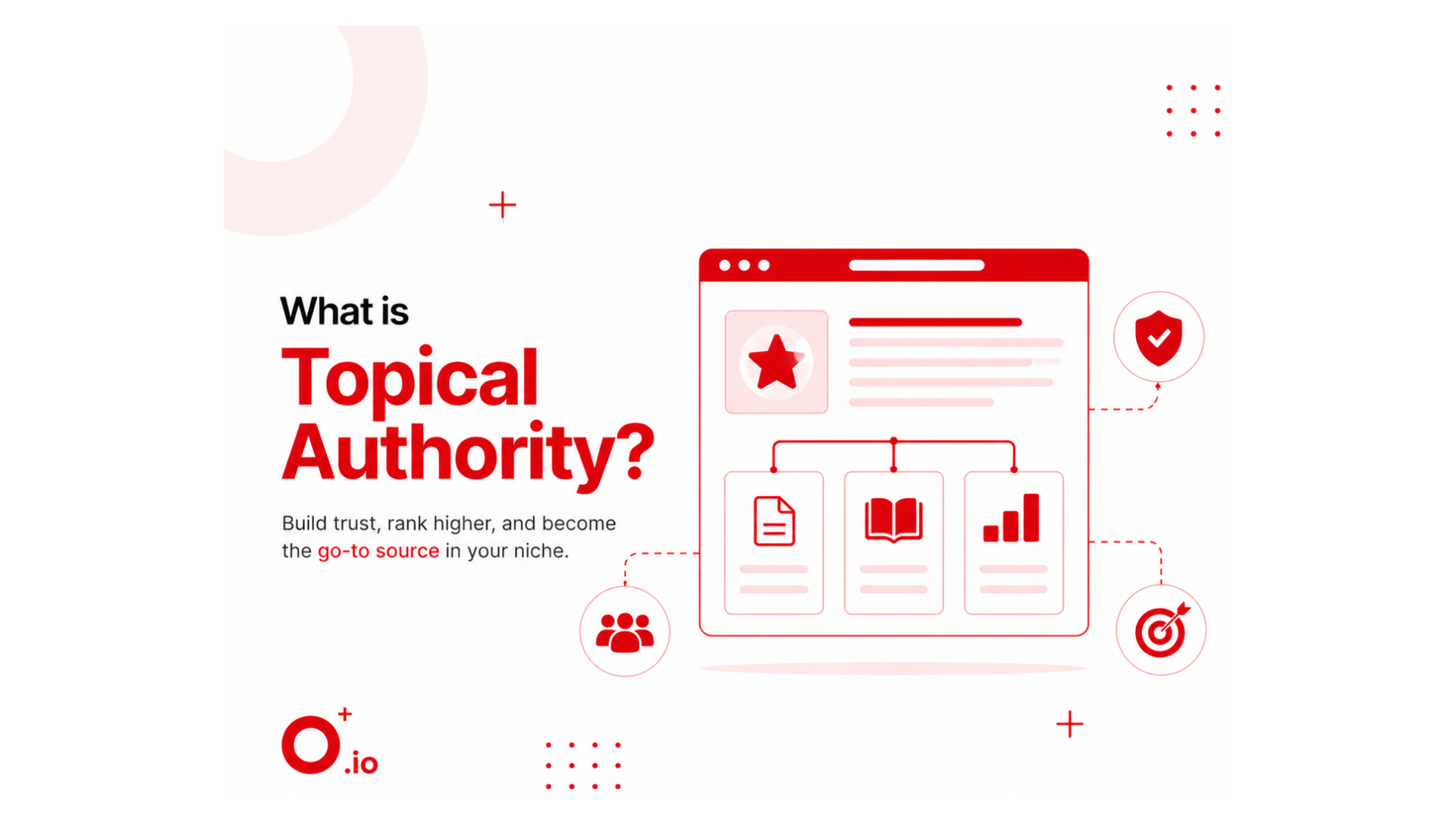
What is topical authority in SEO?
Search engines recognize topical authority when a website shows real expertise on a specific subject.
Picture your site as a library. Older strategies might focus on one book about espresso machines, but this approach turns your site into a full resource on coffee. You’ll offer many books that index well and link together. Since search engines want full answers, they’ll pick the library over a single book. It’s simply more useful.
You build topical authority by writing detailed content that covers every angle. This involves answering basic questions and fixing advanced problems. Linking related concepts doesn’t just help users. It helps algorithms see your site as the primary resource.
Owning the conversation is what topical authority in SEO’s all about.
Why topical authority matters for modern SEO
- Google’s rewarding expert pages. As its Helpful Content System prizes real knowledge, deep coverage pushes your visibility much higher.
- You’ll likely see better rankings for many related terms. Building a topic cluster helps every page so you don’t fight for single keywords.
- Trust builds up over time because accuracy matters, and since answers are right, they’re likely to stick around. Readers often turn into loyal fans.
- Smaller sites beat the giants. When search intent’s specific, depth’s the winner. A niche brand with a topic cluster outranks a generalist.
- An SEO moat isn’t built overnight. Since these networks take time to grow, competitors can’t just copy them.
- This method proves your E-E-A-T. Experience shows through the depth of your writing. It’s a real plan for topical authority.
Topical authority vs. Domain authority: what’s the difference
SEO tools use Domain Authority (DA) to guess how well your site ranks. It is mostly about your backlink profile and how long your domain has existed. Basically, it predicts your general performance across search engines.
Does your site own a specific niche? Topical authority measures that depth. You build it through content breadth and internal links that show you understand what users want.
The real distinction matters. While DA looks at overall popularity and link equity, topical authority focuses on how well you cover a single subject. Think about a massive news site. It might have a high DA, but it often doesn’t have the specific expertise of a tiny coffee blog that writes about nothing but specialty brewing. The smaller site often wins on relevance.
| Attribute | Topical Authority | Domain Authority |
|---|---|---|
| What it measures | Depth and breadth of content on a specific subject | Overall site strength and backlink profile |
| Primary signal | Full content coverage and internal linking | Backlink quantity and quality |
| How it’s built | Topic clusters and pillar pages | Link building and domain age |
| Competitive advantage | Niche dominance for related searches | General ranking potential across many topics |
How to build topical authority step by step
Building topical authority feels more like training for a long-distance race than a quick sprint. This framework helps you plan a strategy for sites of any size, whether you manage a tiny five-page blog or a massive portal. A clear approach ensures your effort actually helps your search rankings.
You can follow these specific phases:
- Look for phrases that cover the whole subject area.
- Using a main pillar and smaller clusters helps organize the site.
- Detailed articles that show off actual knowledge are best.
- A map for how your pages link together is helpful.
- Give older articles a regular tune-up.
Step 1: Conduct topic-based keyword research
The goal is to find every question or side topic a reader might think of. Why does a person click from one article to the next? Instead of just looking for one high-traffic term, you are mapping the path a visitor takes.
Several practical tasks help with this:
- Start with a broad seed term like ergonomic office chairs or light roast coffee to define the territory.
- Research tools can turn that big idea into a web of specific questions based on what people want.
- Check the “People Also Ask” boxes on Google to see the phrasing real people use.
- Looking at what other websites are saying helps you find the parts they missed.
- Create a main document to track categories, reader intent, and how you will prioritize each page.
This work results in a map of what users need based on intent rather than just a long list of words. It is basically a blueprint for the whole site.
Step 2: Structure your content with pillar pages and topic clusters
Group the different parts of the website before you start the writing process. Many people suggest a hub and spoke model.
- Pillar pages act as the main guides that give a high-level summary and link to more specific details.
- Cluster content involves deep-dive articles that answer one narrow question or solve a small problem.
Hub and spoke model
- The hub is a central point that ties all the related pages together.
- Each spoke focuses on one detail and links back to the main page.
Each spoke needs to point back to the pillar, while the pillar should link out to every active spoke. This setup tells search engines how the topics relate and makes it easier for people to find their way around. By making these connections, you show that you covered the subject from every angle.
Step 3: Create in-depth, authoritative content
Content creators should stick to these standards:
- Try to build the most helpful page on the internet for the specific sub-topic.
- Using your own data or frameworks helps the content stand out from the crowd.
- Write for every part of the user journey, from simple definitions to product comparisons.
- Focus on fixing the actual problems that readers face in their daily lives.
- Visual aids like charts or short clips keep people interested and help them learn faster.
- Break up long blocks of text with headers so the main points are easy to see.
A few high-quality pages will help your seo topical authority much more than dozens of thin posts. Quality is the part that matters. The process doesn’t need to be more complicated than that.
Step 4: Build a strategic internal linking plan
Links are the tissue that makes a topic cluster easy for search engines to read.
- Ensure every cluster article has a link pointing back to the main pillar.
- The pillar page should point out to every related cluster piece you have published.
- Connect two cluster pages if the information naturally overlaps.
- Descriptive anchor text explains what the reader will find after they click.
- Link from popular pages to new ones so they get noticed more quickly.
A few basic rules help keep things in order:
- Two-way links usually work better for visitors than simple one-way paths.
- Limit how many links you put on a page so each one has a purpose.
- Check your anchor text every now and then to make sure it still makes sense.
Step 5: Regularly audit and refresh your content
Authority isn’t something you keep forever without work. It needs upkeep because facts change and readers ask new questions. It is smart to set aside time to check your pages.
Begin your review with these specific tasks:
- List your cluster articles and find any that haven’t been updated in a year.
- Check your data and examples to see if the numbers are still right.
- Combining two pages is a good idea if they cover too much of the same ground.
- Expand your articles by adding answers to new questions that are becoming popular.
- Track the performance of the whole group of pages instead of just one or two top ones.
Small updates over time lead to bigger gains in authority. Content refreshes should happen every few months.
How opositive.io’s AI-driven strategy unlocks SEO growth
Mixing hard data with creative thought builds real topical authority. If you are mapping a whole topic ecosystem, deep research and a steady page flow are necessary. AI finds gaps. Then, it’s grouping keywords into a topic cluster based on actual search habits. By using live results, you’ve built hub and spoke links that don’t feel forced. The Queen+ Content Hub doesn’t let quality drop even when publishing many articles.
Automation isn’t just a guessing game.
While editors are still key, AI points to the topics that need attention first. This turns a search for topical authority into a plan you’ll repeat.
Common mistakes that hurt topical authority in SEO
- Stray posts that deviate from your defined topic cluster can impair site performance. Traffic often dips when content ignores the main map.
- Stop publishing thin pages. Clicks vanish when readers don’t find the depth they need.
- By linking related articles together, you ensure readers do not lose the thread of your topical relationships.
- Forget chasing only high-volume phrases. Long-tail queries often drive conversions.
- Freshness counts. Your authority might drop if you let old posts sit untouched.
How to measure topical authority
Assessing your standing requires looking at multiple signals.
- Monitor how different keywords in a topic cluster move as a group. If you see movement across the board, it’s a better sign than one high-ranking word.
- Aggregate traffic across a content group tells a better story than one lone URL. If total volume climbs, the whole group is gaining power.
- Use an SEO tool to compare your search share against what rivals are getting.
- When other sites link to your topic cluster, they’re giving you a digital thumbs up. These mentions prove you’re a source of truth.
- Look at your bounce rates. If visitors stick around and return later, your coverage is likely hitting the mark.
Check these stats every month. If numbers don’t budge, fix your internal links or add more detail.
Conclusion
Gaining topical authority takes time and does not happen with a quick win. Rather than treating pages as isolated islands, you should view your site as a living ecosystem. It’s about choosing depth over fast results. When you build a full web of connected articles, you create something people trust. Search engines notice this. This trust is a real edge because competitors can’t copy it overnight.
Just map the subject first.
Build pillar pages and cluster content while treating internal links and audits as regular chores. Do this work to stop fighting for one keyword and start owning the niche.
FAQs
1. What is a topical map in SEO?
A topical map is basically a content blueprint for a website. It covers every subtopic, common question, and format tied to your main subject. By grouping keywords based on what users want, you can see how pages link together. This plan keeps your links organized so search engines understand your site structure. Think of it as a guide that ensures you don’t miss any part of the conversation.
2. What is topical relevance in SEO?
This concept describes how well your page matches what a searcher is looking for. It is a mix of depth and context.
If your content answers a topic in full, your site gains a stronger reputation with search engines. This leads to much better rankings because you provide the exact value the user is seeking. It’s about being the best answer available.
3. What is the SEO authority?
Authority is the trust your site builds with search engines over time. It comes from quality backlinks, user time on page, and your overall topical coverage. Expertise in one specific area is also very common for smaller players who want to stand out.
4. What are the 4 types of intent in SEO?
Search intent usually falls into four buckets which are informational, navigational, commercial, and transactional. You need different content for each one. For example, a how-to guide helps someone looking for info, while a comparison page helps someone ready to buy. It is about matching your page to their specific goal at that moment.
5. How long does it take to build topical authority?
You probably won’t see results overnight. It typically takes a few months to a full year to see a real change. This timeline depends on your competition and how much quality content you can produce.
6. Can a small website build topical authority to compete with larger sites?
Yes, you definitely can. By focusing on a narrow niche and going deeper than anyone else, your small site can beat out giant competitors. Search engines value expertise. If you provide original insights, you create influence that scales fast. Depth often matters more than having thousands of pages on unrelated topics. Expertise wins.
7. Do you need backlinks to build topical authority?
While backlinks are helpful, they are not the only thing that matters.
If you build a solid structure with great content, you’ll earn links naturally. Good coverage can help you establish your presence even before you have a massive backlink profile. They speed things up.
8. How often should you update content to maintain topical authority?
Aim to check your cluster content every six to twelve months. If you work in a fast-paced field, do this more often. Look for pages where traffic is dropping or data feels old. Keeping things fresh ensures your site stays useful for your readers and holds its spot in search results.