What is TL;DR in SEO and how does it help you ace AI Overviews
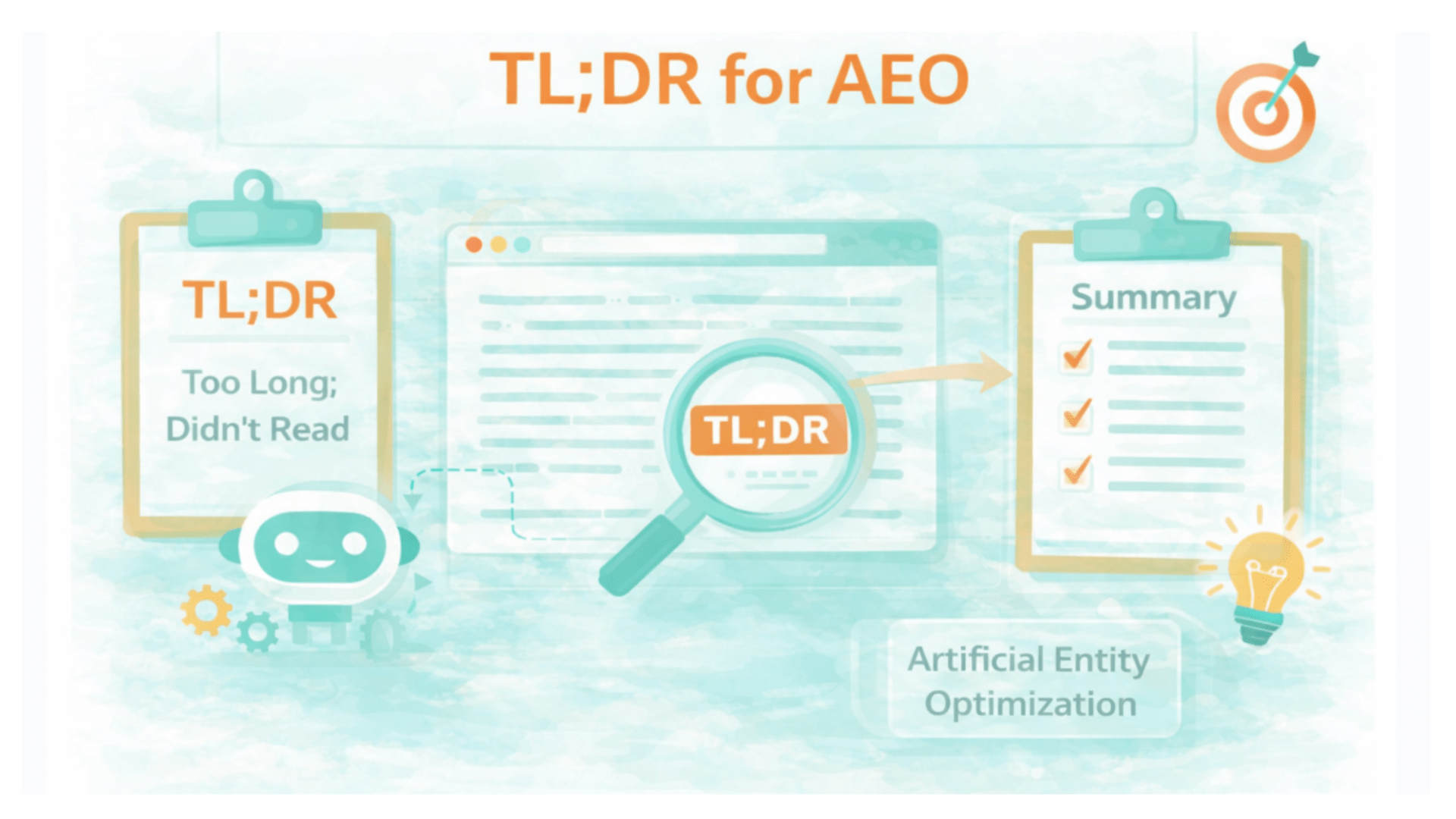
“Too Long; Didn’t Read” began as a lazy reply in forum threads. Today, TL;DR in content is a real strategy. What is a TL;DR in SEO? It is a brief summary placed at the page top. This helps readers and bots understand the main point in seconds. Instead of a gimmick, it’s a tool for better readability.
Because attention spans are shrinking, search engines favor quick answers over basic links. Google’s AI Overviews search for small text blocks to pull into results. A solid summary helps both people and machines. This increases the odds of your page appearing in those generated boxes. If you use TL;DR SEO for AI, you’re giving crawlers the data they need. Plus, it helps with TL;DR SEO by keeping visitors on your site longer.
Next, we’ll explain how TL;DR for AEO works and how to write one that gets cited. You will find advice on length, where to put it, and mistakes to skip.
Key Takeaways
- If you ask what is a TL;DR in SEO, it’s a 50 to 80 word recap (too long; didn’t read) that sits at the top to give people facts fast.
- These snippets improve your TL;DR SEO for AI and your overall TL;DR SEO because they feed Google’s AI Overviews and lift engagement.
- Stick that summary right after the intro and don’t forget a primary keyword to answer the reader’s question.
- While you focus on a TL;DR in Content or a TL;DR for AEO, you should keep the language simple so dense text doesn’t hurt your site’s visibility.
What is a TL;DR in SEO?
A TL;DR in SEO is a short summary that gives readers the main answer immediately.
People once used “Too Long; Didn’t Read” to skip over long articles, but today, it is a way to help your audience find facts fast. You don’t want them to hunt for details.
In many cases, a TL;DR in Content sits in a box to summarize advice. Depending on the topic, you might use a few bullets or a quick paragraph. This is a key part of TL;DR SEO for AI and TL;DR for AEO. Since the goal is to provide a self-contained answer, knowing what is a TL;DR in SEO makes your site much more helpful.
Why does a TL;DR matter for AI Overviews and AEO?
Most search engines want data their crawlers can parse without effort. For many sites, TL;DR SEO for AI is a fast track for these crawlers.
- Citations increase when you simplify data extraction. Since bots hunt for quick answers, a summary provides the exact quote they need.
- Prioritizing answer engines is key. To master TL;DR for AEO, you have to be the trusted source. You’ll do this by leading with your main point. Do you monitor your snippets?
- Usually, engagement stays high when you cut the fluff. Readers don’t want to dig through filler. When you value their time, your TL;DR SEO signals improve.
- Brand representation is protected through summaries. Controlling the summary stops an AI from pulling a confusing sentence. We’ll decide what the message says.
How to write an effective TL;DR for SEO
Often, TL;DR SEO helps people find fast answers instead of scrolling through every single long paragraph of text.
Keep it concise and insightful
Quick answers save time. When you’re writing your TL;DR SEO for AI, think of it as a fast note to a coworker who’s stuck in a meeting.
- Try to stay under 80 words or use a couple of short lines.
- Give them a real tip instead of a repeated headline.
- Plain language helps if you don’t use jargon.
- Active verbs show readers exactly how to get a better TL;DR in Content.
Prioritize strategic placement
Right after the opening paragraph, place your summary. It’s a move that helps readers get fast answers. This early spot also provides the clear signal needed for TL;DR SEO for AI. Even though some writers put summaries at the bottom, that tactic doesn’t usually work for TL;DR for AEO. Generally, bots won’t grab info from the bottom of a page to find quick answers.
Label the section with something simple like “Key takeaways.” By doing this, humans and search engines will likely see the block as your main summary for TL;DR in Content.
Incorporate keywords naturally
Putting a primary keyword into your TL;DR naturally is key. It helps search bots and humans quickly see exactly what the page offers without any guesswork.
Don’t overdo it. If the content targets TL;DR SEO for AI, answering the user directly often boosts visibility. Since AI Overviews favor clear summaries, this direct approach usually saves your readers from hunting for answers they need.
Align with search intent
Effective TL;DR SEO usually answers questions fast. Before drafting, see how others win snippets and what users actually type. If a reader wants information, don’t make them wait. They will need that definition immediately. For buyers, the main benefit should come first. Being direct helps an AI find and cite your content.
Common mistakes to avoid with TL;DR sections
Messing up your summary is a fast way to hurt your TL;DR SEO and lose reader trust. These mistakes happen all the time. Still, you can avoid them with a bit of focus.
- Give people real answers they can use right away rather than a dry list of topics.
- You should skip the long, rambling paragraphs since they defeat the purpose of a quick recap.
- Don’t force keywords or awkward sentences into the text just to try and trick search engines.
- It is a bad idea to hide the section at the bottom of the page or call it something weird.
- Each time you edit the main body, check that your TL;DR in content stays accurate.
| Don’t | Do |
|---|---|
| Using vague lines like “This post covers X and Y” | Stating facts like “X cuts load times by 40 percent” |
| Jargon that makes people close the tab | Plain words your readers actually use |
| Forcing too many keywords into a tiny space | Letting the main term sit naturally |
| Hiding the summary at the end of the post | Placing it after the intro with a clear name |
| Leaving old info in the summary after edits | Updating the recap with every single change |
Structuring all content for AI visibility beyond TL;DR
A summary is just the surface level. To make your TL;DR SEO for AI work, you have to scatter main points through the entire page. Machines need to see a pattern of facts to trust your data.
Organize your TL;DR SEO text with one H1 and several H2s.
Lists and tight paragraphs make your work easier to scan. Bullet points provide clear data that machines parse without effort. Cut the fluff. If you are explaining what is a TL;DR in SEO, you might need a longer sentence, but brevity usually wins. The goal is making the point and moving on. Don’t waste time on flowery intros.
Schema helps provide context. Article and FAQ markers give bots the roadmap they expect. By using FAQPage schema, you clarify your TL;DR in Content.
Stick to the facts. If you cite a number, prove where it came from. Credibility matters to AI models because they tend to pick sources that show the math and provide clear evidence for their claims.
Write in modular blocks. Dividing an article into parts lets an AI extract info faster. Placing a summary under H2s improves your TL;DR for AEO.
Conclusion
TL;DR sections aren’t just optional extras. They offer readers a fast way to digest your information. When you optimize a TL;DR for AEO, you provide AI systems with the clear answers they’re looking for.
Expect more citations as a result. Aim for a 50 to 80 word summary right at the top. Being fancy doesn’t work as well as plain talk. Because search engines use these blocks to pull facts, TL;DR SEO for AI helps you claim credit for your data. Review best pages to add summaries where they are missing. Using brief headings and schema helps too.
FAQs
What is TLDR in marketing?
For marketing teams, a TL;DR in content gives a quick recap of reports or campaigns. To help you prioritize tasks, we use these snippets. Speed wins. Since they simplify the message, you’ll find that sharing the point becomes much easier.
What does AEO stand for?
To succeed with AEO, you must format content so AI bots can cite your work. A TL;DR for AEO helps engines pull data for answers. Simple. It’s usually about schema and authority. Data shouldn’t be too complex.
Can TL;DR help in multilingual SEO?
By adding a TL;DR in content, you won’t let readers and bots get lost. Translators find brevity easier. Since simple text works, machine tools don’t struggle and summaries remain useful. This usually improves rankings across every language.
What is a TL;DR in SEO
Search engines might find clear answers faster with a TL;DR in content. Using this summary often improves your odds for featured snippets. Before choosing, Google still checks page context and authority, even if it helps your TL;DR SEO for AI.
How does a TL;DR impact voice search SEO?
Voice bots don’t want long, rambling talk. Because they’re searching for quick answers, a TL;DR for AEO typically helps assistants grab facts fast, so your site’s visibility might grow. It’s best to write like you’re talking.
Isnt using ‘TL;DR’ in a professional article considered rude?
It is not always that way. Your readers usually decide our tone. While tech groups like TL;DR in Content, formal sites prefer Quick Answer. Both help TL;DR SEO for AI and don’t confuse bots.
What are some good alternatives to using the ‘TL;DR’ label?
Try “Quick Answer” as a heading. Humans and bots do not miss a clear TL;DR SEO when you use tags. That’s efficient.
Should the TL;DR be updated if the main article content is significantly changed?
Refresh your TL;DR SEO for AI when findings change. Stale summaries fail. If you don’t, bots often scrape wrong data and mislead your readers.
Can a TL;DR be effectively used for e-commerce product pages?
Stick a summary at the top of each product page. Shoppers don’t need to dig for benefits or the buy button. Because this TL;DR SEO for AI strategy feeds bots specific facts, they get clear answers. It’s a fast fix.

Mansi Jain
Senior AI SEO Specialist @ Opositive.io
GEO, AEO & LLM Optimization Specialist · 6.5+ yrs Technical SEO
About Mansi
Mansi Jain is a Senior SEO Specialist with 6.5+ years of experience in technical SEO, content strategy, ecommerce SEO, and AI-powered search optimization. At Opositive.io, she helps businesses improve their visibility across traditional search engines and emerging AI platforms through data-driven SEO strategies.
Her expertise includes technical audits, keyword research, schema implementation, content clustering, and AI SEO (GEO/AEO). Passionate about staying ahead of search trends, Mansi shares practical insights and actionable strategies that help marketers, founders, and businesses achieve sustainable organic growth.
“Practical, data-driven SEO that helps businesses grow sustainably across both traditional search and AI platforms.
Specialization
Technical SEO, Ecommerce SEO & AI SEO (GEO/AEO)
Education
B.Tech, Information Technology
College of Technology and Engineering, Udaipur · 2015 – 2019
Experience
Senior SEO Specialist, Opositive.io
3+ years at Opositive · 6.5+ years in SEO & AI-powered search
Skills
Technical audits, keyword research, schema, content clustering