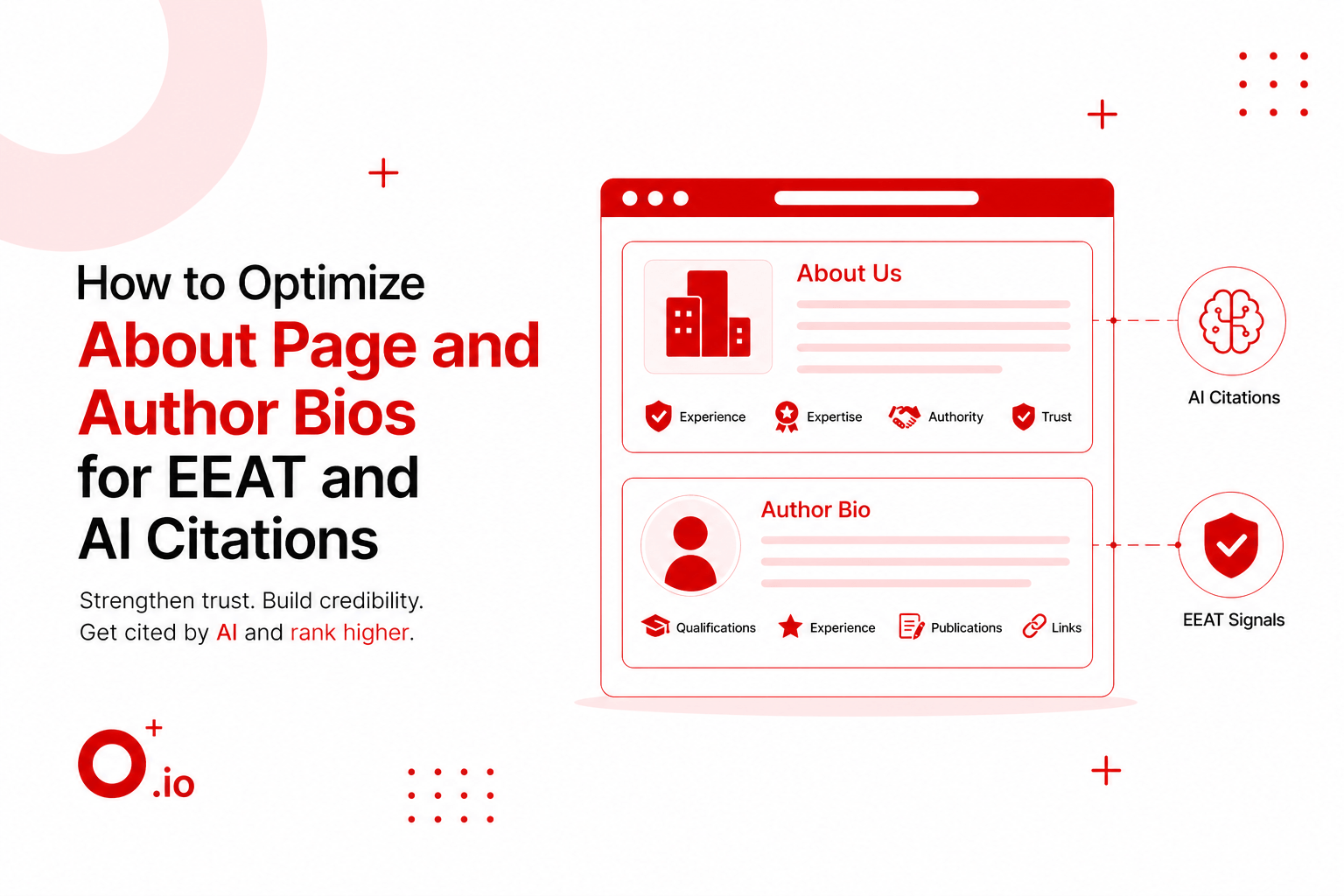
How to Optimize About Page and Author Bios for EEAT and AI Citations
Keyword density hasn’t satisfied search engines for a long time. Instead, they’re looking for proof over promises. Modern algorithms and AI overviews don’t just count your headings because they’ll want to know if you actually understand your topic. Is your site trustworthy?
Google uses the shorthand EEAT, which stands for experience, expertise, authoritativeness, and trust. You will want to start by building author and publisher entities if you’re looking for visibility that lasts through algorithm updates. This guide provides a plan for EEAT optimization. It covers author bio SEO and about page optimization to help you create content AI can cite so you’ll get real citations and authority.
What is EEAT optimization, and why does it matter for AI search?
EEAT refers to Experience, Expertise, Authoritativeness, and Trust. You can think of it as standards Google uses to see if your content is reliable and who is behind the keyboard. It helps search engines evaluate whether your content is credible and backed by real expertise.
- Experience comes from having first-hand knowledge and showing you have done the work. Include original case studies, stories, or photos to prove you aren’t just repeating others.
- Expertise is the depth of knowledge a creator shares. Your certifications, published works, and deep dives help you signal that you are a master of the subject.
- Authoritativeness depends on your reputation. When you get backlinks from sites people trust or mentions in major outlets, you become a recognized voice that others listen to.
- Trustworthiness involves being honest about your data. To build this, you need a secure site, contact details, and editorial policies that show you check your facts.
How does this change things for AI search? Generative features pull answers from many places. They lean toward content that is easy to verify. This helps both bots and humans see that your pages are worth quoting.
How to optimize your author bio and about page for SEO
Search engines look at your author bios and About pages to figure out who’s actually responsible for your writing. These sections offer a direct path to establishing a clear author entity and a publisher that people can actually trust. You should treat these pages as your most important assets rather than just chores to finish at the last minute.
Building entity authority through author bios
While many sites overlook the bio section, it usually performs three specific tasks. It identifies the writer, proves they have topical expertise, and links them to other signals found elsewhere on the internet. You can start with a short sentence that says who you are and why you have the right to speak on a subject. The technical assessment of authorship relies on verifiable data points.
- Include a clear and professional headshot for each writer. Since faces often help build trust, using the same photo across different platforms helps search engines recognize the person.
- You should list your specific degrees, certifications, and how many years you’ve worked in the field. Adding details about major projects or job titles helps you avoid making claims that sound too vague.
- Provide links to your social media profiles on sites like LinkedIn or X and mention any other sites where your work appears. These links act as a digital trail that helps systems verify your reputation.
- Creating a unique bio helps you show off your actual experience. Mention a specific problem you solved or a client you helped, because a short claim without any proof won’t help your EEAT scores much.
- Use Person schema markup to link your identity to the articles you write. By using structured data for your name and affiliations, you make it easier for machines to connect your profile across the web.
Every author page needs to be indexed and linked from the byline of your articles. Updating these bios regularly ensures the details stay fresh for your audience. Stale information might hurt your standing with both readers and search bots. Author bios should be actively maintained and updated to reflect current expertise and credentials.
How to optimize your About Us page for trust signals
Your About page is the place where you prove to search engines that your business is real. Your About page should be structured for both human trust and machine readability.
- Write out your company history and your core mission. You can include founding dates and the specific problems you solve to give your brand more context for readers.
- Mentioning your key team members with links to their individual bios is also helpful. This helps systems track who is responsible for different parts of the website.
- You must provide a physical address and direct ways to contact you. Having a phone number or an email address acts as a major signal that your site is legitimate.
- Display any awards, testimonials, or times you were mentioned in the news. If you quote short snippets from other news sites, it helps prove your brand is well known and respected.
- By putting Organization schema markup on the page, you define your publisher entity. Include your legal name and links to social profiles so your brand appears correctly in various knowledge graphs.
If your site sells products, you should include clear policies for returns and shipping. These small details show you care about your customers and help boost the overall trustworthiness of your pages. This is how you signal that your operation is professional.
How to build a framework for AI-citable comparison content
You can demonstrate expertise and reach buyers by creating comparison posts. These pieces tackle specific issues by presenting facts that search engines can easily cite. Think about the person doing the research. What specific problem are they trying to solve? If you back up your claims with data and verifiable links, automated answers are more likely to highlight your work.
Structuring for clarity and scannability
You need to organize your comparison articles so both humans and bots can find details quickly.
- Start with a summary table at the top so your readers see the big differences right away. This gives users a fast overview and provides search engines with a clean set of data.
- By using H3 and H4 tags, you can look at specific parts of a product side by side. It is helpful to follow the same pattern for each section, like pricing or the main details, to keep the page tidy.
- Lists and bold text help your main points pop. This keeps people reading and ensures your facts don’t get buried in long paragraphs.
- Include a final section about which user should pick which product to help your reader decide. This also signals to search engines exactly who your content is meant for.
Comparison table
| Feature | Product X | Product Y |
|---|---|---|
| Price | $X monthly for tiered plans | $Y monthly for pay-as-you-go |
| Core use case | Good for small teams that want simplicity | Good for enterprise workflows |
| Trial and Refund | 14-day trial with partial refunds | 30-day trial with a limited refund policy |
| Strength | Faster setup at a lower cost | Advanced tools and strong integrations |
| Weakness | Limited API and few connections | Higher price and a steep learning curve |
How to integrate credibility signals directly into your content
Trust grows when you put verification tools right inside your writing. This approach makes it easier for AI tools to see your site as a top-tier source.
- Take your own photos and videos to show you really used what you are reviewing. If you include your own screenshots or demos, it proves you didn’t just scrape info from other sites.
- If you give your readers proof by citing sources and linking to them, they can trust the content. You can use a quick note like “as shown in the report from company X” to help people check your claims.
- Expert advice from your team specialists adds more context and value. These points of view show that real people with actual experience put the piece together.
- Technical code like Product or Review schema helps search engines read your data. This step makes it much easier for machines to process your comparisons.
If you combine fresh data with clear sources, your comparison will stand out from the rest.
Scale your content authority with AI-powered SEO
Managing EEAT for a single post is simple. Scaling those same standards across thousands of pages usually gets messy, which means you need the right tools since success isn’t guaranteed.
For tracking workflows, content teams rely on the opositive.io platform.
The Opositive Content Hub pairs writers who have real experience with AI tools to ensure articles stay on brand while reflecting actual expertise. By removing boring chores, the system protects the human perspective that EEAT requires. AI Assisted Competitor Analysis identifies missing information and ways to build credibility. It shows where author entity signals carry the most weight. Editors focus on work AI Overviews and users trust.
How do you measure and improve credibility signals?
Bettering EEAT requires a long game where you pick specific numbers and watch them for several months.
- SEO software tools help you track brand mentions and backlink profiles. Looking at who links to your pages tells you if your writers are being cited by name.
- When you check articles for expertise gaps, find ones lacking original data. This makes it easier to prioritize updates for your most valuable pages.
- Public reviews are trust signals that carry weight. Add Review schema and put top testimonials on busy pages to help buyers feel secure.
- Google Search Console shows how the engine views your site. Review your queries to find out if you appear in AI answers or rich snippets.
- Tracking author-level metrics shows what works. It is useful to see which author bios connect to top pages or if traffic rises when writers get mentioned elsewhere.
Numbers don’t lie about the gaps. Consistent refinement builds real authority.
Conclusion
EEAT and author entities have become mandatory. They are the backbone of search visibility now that AI summaries can scrape and cite content almost instantly. To keep rankings steady, you should prove who authored the piece, explain their background, and show how the publisher supports that individual’s claims.
Focus on author bio SEO and about page optimization first.
Develop comparisons or research that’s based on real experience. Using structured data helps search engines link these pieces together. Once you’ve set that up, you can track results and expand using specific tools. Building authority takes time. You’ve got to show the work, prove the expertise, and make trust easy for anyone to find. By staying consistent, you’ll earn citations from humans and algorithms alike.
FAQs
1. What are the E-E-A-T standards?
These four letters stand for experience, expertise, authoritativeness, and trustworthiness. Google uses these specific signals to figure out if your content is actually reliable and worth showing to users. Much of this focuses on your first-hand experience and your specific credentials within a topic. It also covers site security and how your reputation is seen across the web.
2. Where is “eeat” commonly used?
You’ll often hear this term during talks about content quality or webmaster guidance. It’s a part of the daily workflow for search quality raters. SEO teams use it for editorial strategy and author bios. They also use it on About pages where your credibility changes user outcomes.
3. Is EEAT a direct ranking factor?
While some think there is a score, Google doesn’t have a single number for this that acts as a ranking factor. Instead, the search engine uses the ideas behind these standards to train its algorithms to recognize quality. Signals like your backlinks and author attribution do change your rankings. Secure sites often perform better too.
4. What is the difference between authoritativeness and expertise?
Expertise relates to how much you know about a topic based on your personal work. You show this through credentials. Authoritativeness is different because it reflects your reputation across the web. It is usually measured by how many other sites link to you or mention your brand.
5. How does Person schema markup contribute to an author’s EEAT?
By using this markup, you make your identity easy for a computer to read by declaring your name and job. It helps search systems connect your articles across the web. This process improves author entity SEO by linking your work to external signals that prove you are a real person. Because search engines want to verify identities, this code provides a clear trail.
6. Can AI-generated content meet Google’s EEAT criteria?
You can use AI to help, but only if real experts stay involved. While a bot can draft text, the final version won’t work without your first-hand experience and an expert review. You have to ensure there is clear authorship and every claim is easy to verify.
7. Does EEAT matter for B2B and SaaS content?
In the SaaS and B2B worlds, buyers do a lot of research. They look for case studies and check your author credentials to see if you’re legit. Third-party validation matters. Using these signals helps your product content and thought leadership rank better and convert.
8. How long does it take to see SEO improvements from EEAT optimization?
Quick fixes like adding schema or updating your author bylines can show results in weeks. Bigger projects take more time. Earning strong backlinks or doing your own research usually takes months to move the needle for your site. You should expect steady growth over quarters or even years.