Schema Markup for GEO and AEO in AI search 2026
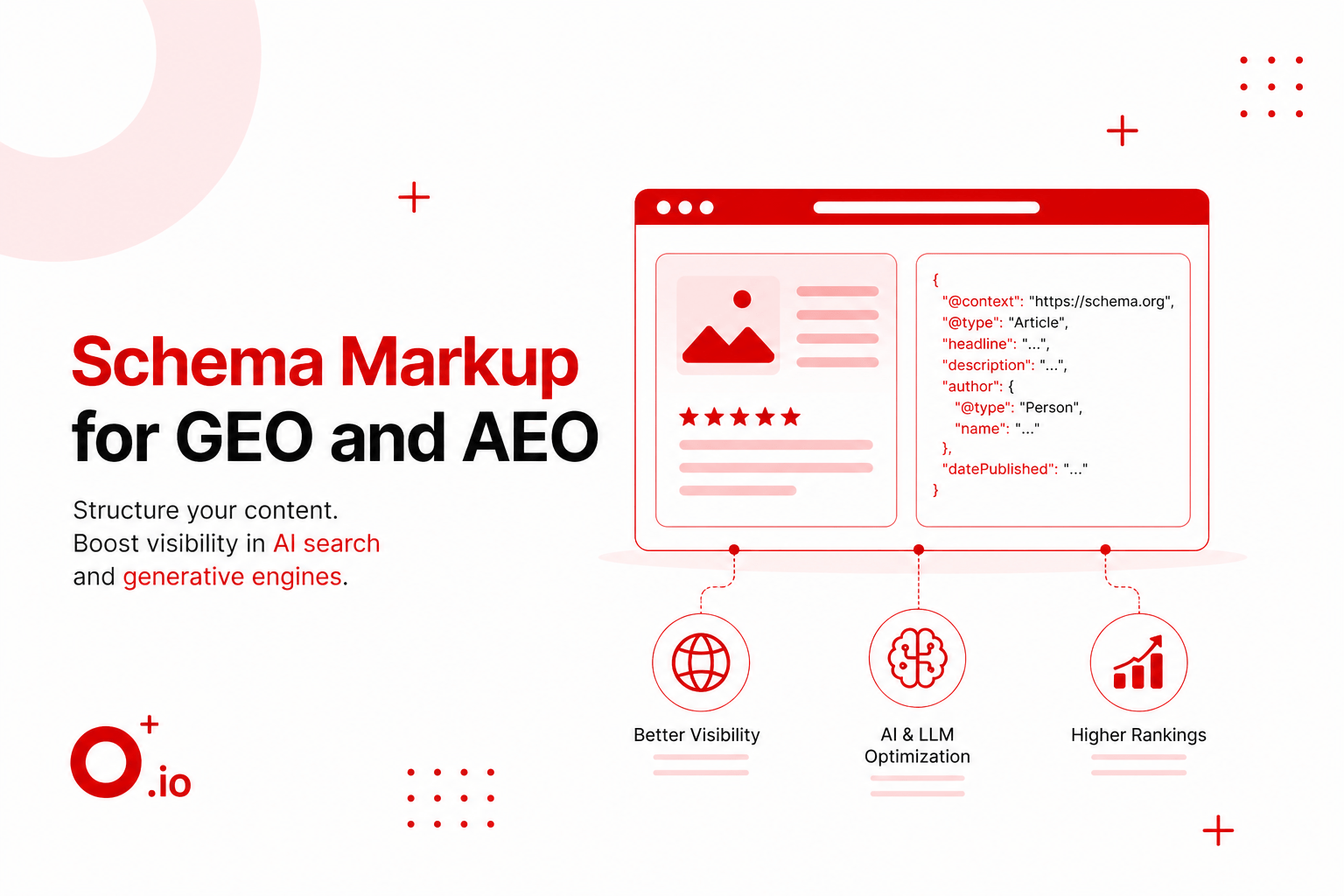
Schema markup is a specific vocabulary you add to a site so machines can grasp what the text actually means. For AI search results, structured data isn’t just a technical detail.
It is what allows AI systems to map your words to real facts, specific places, and the people involved. Because AI Overviews now show short answers, this code matters more today. In most cases, structured data for GEO (local relevance) and AEO service (AI answer engines) builds a link between human-readable text and the data engines trust.
To improve your visibility, this guide offers a simple way to set up schema markup. They’ll help you appear in AI summaries and standard local search results.
Why schema markup important for GEO SEO and AI search
Schema isn’t just about making your search results look pretty anymore. It is the underlying foundation for how modern search engines understand your site. By using it, you tell these systems what your page is actually about and how it connects to the real world.
Traditional SEO: how schema complements ranking
By using these tags, you help search engines show your work more clearly in old-school results. This includes rich snippets or those Knowledge Panel boxes you see on the side of the screen. When you add details for your products, local shops, or events, you usually see more people clicking your links. Search engines don’t just guess what you offer when your data is structured. For standard search, you mainly want to be seen and get more traffic.
AEO (AI answer engines): how schema drives citation and trust
AI tools pull facts from many places at once to build a single answer, but structured data stops these systems from getting confused about your identity or what you are saying. It is how you help the AI map your claims to trusted sources. If you don’t provide this clarity, your site might get skipped. This increases the chance that the system picks your site for its summary.
GEO (local search and location relevance): how schema anchors place data
When it comes to local search, schema holds your data in place. It lists your exact coordinates, when you open, and how your different branches connect to a main office. This helps AI and local maps match you with people looking for services in a specific neighborhood or region.
| Strategy | Primary goal | How schema helps |
|---|---|---|
| Traditional SEO | Increase SERP visibility and CTR | Provides structured fields that enable rich snippets, product cards, and Knowledge Panel signals |
| AEO (AI Overviews) | Be chosen and cited as a source for direct answers | Removes ambiguity about entities and claims, linking facts to trusted identifiers and attributes |
| GEO (local relevance) | Improve local matching and region-specific displays | Encodes geocoordinates, addresses, service areas, and cascading location attributes |
What are the most important schema types for GEO and AEO?
Focusing on data that defines entities and answers user intent is the best approach. This includes Organization, LocalBusiness, Place, Person, and Product. Factual data that clarifies who, what, where, and when is what really matters.
- Organization or LocalBusiness Schema – Brands and physical spots are identified through Organization or LocalBusiness tags. You can pick specific options like Restaurant or Store to match your business. Don’t forget to include the address and contact details to help GEO systems pinpoint your location.
- LocalSchema – Visibility depends on using Place, PostalAddress, and GeoCoordinates to provide specific geographic data. While GeoCoordinates handles latitude and longitude, the PostalAddress tag manages standard street details. Local search systems need this data to connect queries to your location. That’s how you show up where you should.
- Author schema – Showing your professional history and credentials through the Person or Author schema helps build trust. It signals your expertise to search engines. AI models look for clear author attribution when deciding if a source’s reliable enough to use in an answer.
- Product schema – For shoppers, prices and inventory levels are captured using Product, Service, and Offer tags. They also include things like vendor links and SKU numbers. AEO engines pull this information to answer users directly when they’re looking to buy. This data helps satisfy the intent behind commercial searches.
- FAQ and HowTo schema – Article, FAQPage, and HowTo schema help with machine readability even if rich results change. It doesn’t mean you should stop using them. They’re still important for machines to parse your content.
- SameAs and identifiers are the tools you use to link profiles to sites like Wikidata or LinkedIn. It’ll help AI map your specific entity into the broader knowledge graphs. This makes it easier for systems to verify your identity.
| Strategy | Primary goal | How schema helps |
|---|---|---|
| Entity credibility (Organization, Person) | Show who owns the content and why it is trustworthy | It provides identity fields and links to connect your content to verified entities |
| Location precision (Place, GeoCoordinates) | Connect queries to specific spots or service zones | This encodes coordinates and addresses to boost relevance for GEO |
| Intent mapping (Product, Service) | Use facts to satisfy both shopping and research intent | It highlights prices and features that AEO uses for product questions |
| Q&A extraction (FAQPage, HowTo) | Deliver procedural steps and Q&A for machines | It provides clear pairs of questions and answers for AI to read easily |
How to implement schema markup step by step
Focus on your most important pages first. AI systems and local databases look for entities like your company name or specific staff members. When you define these primary services clearly, it creates a solid footprint across the site. This clarity stops AI from guessing about your brand. A messy pile of conflicting data will just confuse the bots.
Identify priority pages and entities
Start with pages where structured data has a real effect on GEO or AEO. Engines scan these locations first to pull facts for their answers. The brand stays invisible to these systems if the data is missing.
- Organization schema and a high quality logo file are usually necessary for the homepage.
- Try adding LocalBusiness and GeoCoordinates to your contact or office location pages.
- Service and product pages benefit the most from Product and Offer properties.
- Use Article and Author schema on your top blog posts and pillar guides.
- This code works well for resource pages or FAQs that answer specific user questions.
Generate the JSON-LD markup
JSON-LD is the standard choice since it’s easy to handle and won’t mess up your site design. These code blocks allow for backend adjustments without changing the visible HTML constantly. Code creation does not require manual typing from scratch.
- Google provides structured data tools and a test for checking basic markup.
- Different online generators from SEO vendors can produce code snippets in seconds.
- WordPress sites can use plugins like Rank Math or Yoast to handle the technical work.
- Developer libraries or CMS integrations can manage blocks that update automatically.
Try separate JSON-LD objects for businesses with several locations. Systems often struggle to process a single massive block of code.
Add the schema to your website
The way you add code depends on the platform and how often you update the site. Crawlers must be able to see the JSON-LD script. The code must match what users actually see on the page.
- Static sites should have JSON-LD in the head or right before the body ends.
- Use custom HTML fields or template injections for the code if you use a CMS.
- Server-side generation for dynamic pages ensures the right prices show up.
- Google Tag Manager is an option for those who can’t access site templates.
Validate and test your markup
Schema becomes invisible if there is a small syntax error or a mismatch with page content. You must verify the code to make sure it functions correctly.
- The Rich Results Test shows if a page qualifies for specific search features.
- Vocabulary checks against schema.org rules are handled best by the Schema Markup Validator.
- Check the live page source to ensure nothing is blocking the code.
- Catch any errors by watching the enhancement reports in Google Search Console.
How do you measure the impact of schema on AI and GEO performance?
Tracking the real effect of schema markup requires looking past standard search rankings. Often, the best wins happen inside snippets or AI Overview citations. Success means showing up exactly where people are looking.
- Search Console reports help you find valid data and clean up coding mistakes. When error counts go down, it usually means search engines are reading your code correctly.
- Keep an eye on click-through rates once your structured data goes live to find quick wins. If rich results start appearing, you’ll probably get more clicks and higher traffic.
- Applying filters for certain cities in your analytics helps you measure GEO performance. Expect local traffic to grow in specific areas where your markup is active.
- Check how users behave on your site to see if visitor quality has improved. When AI mentions send the right people, they usually stay on the page.
- Because direct data doesn’t show up in dashboards yet, you’ll have to check AI summaries by hand. It takes time, but it is necessary to track your citations.
Common mistakes to avoid in your schema strategy
- Content that doesn’t match If you mark up facts that readers don’t see, you might get flagged for inconsistency. This hurts trust levels. Always check that your schema matches the visible text.
- Missing required properties Leaving out required fields results in weak code that doesn’t work.
- Poorly nested code Relationship graphs often break when you nest entities in the wrong place, like putting an Author object inside the wrong part of an Article. Parsers can’t read these broken links. Engines fail to map data correctly when the hierarchy is messy.
- Outdated information Old facts often appear as errors to search engines.
- Choosing incorrect types A generic Thing type usually offers less value than labels like LocalBusiness. You should pick a detailed category.
Conclusion
Schema markup is a necessity for your digital presence. Without this code, search engines might struggle to grasp what your page truly offers you and your customers. For GEO goals, the technical setup fixes your physical location and business facts in place.
It is about turning your site into something AI bots can actually cite for AEO. Clarity wins.
Connecting facts to trusted IDs helps search engines verify your details. AI systems pull from this content because it’s reliable. Using clear data keeps your traffic steady while search tools change.
FAQs
1. What is schema markup for location?
Adding a snippet of code to your site that highlights your physical address lets search engines know your exact spot. You might use types like Place or PostalAddress to hand over specific coordinates and store hours. This way, map apps can point a customer right to your front door without any guesswork. It is a simple way to make sure your business shows up in local queries when someone is nearby and ready to buy.
2. What is Google schema markup?
This is structured data that sticks to the rules Google likes best. While you have options for how to write it, the search giant generally looks for the JSON-LD format. It relies on the schema.org vocabulary to push your pages toward those eye-catching rich results. Machines find it much easier to understand what your page is actually about when it is organized this way. Sticking to this format keeps your site in line with the web’s biggest search engine. It also helps your site qualify for special features like review stars or price displays in the search results.
3. What is structured data for AI?
Defining specific entities and how they connect with code builds a clear path for AI systems to follow. This setup lets these tools grab facts directly from your pages instead of trying to guess what you mean. Answer engines are also more likely to use your content as a primary source if the data is organized neatly. It clears up the confusion that often causes large language models to stumble. When your data is structured, AI tools can link your brand to specific topics with much higher confidence.
4. What is an example of a schema markup?
If you check the code of a standard homepage, you will probably find Organization schema. This script usually includes the name of the brand, a logo, social profiles, and phone numbers. When it is written in JSON-LD, it is a clear signal of identity that AI and search bots use to confirm your details. It helps you build a digital presence that is easy for bots to sort through. This type of markup is often the first thing people set up to establish their brand online.
5. Can I use multiple schema types on the same page without causing conflicts?
You can definitely put more than one type on a single page. If a page has a blog post, a product for sale, and company info, you should add code for all of them. Just keep each item separate in the script. It is important that the code mirrors what a human visitor sees on the screen so you don’t get penalized for being deceptive. The match between the visual page and the backend code is what really counts. Mixing types allows you to describe different parts of a page in a way that search engines can easily digest.
6. How long does it take for schema to show in search results?
There is no set schedule for when these features appear. You might notice a change in a few days, but it often takes a few weeks for Google to crawl the site and refresh its search listings. A smart move is to watch your Search Console. You can track exactly when those impressions begin to rise there. Do not expect things to change the second you hit the publish button. Patience is part of the process when you are waiting for search bots to update their index.
7. Can schema markup help with voice search?
It certainly helps. Since voice assistants need to give answers fast, they rely on structured data to find the right facts. If your business details or product specs are well organized, your content has a better shot at being the one the assistant reads out. These devices generally favor data that is already broken down into simple, factual chunks. Clear data makes it much simpler for an assistant to find a price or an address while a user is on the go.
8. How do I fix schema errors in Google Search Console?
Open the Enhancements report first to see what is actually broken. Once you find the missing fields or typos in the code, you can go in and fix them. Use the Rich Results Test to make sure the code works before you ask Google to crawl the page again. Keeping up with these reports prevents your rich results from dropping out of the search pages. Regularly checking for errors ensures that your structured data remains active and effective.

Mansi Jain
Senior AI SEO Specialist @ Opositive.io
GEO, AEO & LLM Optimization Specialist · 6.5+ yrs Technical SEO
About Mansi
Mansi Jain is a Senior SEO Specialist with 6.5+ years of experience in technical SEO, content strategy, ecommerce SEO, and AI-powered search optimization. At Opositive.io, she helps businesses improve their visibility across traditional search engines and emerging AI platforms through data-driven SEO strategies.
Her expertise includes technical audits, keyword research, schema implementation, content clustering, and AI SEO (GEO/AEO). Passionate about staying ahead of search trends, Mansi shares practical insights and actionable strategies that help marketers, founders, and businesses achieve sustainable organic growth.
“Practical, data-driven SEO that helps businesses grow sustainably across both traditional search and AI platforms.
Specialization
Technical SEO, Ecommerce SEO & AI SEO (GEO/AEO)
Education
B.Tech, Information Technology
College of Technology and Engineering, Udaipur · 2015 – 2019
Experience
Senior SEO Specialist, Opositive.io
3+ years at Opositive · 6.5+ years in SEO & AI-powered search
Skills
Technical audits, keyword research, schema, content clustering