SEO vs Google Ads: Which delivers better ROI?
Every marketing leader faces the same question eventually, usually when budgets tighten and the pressure to hit numbers intensifies: pour money into Google Ads for quick wins, or invest in SEO for long-term growth? The decision matters. The wrong choice wastes budget. The right one reshapes your entire business economics.
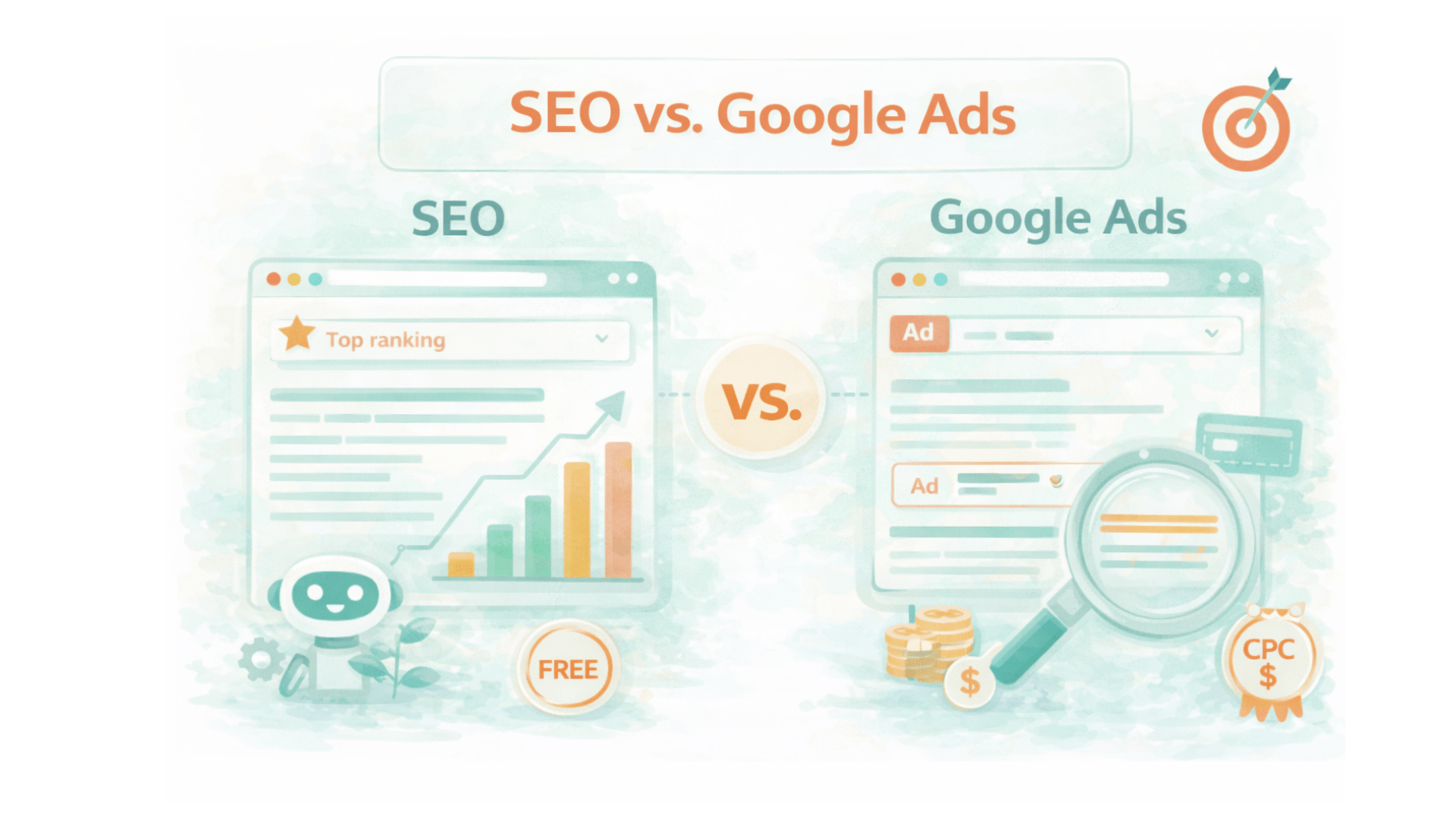
SEO takes the slow, steady route. You build content, structure, and authority so your site earns organic traffic over months and years. Google Ads is sprint work. You pay to appear at the top of search results and get immediate clicks, conversions, and actionable data right away.
This post looks at both channels through a single lens: return on investment. We’ll lay out the real tradeoffs, show where each channel wins, and explain why the best outcomes come when you use both together.
Key Takeaways
- SEO is a long-term strategy for building sustainable, organic traffic and authority, while Google Ads offers immediate visibility and traffic through a pay-per-click model.
- The choice between SEO and Google Ads depends entirely on your business goals; Google Ads excels for speed and testing, whereas SEO provides unmatched long-term, compounding value.
- Google Ads can deliver results almost instantly, but SEO typically requires 3-6 months to show significant impact, and sometimes longer for competitive terms.
- The most effective approach combines both channels, using data from Google Ads to inform and accelerate your long-term SEO strategy for maximum overall growth.
What is SEO (Search Engine Optimization)?
SEO is the practice of optimizing a website so it ranks higher in organic, unpaid search results. The goal is straightforward: attract relevant visitors who are already searching for what you sell or explain. Unlike paid ads, organic visibility builds over time. Your content and technical improvements become a durable asset that keeps attracting clicks long after the work is done.
How does this work? You create useful, relevant pages, make them easy for search engines to crawl and understand, and earn signals of trust from other sites. Over time, Google treats your site as more authoritative and shows it for more queries. That drives steady, compounding traffic.
The core pillars of an SEO strategy
Every solid SEO program rests on three categories of work. They depend on each other. Skip one and the whole system weakens.
On-Page SEO
On-page work focuses on individual pages: keyword research, writing content that answers what searchers actually want, and optimizing title tags, headings, and meta descriptions. When searchers and engines both understand what a page is about, rankings improve. Clean, scannable content with clear calls to action boosts both rankings and conversions.
Off-Page SEO
Off-page SEO covers signals outside your site, primarily backlinks. When reputable sites link to your content, search engines see that as a vote of confidence. The right backlinks improve your topical authority and help pages climb rankings. Off-page work also includes PR, partnerships, and brand mentions that raise your site’s credibility.
Technical SEO
Technical SEO is the infrastructure. Page speed, mobile experience, site architecture, structured data, and crawlability determine whether search engines can find and index your content. They also determine whether users have a fast, frictionless experience when they arrive.
What are Google Ads?
Google Ads is Google’s paid advertising platform where advertisers bid to show ads in search results and across Google’s network. You pay only when someone clicks your ad. Ads give you instant visibility for the keywords you choose, with targeting options for location, device, demographics, and more.
At its heart, Google Ads is built for speed and control. You can set budgets, launch campaigns in hours, and measure conversions with tight attribution. That’s why it’s the go-to for short-term revenue goals, promotional pushes, and quick testing.
How the Google Ads auction works
Ads do not go simply to the highest bidder. Google runs an auction every time an eligible impression exists, evaluating several factors to decide which ads appear and in what order. The auction balances bid amounts with ad quality and context to show the most relevant results for users.
The Role of Bidding and Keywords
Advertisers bid on keywords they want to trigger their ads. The bid sets the maximum you will pay per click, but your actual cost is usually lower. Bids matter, yet they are only one part of the Ad Rank calculation.
The Importance of Quality Score
Quality Score is Google’s rating of the quality of your keywords, ads, and landing pages. Higher quality leads to better ad positions and often lower cost-per-click. Well-written, relevant ads and fast, clear landing pages can beat higher bids from competitors.
Common Ad Formats
Search Ads appear alongside organic results. Display Ads run across publisher sites. Video Ads run on YouTube and similar platforms. Shopping Ads show product listings with images and prices. Each format targets different stages of the funnel, from awareness to direct purchase.
SEO vs Google Ads: How They Actually Compare
Both channels aim to drive traffic from Google, but they work differently and have different cost structures. Here is how they stack up on metrics that actually affect ROI.
| Metric | SEO | Google Ads |
|---|---|---|
| Cost | Investment in content, technical work, and link building. Upfront plus ongoing maintenance, costs amortize over time. | Direct pay-per-click costs, immediate budget consumption. Costs stop when you stop paying. |
| Speed | Slow. Meaningful results commonly take months. Some changes can show sooner, but competitive terms take longer. | Fast. Campaigns can drive traffic and conversions within hours of launch. |
| Longevity | Compounding. Content can generate traffic for years with relatively low ongoing cost. | Temporary. Traffic stops when spend ends. Long term costs accrue if you need continuous exposure. |
| Targeting | Based on search intent and content matching. Harder to exclude or narrow audiences precisely. | Highly granular targeting: keywords, demographics, location, device, retargeting. |
| Trust | Users tend to trust organic listings more, especially for research-heavy queries. | Recognizable as ads, which some users avoid; strong copy and assets can still convert well. |
Cost and budgeting
Google Ads is straightforward: you set daily or monthly spend, and each click reduces that budget. SEO costs are less direct. You pay agencies, writers, tools, or in-house teams to create content and improve technical health. Those are investments in an asset. The ROI shows up on a longer timeline. Here is the key difference: ads are an operational expense. SEO is an investment in a channel you own.
Speed to see results
Need customers today? Google Ads wins decisively. Ads can produce clicks and conversions almost immediately. SEO rarely works that fast. Even with great content and technical fixes, three to six months is typical for significant movement on competitive queries. In crowded verticals, the wait can be even longer. Google itself notes that some changes take effect quickly, but meaningful ranking shifts often take several months.
Long-term sustainability
SEO compounds. Once a page ranks on page one, it drives traffic with little ongoing spend beyond occasional updates. That makes the customer acquisition cost from organic search dramatically lower over time. Google Ads can deliver high returns while campaigns run. The moment you pause spend, that traffic stops.
Audience targeting capabilities
Google Ads offers surgical precision. Want people in a specific city, on mobile, who have visited your site and fall in a certain income bracket? Ads can do that. SEO targets intent. Someone searching a purchase-intent keyword shows intent inherently. You cannot pick the demographic slice as precisely as with paid targeting.
Trust and credibility
Users often trust organic results more, especially for high-stakes queries in health, finance, or legal advice. Research consistently shows organic listings take a larger click share from the first positions than ads do from the top ad slots. That trust translates into stronger brand equity and often higher conversion rates for the right audience.
Which channel actually wins on ROI
ROI is situational. The better channel depends on your current goals, margins, timeline, and market dynamics.
When Google Ads delivers higher ROI
You are a new business that needs immediate traffic and sales. You run time-limited promotions, events, or seasonal launches. You are testing product-market fit, pricing, or messaging and need fast signals. Your products have high margins and can absorb higher customer acquisition costs. Your market has low organic search volume for high-intent queries, but ads can reach active buyers.
Ads let you buy visibility while you build the organic engine. Startups and ecommerce brands rely on paid channels early on to fund learning and inventory shifts. That’s why this strategy dominates in fast-moving markets.
When SEO delivers higher ROI
You want to build long-term brand authority and lower your customer acquisition cost over time. Your audience researches before they buy, and organic content shapes decisions. You can sustain a content and technical program and wait for compounding returns. Your business rewards repeat visits and lifetime value. That upfront SEO investment pays off over years.
For most established businesses with time and a content plan, SEO produces the best long-term ROI. Customer acquisition costs typically fall as organic visibility grows.
Why the best strategy combines SEO and Google Ads
Treating SEO and Google Ads as enemies is short-sighted. They are complementary. Paid campaigns generate fast revenue and data that helps you prioritize SEO work. Organic success reduces your long-term paid costs and increases overall brand presence across the search results. The most effective programs create a feedback loop between paid and organic efforts.
Use Ads Data to Fuel Your SEO Strategy
Google Ads delivers rapid signals about which keywords convert, which headlines resonate, and which landing pages perform. Instead of guessing which topics will drive revenue, use paid campaigns to learn fast. That data helps you prioritize SEO content for search queries with proven commercial intent. You reduce wasted content spend.
How to Dominate the SERP with a Dual Presence
Show up in both paid and organic listings for a keyword, and you occupy more real estate on the search results page. Total click share increases. Competitor conversions fall. Dual presence also builds credibility: users see your brand multiple times and start to associate it with authority on that topic.
Retargeting Organic Visitors with Paid Ads
Not everyone who finds you organically converts on the first visit. Use paid retargeting to bring those visitors back with tailored messaging nudging them toward purchase. It’s an efficient way to raise conversion rates for traffic you already acquired for free.
Conclusion
Asking whether SEO or Google Ads delivers better ROI is the wrong question. The better one is how to allocate budget across both channels so they feed each other. Ads are for speed, tests, and capturing immediate demand. SEO builds a durable asset that lowers acquisition costs over time and increases brand trust.
If you must choose today, base the decision on your objectives. Need revenue now? Use ads. Building a sustainable growth machine? Invest in SEO. If you can do both, use paid campaigns to learn fast and let organic tactics compound the wins.
Start with clear goals. Measure outcomes carefully. Let those results guide where you invest next. That approach makes ROI predictable, not a guess.
FAQs
1. Is Google Ads better than SEO?
Neither is universally better. Google Ads wins when you need quick traffic and measurable experiments. SEO wins when you want sustainable, low-cost traffic and brand authority. The two together usually produce the best ROI.
2. Can I do SEO by myself?
Yes. For many businesses, you can handle basic SEO in-house, especially on-page work and some technical fixes. Scaling SEO, creating a steady stream of high-quality content, and building authoritative backlinks typically require either a specialist or an agency.
3. What are the 4 types of SEO?
SEO usually breaks into four categories: on-page SEO, off-page SEO, technical SEO, and local SEO. Each focuses on a different set of signals that help pages rank for relevant queries.
4. How long does it take for SEO to show a return on investment compared to Google Ads?
SEO usually takes months to show measurable shifts. Three to six months is typical for moderate-competition queries. Competitive industries often require longer. Google Ads can produce measurable ROI as soon as the campaign is live and data starts to accumulate.
5. Does the data from Google Ads campaigns help improve an SEO strategy?
Absolutely. Paid campaigns reveal which keywords convert, which ad copy resonates, and which landing pages work. That information helps prioritize SEO topics and page improvements, shortening the time to find high-value organic keywords.
6. Which channel do customers trust more, organic search results or paid ads?
Many customers trust organic search results more, especially for research-heavy or high-stakes topics. Organic rankings carry an implicit endorsement from search engines and often produce higher click share from top positions. Well-executed ads with strong creative can still convert effectively.
7. Can a new business with a small budget use Google Ads effectively?
Yes, with careful targeting and small, well-measured campaigns. Test a few high-intent keywords, optimize landing pages, and track conversions closely. Even modest budgets can deliver useful signals that guide both paid and organic efforts.
8. What happens to my website traffic if I stop paying for Google Ads?
Paid traffic stops shortly after you pause or end campaigns. If you have organic visibility, that traffic continues. That’s why combining paid for short-term goals and SEO for long-term sustainability is the smarter approach.

Mansi Jain
Senior AI SEO Specialist @ Opositive.io
GEO, AEO & LLM Optimization Specialist · 6.5+ yrs Technical SEO
About Mansi
Mansi Jain is a Senior SEO Specialist with 6.5+ years of experience in technical SEO, content strategy, ecommerce SEO, and AI-powered search optimization. At Opositive.io, she helps businesses improve their visibility across traditional search engines and emerging AI platforms through data-driven SEO strategies.
Her expertise includes technical audits, keyword research, schema implementation, content clustering, and AI SEO (GEO/AEO). Passionate about staying ahead of search trends, Mansi shares practical insights and actionable strategies that help marketers, founders, and businesses achieve sustainable organic growth.
“Practical, data-driven SEO that helps businesses grow sustainably across both traditional search and AI platforms.
Specialization
Technical SEO, Ecommerce SEO & AI SEO (GEO/AEO)
Education
B.Tech, Information Technology
College of Technology and Engineering, Udaipur · 2015 – 2019
Experience
Senior SEO Specialist, Opositive.io
3+ years at Opositive · 6.5+ years in SEO & AI-powered search
Skills
Technical audits, keyword research, schema, content clustering