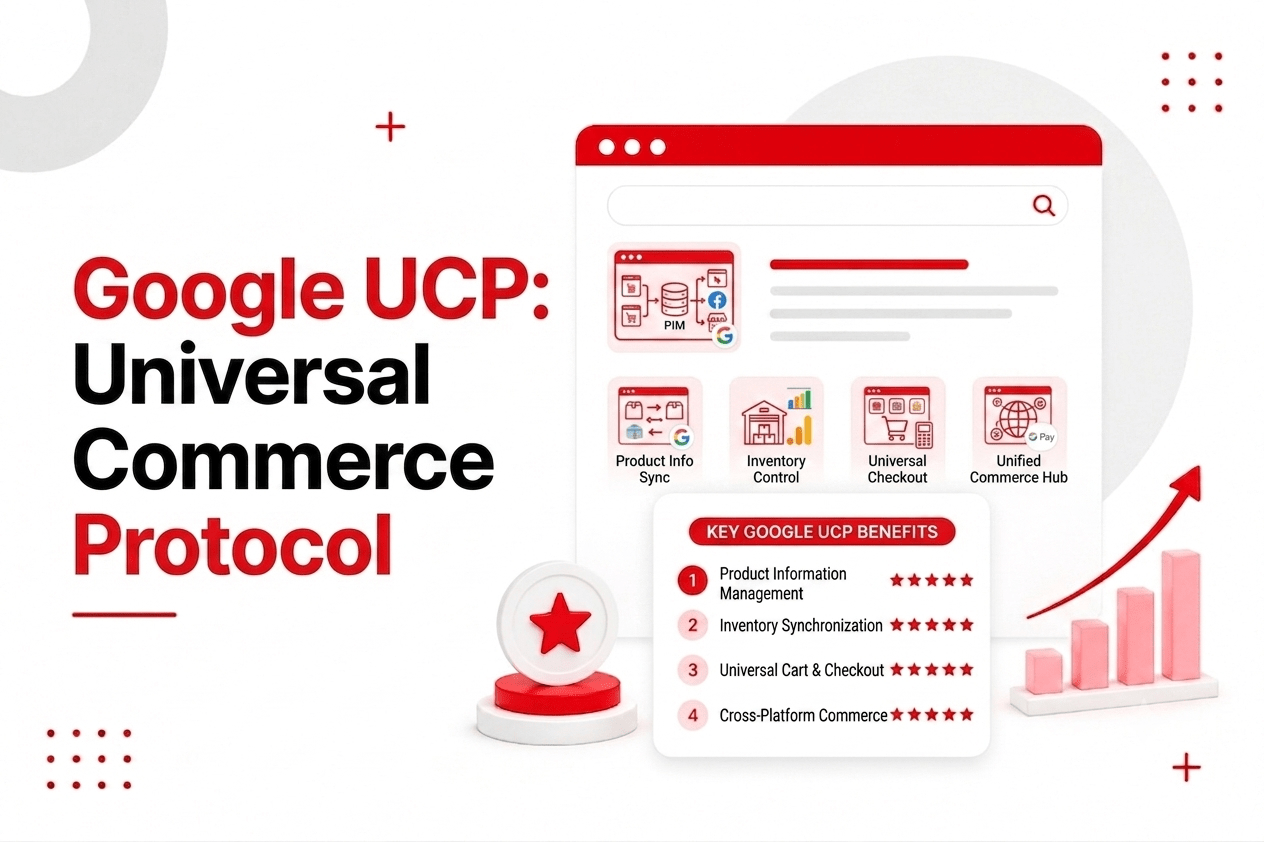
Google UCP: What Ecommerce Brands Must Do to Be Agent-Ready
A shopper opens Gemini, describes the running shoes they want, compares three options in conversation, and buys — without ever loading a product page. The sale is yours. The customer is yours. The checkout happened somewhere you don’t own.
That is Google’s Universal Commerce Protocol working as designed, and it went live with US retailers in May 2026. Most coverage of UCP explains the concept and stops there. This guide starts where the work actually begins: whether your catalog qualifies, which fields you have to fill, who builds what, and what to do if agentic checkout hasn’t reached your market yet.
Objective
This guide explains what Google UCP is, how agentic checkout changes the job of ecommerce data, and what a brand has to do to be selected and transacted on by AI agents. You will learn which product categories are ineligible for UCP checkout today, the exact Merchant Center settings and feed attributes Google requires, the six conversational attributes available globally right now, and a 90-day readiness plan you can run whether or not UCP has launched in your market.
Key takeaways
- UCP is Google’s open standard letting AI agents discover, cart and buy on a shopper’s behalf inside AI Mode and Gemini — you stay the Merchant of Record and keep the customer data
- A large share of D2C catalogs are ineligible for UCP checkout today, including subscriptions, personalised goods, pre-orders, final-sale items and services — check this before planning anything else
- Integrating UCP does not improve your rankings; it adds a purchase option to offers that already surface, so discovery still has to be earned
- The highest-return work is product data, it costs nothing, and it is available worldwide regardless of where checkout has launched
- Your feed has quietly become your storefront — agents read structured data, not your product page design
What is Google UCP?
The Universal Commerce Protocol is an open standard that gives AI agents a common way to interact with online stores across the full shopping journey: discovery, cart building, checkout and post-purchase support.
Google announced it at the National Retail Federation conference on 11 January 2026, co-developed with Shopify and with Etsy, Wayfair, Target and Walmart as launch partners. More than 20 retail and payments companies endorsed it, including Visa, Mastercard, American Express, Stripe, Adyen, Best Buy, The Home Depot, Flipkart and Zalando.
The problem it solves is unglamorous but real. Before UCP, every AI agent needed a bespoke integration with every merchant and every payment processor. That N×N mess made agentic shopping impossible to scale past demos. UCP replaces it with one specification any agent and any merchant can implement.
For you, it means a checkout that happens on a surface you don’t control, using data you do.
UCP, AP2, A2A and MCP: how they fit together
These four get confused constantly, so it is worth separating them once.
| Standard | What it handles |
| UCP | The commerce journey — discovery, cart, checkout, orders, post-purchase |
| AP2 (Agent Payments Protocol) | Secure, agent-authorised payment as a layer inside UCP |
| A2A (Agent2Agent) | How agents talk to other agents |
| MCP (Model Context Protocol) | How AI models connect to tools and data sources |
UCP is interoperable with all three and supports both REST and MCP transport. You do not have to pick one.
Where UCP actually stands right now
Vendor blogs tend to freeze at whichever announcement they were written around. Here is the full sequence.
| Date | What happened |
| 11 Jan 2026 | UCP announced at NRF; spec v2026-01-11 released |
| 23 Jan 2026 | Spec v2026-01-23 |
| 19 Mar 2026 | Cart, Catalog and Identity Linking added, plus simpler Merchant Center onboarding — covered in our breakdown of the March UCP update |
| 8 Apr 2026 | Spec v2026-04-08 adds the error session status, among other changes |
| 24 Apr 2026 | Tech Council expands to 16 seats, adding Amazon, Meta, Microsoft, Stripe and Salesforce |
| 28 Apr 2026 | Stripe joins the Governing Council alongside Google and Shopify |
| 20 May 2026 | Google Marketing Live: Universal Cart, checkout live with US retailers, Direct Offers, YouTube Shopping ads, Affirm and Klarna in Google Pay |
| 16 Jul 2026 | Food Technical Council formed — Block, DoorDash, Google, Toast, Uber Eats |
| 11 Aug 2026 | Lodging Technical Council formed — Amadeus, Booking.com, Expedia, Google, Hilton, Marriott, Trip.com |
Two things stand out.
The first is the Tech Council roster. Amazon sitting on the governance body of Google’s commerce standard is not a small thing. Neither is Microsoft, which has its own Copilot commerce ambitions. When competitors join your standard’s governance rather than building a rival, the standard tends to stick.
The second is vertical expansion. Food and lodging councils forming within seven months means Google is treating UCP as commerce infrastructure, not a shopping feature. Hotel booking and restaurant ordering are on the near roadmap.
Market availability as of now: UCP-powered checkout is live for eligible US retailers. Google has confirmed Canada and Australia follow in the coming months, with the UK after that. The protocol roadmap names India, Indonesia and Latin America for a phased rollout with localised payment interoperability, but without committed dates.
The three shifts that actually matter
1. Your feed becomes your storefront
When an agent evaluates your product, it is not reading your product page design, your reviews widget or your cross-sell carousel. It is reading structured data. If your feed says the jacket is waterproof and your site says water-resistant, the agent will confidently tell a shopper the wrong thing.
This inverts a decade of ecommerce priority. The feed used to be a channel obligation. It is now the primary representation of your product to the systems making recommendations. Everything in our guide to AI SEO for ecommerce still applies on-site; UCP adds a second front.
2. Ranking and eligibility are separate problems
Google is explicit that choosing native integration does not influence how your offers rank in product listings. UCP does not buy you visibility.
What it changes is what happens after visibility. Two products surface, one is buyable in three taps and the other requires leaving the conversation. That is a conversion advantage, not a ranking one — which means discovery still has to be won the usual way. Being the brand an agent selects in the first place is a different discipline, and we’ve mapped it in detail in agentic search optimisation.
3. Compliance moves into the feed
Return policies, consumer safety notices, support contacts and terms of sale all now have to be machine-readable, because Google renders them on a checkout screen you do not control. Legal and merchandising suddenly have a stake in feed hygiene.
The agent-readiness stack
Most brands try to answer “should we do UCP” as one question. It is four, with different owners and very different timelines.
| Layer | Question | Owner | Available outside launch markets? |
| 1. Eligibility | Does our catalog qualify at all? | Merchandising | Yes — assess now |
| 2. Account foundations | Are returns, support and policies configured? | Ecommerce ops | Yes |
| 3. Product data | Can an agent answer questions about our products? | SEO / content / PIM | Yes |
| 4. Checkout integration | Can Google transact against our systems? | Engineering | No — launch markets only |
Layers 1 to 3 are open to everyone globally and pay off in AI search regardless of checkout. Layer 4 is gated by market and approval. Work top-down.
Layer 1: Does your catalog even qualify?
This is the section every other UCP guide skips, and the one that changes strategy most.
Google publishes a list of product categories ineligible for UCP checkout. These items must have native_commerce(checkout_eligibility) set to FALSE or left empty.
| Category | Examples |
| Recurring billing | Subscriptions, merchant-mandated installment or financing plans |
| Customised goods | Engravings, monograms, made-to-order items |
| Non-new or final sale | Refurbished, used, items marked final sale with no returns |
| Pre-orders | Future release dates, deferred fulfilment |
| Bundled services | Warranties, installation, setup contracts |
| Special shipping | Freight, white-glove or premium delivery |
| Gifting | Split-invoice logistics, hidden pricing for recipients |
| In-store activation | Products requiring physical activation at retail |
| Age restricted | Alcohol, tobacco, anything needing ID verification |
| Prohibited | Weapons, adult content, pharmaceuticals, counterfeits |
| Services | Lessons, classes, travel packages |
| Rentals | Equipment leasing, media rentals |
| Virtual items | In-game currency, skins, digital goods |
Read that list against your own catalog before doing anything else. A subscription-first supplements brand, a made-to-order furniture business, a refurbished electronics marketplace or a services company will find most of their revenue is out of scope for UCP checkout today.
That is not a reason to disengage. It is a reason to invert the plan. Discovery, catalog and conversational attributes still apply to every one of those businesses. An agent can still recommend your subscription bundle and send the shopper to your site — it simply cannot complete the transaction in-conversation. So you spend effort on layers 2 and 3, skip layer 4, and revisit as the protocol expands. Shopify has already signalled that subscription cadence and pre-order terms are things UCP is designed to eventually represent in chat.
Brands with a mixed catalog have a third path: flag the eligible subset TRUE and leave the rest empty. Partial eligibility is a supported, sensible state.
Layer 2: Merchant Center foundations
Before any engineering work, your Merchant Center account needs to be in good standing with approved free listings, plus three things configured.
Return policy. Mandatory, because it is a Merchant of Record requirement and gets rendered on the checkout screen. You must supply return cost, return window and a link to the full policy. Policies apply account-wide by default; use return_policy_label to scope one to a product subset, or the returns attribute to define a policy entirely within the feed. On advanced accounts, configure returns at each sub-account — a common oversight for brands running multi-country structures.
Customer support information. At least one of a support URL, email address or phone number. This generates the “Contact Merchant” link on the order confirmation page.
Three feed attributes. These belong in a supplemental data source, not your primary feed, so a formatting error cannot disrupt regular product ingestion.
| Attribute | Purpose |
| native_commerce(checkout_eligibility) | Boolean opting the product into UCP checkout. Defaults to FALSE if missing. |
| consumer_notice | Regulatory warnings. Takes notice_type (legal_disclaimer, safety_warning or prop_65) and notice_message (max 1000 characters, limited HTML). Displayed prominently at checkout. |
| merchant_item_id | Maps your feed id to the product ID your checkout API expects, when they differ. Takes precedence over id in agentic requests. |
That last one causes more integration failures than its size suggests. Plenty of brands run one ID scheme in the feed and another in the commerce backend and have never had to reconcile them, because no external system needed to match the two. UCP does. This is technical SEO work in the most literal sense — data plumbing that nobody notices until it breaks something expensive.
Layer 3: Conversational attributes, the highest-return work available to everyone
Every UCP explainer mentions that Google added “dozens of new attributes for conversational discovery.” Almost none tell you what they are. There are six, they are fully documented, they are optional, and — importantly for brands outside launch markets — Google has made them available to retailers globally.
| Attribute | What it does | Example |
| question_and_answer | Q&A pairs about the product | “Does it have a headphone jack?”:”This version doesn’t have a headphone jack.” |
| document_link | PDF manuals, spec sheets, assembly guides | https://example.com/manual.pdf |
| related_product | Accessories, required parts, frequently bought together | accessory:gtin:811571013579 |
| item_group_title | Parent title for a variant family | Organic Cotton Men’s T-Shirt |
| variant_option | Named variant properties | Shoe width:narrow, size:8 |
| popularity_rank | Product performance as a percentile of your inventory | 95.5 |
Some practical notes that are not obvious from the spec.
question_and_answer is the one to prioritise. It is the most direct way to control what an agent says about your product. Pull the questions from your own support tickets, on-site product Q&A and review complaints. If shoppers keep asking whether the fabric shrinks, answer it here — because an agent that cannot find the answer will either omit your product from a comparison or infer something.
related_product is quietly a merchandising lever. Agents building carts need to know what goes with what. A required part or compatible accessory declared here is how you get a second SKU into an agent-built basket. Cross-sell does not disappear in agentic commerce; it moves into the feed.
popularity_rank is a signal you control. Ranked as a percentage of your own inventory, it tells agents which of your products actually perform. Leaving it blank asks an agent to guess.
Do not duplicate. If a detail already sits in description, product_highlight or product_detail, Google says you need not repeat it here.
Adding these has no effect on the approval status of existing products, which makes it close to a free experiment. If you do nothing else on this page, do this. For most stores it is the single highest-leverage task in an ecommerce SEO programme right now.
Layer 4: Checkout integration
Two integration paths exist. Native is the default and the one Google recommends.
Native checkout
You build a REST API that Google calls to manage checkout sessions. Three core endpoints:
- POST /checkout-sessions — create
- PUT /checkout-sessions/{id} — update (shipping, tax, discounts, payment instrument)
- POST /checkout-sessions/{id}/complete — complete
The session moves through a defined lifecycle: incomplete → ready_for_payment → ready_for_complete → completed, with canceled and error as terminal alternatives. Google renders the payment and fulfilment UI, and the agent hands off before sensitive details are entered, which keeps that step deterministic rather than model-driven.
Multi-item checkout is supported — all line items go in the line_items array at session creation.
Embedded checkout
An optional path for approved merchants with bespoke or complex checkout flows. Google embeds your checkout page in an iframe and your front end communicates with the host via postMessage. You keep your branding and custom logic at the cost of more front-end work and less agentic capability.
The requirement nobody mentions: SLOs
Google publishes service level objectives that integrating businesses are expected to meet.
| Endpoint | Availability | p50 latency | p95 latency |
| Create session | ≥ 95% | ≤ 1s | ≤ 4s |
| Update session | ≥ 95% | ≤ 1s | ≤ 5s |
| Complete session | ≥ 95% | ≤ 6s | ≤ 10s |
This is where “UCP is a marketing opportunity” becomes “UCP is an infrastructure commitment.” A one-second p50 on session creation means real-time inventory and pricing lookups have to be genuinely fast. Google also health-checks your endpoints with a Google-UCP-Prober/1.0 user agent.
Real-time inventory is explicitly your responsibility as Merchant of Record. If an item goes out of stock mid-session, your API must return the out_of_stock error code. Same for undeliverable addresses — Google passes you the destination and expects address_undeliverable or address_unverifiable back. Set error severity to recoverable where it is, or the shopper hits a dead-end screen instead of a prompt to fix their address.
Platform reality check
Shopify co-developed UCP and ships it through Agentic Storefronts. For most Shopify merchants the integration is not the problem; data quality is. That makes it a merchandising and Shopify SEO exercise rather than an engineering one.
WooCommerce, Magento and custom stacks need the endpoints built, either through a community plugin or in-house. Budget properly — the SLOs above are the real spec.
Either way, you need to join Google’s waitlist and be approved before going live.
What to do if UCP checkout is not in your market
If you sell in India, the UAE or anywhere else outside the current rollout, layer 4 is not available to you and will not be for a while. That is not the same as having nothing to do.
The product data work is global and immediate. Conversational attributes are open to retailers worldwide right now. Every hour spent on question_and_answer and related_product improves how agents represent you in AI Mode and Gemini today, in any market, independent of checkout. This is the core of what AI SEO looks like for a product catalog.
Merchant Center AI performance insights is coming to India. Google confirmed at Marketing Live that the new tool — showing how your brand performs on AI surfaces versus similar brands — rolls out in Australia, Canada, India, New Zealand and the US. India is in the first cohort. Have your feed in shape before the measurement arrives, not after, and pair it with independent AI visibility tracking so you are not reading a single vendor’s scorecard.
Fix the ID reconciliation now. Mapping feed IDs to backend product IDs is tedious, unglamorous and completely market-independent. It is also the thing that will hold up your integration eighteen months from now if you leave it.
Audit eligibility while it is cheap. Knowing that 60% of your catalog is structurally ineligible is a planning input, not a disappointment.
Brands treating the waiting period as preparation will go live in weeks when their market opens. Everyone else starts from zero.
UCP vs ACP: do you need both?
The other protocol in this space is the Agentic Commerce Protocol, developed by OpenAI and Stripe, focused on checkout inside ChatGPT.
| UCP | ACP | |
| Origin | Google + Shopify, plus launch partners | OpenAI + Stripe |
| Scope | Full journey — discovery, cart, checkout, post-purchase | Checkout execution |
| Architecture | Decentralised; merchants host their own profile | Platform-mediated |
| Primary surfaces | AI Mode in Search, Gemini | ChatGPT |
| Governance | Multi-party council including Amazon, Meta, Microsoft, Stripe, Salesforce | OpenAI-led |
A note on the fee comparisons circulating online: several widely shared articles quote precise percentages for both protocols. Those figures do not come from primary documentation and should be treated as unverified. Get commercial terms from the platforms directly before building a business case on them.
The strategic read is that these are not really rivals. Stripe co-authored ACP and sits on the UCP Governing Council, which suggests the payments industry expects the open standard to become the shared rail with proprietary programmes plugging into it.
Either way, protocol work only pays off if agents are already surfacing you. Winning visibility inside each assistant is its own discipline — see how we approach ChatGPT SEO and Gemini SEO for the surfaces these protocols plug into.
How to measure UCP traffic
Attribution is the objection most marketing teams raise, and it has a more concrete answer than “use server-side tracking.”
Google documents two ways to identify UCP traffic.
At the network level. UCP requests carry a UCP-Agent:Profile header, and the User-Agent value begins with Google/UCP. That is enough to segment agentic traffic in your logs from day one.
At the application level. Checkout, order and transaction lifecycle events flow through documented API contracts, so you can separate UCP orders from direct orders in your own order management system without inference.
Do not try to geo-restrict incoming requests — Google routes outbound traffic dynamically and cannot guarantee origin country. Authenticate on the OAuth 2.0 bearer token instead. Google also offers BigQuery analytics for UCP data, which is where this should live once agentic orders become material.
On remarketing: because you are Merchant of Record, you hold the customer’s information exactly as you would for a direct purchase. Standard privacy law and consent practice apply. Google has said an explicit marketing opt-in during checkout is planned but not shipped, so do not assume consent you have not collected.
Common mistakes
Treating it as a technical project. The engineering is bounded — three endpoints and a lifecycle. The catalog work is where the effort and the risk live, and it belongs to merchandising and SEO.
Putting UCP attributes in the primary feed. Google recommends a supplemental data source specifically so a malformed row cannot disrupt regular ingestion.
Letting feed and site drift apart. If your feed shows one price and free shipping while your site charges another, an agent will confidently present the wrong offer and your customer finds out at the worst possible moment. Feed accuracy is now a trust problem, not a channel-hygiene problem.
Assuming checkout eligibility equals visibility. It does not. Native integration has no effect on ranking. The fundamentals in a solid ecommerce SEO strategy still decide whether you surface at all.
Waiting for a case study. Brands running UCP now are learning which data structures and offer shapes agents favour. That knowledge compounds and transfers poorly through blog posts, including this one.
Ignoring it because your category is excluded. Excluded from checkout, not from discovery. The catalog and conversational layers apply to every business.
Final takeaway
UCP is not a marketing channel you opt into with a campaign. It is a set of requirements about how accurate, complete and machine-readable your product data is — and those requirements were already being enforced by AI search long before Google gave them a protocol name.
The sensible sequence for most brands: find out what share of your catalog is eligible, get your Merchant Center foundations clean, invest heavily in conversational attributes because they are globally available and cost nothing, then treat the checkout build as a decision you make once the first three are done.
Brands that get this right will not just be ready for agentic checkout. They will be the ones agents can describe accurately, compare confidently and recommend — which matters in every market, including the ones UCP has not reached.
FAQs
Is Google UCP free to implement?
Google has not published a UCP transaction fee. Your normal payment processing costs still apply, and your PSP must be able to process Google Pay tokens — most major global PSPs can. Confirm commercial terms with Google directly rather than relying on figures quoted in third-party articles.
Do I need to support Google Pay on my own website?
No. You do not need a Google Pay integration on your site or app. Your payment service provider simply needs to process Google’s tokens. Note that UCP on Google’s AI surfaces only uses PAN_ONLY for allowed authentication methods.
Will I lose control of customer data?
No. You remain Merchant of Record, you own the transaction and the customer relationship, and your own terms and conditions govern the purchase. Google displays them and the customer accepts them during checkout.
Does implementing UCP improve my rankings?
No. Google is explicit that native integration does not influence how offers rank in product listings. It adds a direct purchase option to offers that already surface, which is why agentic AI SEO and protocol readiness are two separate workstreams.
When will UCP reach India or the Middle East?
No committed date. The protocol roadmap names India, Indonesia and Latin America for phased rollout with localised payment interoperability. Merchant Center AI performance insights is confirmed for India in the near term, which suggests Google is building the measurement layer in these markets first.
How is this different from ordinary ecommerce SEO?
It is the same discipline extended to a new consumer. Traditional D2C SEO optimises pages for people who click. UCP readiness optimises structured data for agents that transact. Understanding the difference between AEO, GEO and agentic optimisation matters here, because each asks something different of your data.
Is this just another passing Google feature?
Unlikely. Amazon, Meta, Microsoft, Stripe and Salesforce sit on the governance council, food and lodging verticals have their own technical councils, and checkout is live with major US retailers. It fits the broader pattern we tracked in AI SEO trends for 2026.